
REAL-TIME ANALYTICS
From Streaming Data to Decisions in Near Real Time.
Build analytical services that process high volumes of events while serving dashboards and applications at workload-appropriate latency. Bassirah designs the full path from event capture to query serving, and proves freshness, concurrency and cost targets before you commit.
ClickHouse (partner or OSS) · Redis · dbt · DataHub

THE CHALLENGE
When Event Volumes Grow, Batch Reporting Falls Behind
Digital channels, applications, devices and networks generate continuous streams of events. Teams want to see what is happening now, and customers increasingly expect analytics inside the products they use. Traditional warehouses and transactional databases were not designed to ingest high event rates while answering many concurrent analytical queries, and stretching them usually means slower dashboards, rising cost and risk to production systems.
- Dashboards refresh hourly or overnight when the business needs current data.
- Reporting queries compete with transactions on the production database.
- Query response degrades as data volume and user concurrency grow.
- Caches are added ad hoc, so users cannot tell live data from stale data.
- Schema changes upstream silently break pipelines and dashboards.
Real-time analytics is an end-to-end design problem: ingestion, storage, serving and caching each need their own targets.
OUTCOMES
Fresh Data, Fast Queries, Predictable Operations
Continuous ingestion
Event and change data flows into the analytical store continuously, with replay and backpressure handling designed in.
Purpose-built analytical serving
A column-oriented ClickHouse design for high-throughput aggregation and filtering on large event datasets.
Targeted caching
Redis used only where measurements show it improves hot lookups or repeated results, with explicit freshness rules.
Measured performance and cost
Freshness, latency percentiles, concurrency and cost tracked against targets agreed in the proof of concept.
REFERENCE ARCHITECTURE
The Path From Event to Insight
A conceptual pattern. The ingestion tooling, table design, cache placement and latency targets are selected and validated for each workload.
- Capture eventsApplications, devices, logs and change data capture (CDC) from operational databases publish events to an ingestion or streaming layer chosen for the required throughput, ordering and replay behaviour.
- Validate and routeIngestion applies schema checks, timestamps and source ownership, and routes malformed records to a quarantine path instead of dropping them silently.
- Store for analyticsClickHouse ingests events into tables designed for the dominant query shapes, with partitioning, ordering keys, materializations and retention set per workload.
- Serve queriesDashboards, APIs and embedded analytics query ClickHouse directly through a service layer that handles authentication, parameterized queries and rate limits.
- Cache where justifiedRedis holds bounded, invalidatable hot results or application state when measurements show a benefit, with expiration and freshness rules visible to users.
- Model, catalog and observedbt models handle batch-friendly transformations where a verified adapter supports the engine, DataHub records metadata and lineage, and monitoring tracks ingest lag, query latency, errors and resource use.
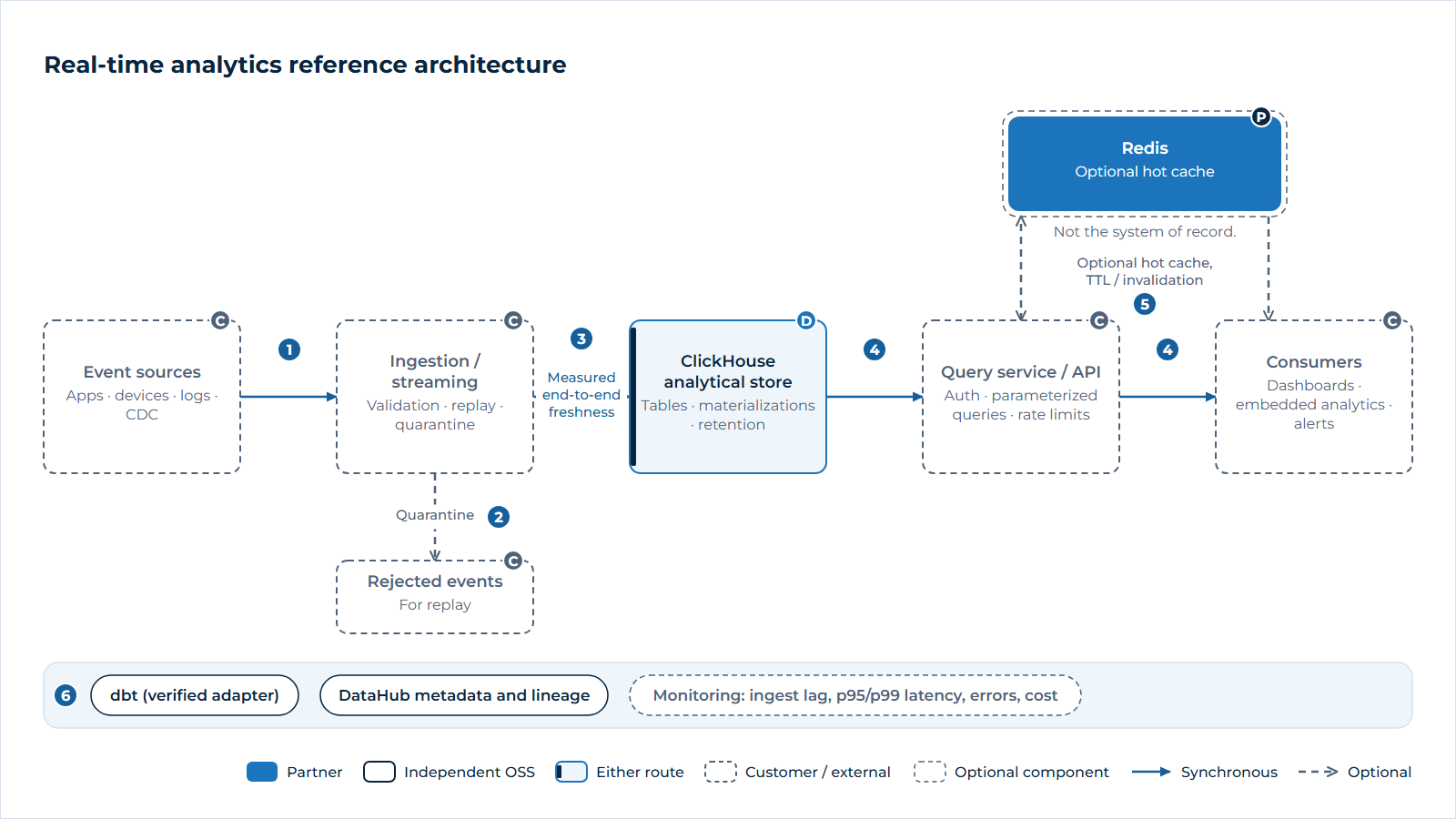
Real-time analytics reference architecture
TECHNOLOGY ROLES
Each Component Has One Clear Job
| Component | Role in this solution | Route | Qualification |
|---|---|---|---|
| ClickHouse | High-performance column-oriented database for real-time analytical serving | Strategic partner (commercial offerings) | Features depend on the selected deployment and entitlement |
| ClickHouse OSS | Same analytical role, self-managed open-source edition | Independent Bassirah open-source engineering | No vendor escalation implied; release and upgrade path agreed per project |
| Redis | Hot cache, session or application state, fast lookups | Strategic partner | Not a durable system of record; persistence, eviction and consistency designed explicitly |
| Ingestion / streaming layer | Event capture, buffering, replay and backpressure | Customer-selected or recommended per workload | Throughput, ordering and delivery guarantees tested |
| dbt Core / dbt OSS | Batch transformations, tests and documentation | Independent open-source engineering | Used only where a verified adapter supports the target engine and version |
| DataHub Core | Metadata, ownership and lineage | Independent open-source engineering | Catalog only; access enforced in ClickHouse, APIs and IAM |
| Trino OSS or Starburst (optional) | Federated queries joining real-time data with other sources | OSS engineering or strategic partner | Not used in latency-critical serving paths |
See ClickHouse, ClickHouse OSS, Redis, dbt and DataHub.
SUPPORT ROUTES
Partner-Led ClickHouse or ClickHouse OSS?
Both routes use the same core technology. The right choice depends on deployment model, required capabilities, support expectations and commercial preferences.
PARTNER-LED
Partner-led ClickHouse
Commercial ClickHouse offerings delivered through our strategic partnership, for teams that want vendor-backed capabilities and support options as defined by the commercial agreement.
OPEN-SOURCE-FIRST
ClickHouse OSS
Independent Bassirah engineering for self-managed ClickHouse OSS: architecture, deployment, tuning, upgrades and operational support under a Bassirah contract.
Independent open-source support.
ClickHouse OSS services are independent Bassirah engineering and do not imply vendor endorsement, upstream support or escalation rights. Partner-led ClickHouse capabilities depend on the selected deployment and entitlement. Latency and throughput figures are validated against your workload in a proof of concept and are never assumed from architecture alone.
USE CASES
Where Real-Time Analytics Delivers Value
Operational dashboards
Give operations, risk and service teams current views of transactions, incidents and capacity without loading production databases.
Digital channel analytics
Analyze web, mobile and product events to understand journeys, feature adoption and conversion, and feed customer-facing analytics.
Observability and telemetry
Store and query logs, metrics and traces at scale for investigation, trend analysis and capacity planning.
DESIGN & ACCEPTANCE CONTROLS
What We Define, and How We Prove It
| Control | What we define | Acceptance evidence |
|---|---|---|
| End-to-end data freshness | Target lag from event creation to query availability, per data product | Measured ingest-to-query lag under representative load |
| Backpressure | Behaviour when consumers or storage slow down: buffering, throttling and alerting | Load test that exceeds normal rates without silent data loss |
| Schema evolution | How new, changed or removed fields propagate, and how breaking changes are blocked | Schema-change test from source to dashboard |
| Query profiles | Representative queries, concurrency levels and target latency percentiles | Benchmark report with p95/p99 results for the agreed query set |
| Retention | Hot retention per table, downsampling or archive rules and deletion policy | Retention policy applied and verified on test partitions |
| Cost/performance | Sizing model linking data volume, retention and concurrency to infrastructure | Sizing and cost model reviewed with your finance or platform owner |
| Cache correctness | Which results are cached, time to live and invalidation triggers | Test showing users can distinguish live from cached data |
Have a latency or freshness target in mind?
We will test it against your data and query patterns.
WHY BASSIRAH
Engineering for Freshness, Speed and Control
Bassirah brings discovery, architecture decisions, implementation services, integration validation, knowledge transfer and operational support into one managed engagement. Technology selection follows measurable workload and compliance requirements.
- Partner-led ClickHouse and independent ClickHouse OSS engineering under one team, with a transparent route recommendation.
- Data modeling for the query shapes you actually run, not generic table templates.
- Redis placed only where measurements justify it, with clear freshness rules.
- Proof-of-concept benchmarks on your data before any performance target is committed.
- Protection of production databases through CDC and dedicated analytical serving.
- Runbooks, monitoring and knowledge transfer, with optional managed operations.
ENGAGEMENT PATH
How a Real-Time Analytics Engagement Runs
- Workload discoveryEvent sources, volumes, query shapes, concurrency, freshness and retention needs.
- Architecture & routeIngestion pattern, ClickHouse design, cache placement and support route.
- Proof of conceptRepresentative data and queries benchmarked against agreed targets.
- Production buildPipelines, tables, APIs, security and monitoring delivered and tested.
- Tune & operateOngoing performance and cost optimization, with contracted managed operations if required.
Real-Time Analytics FAQ
What latency can a real-time analytics platform achieve?
It depends on ingestion design, data model, query shapes, concurrency and infrastructure. We agree target freshness and latency percentiles with you and measure them in a proof of concept on representative data, rather than quoting generic figures.
Should we use ClickHouse or Trino for real-time analytics?
They solve different problems. ClickHouse is designed for low-latency analytical serving on data it stores. Trino or Starburst federates queries across many sources. Many architectures use ClickHouse for real-time serving and federation for broader, less latency-sensitive questions. See Enterprise Lakehouse & Federation →
Is Redis required?
No. Redis is added only when measurements show a benefit, for example for hot lookups or repeated results. It is not used as the system of record, and cached data has explicit expiry and invalidation rules.
Can we run real-time analytics without overloading our transactional database?
Yes. Change data capture and event streaming move data into a dedicated analytical store, so reporting and embedded analytics do not compete with transactions.
Do you support self-managed ClickHouse OSS?
Yes, as independent Bassirah engineering, without implied vendor support. If you need commercial ClickHouse capabilities or vendor-backed support, we can deliver through our strategic partnership instead.
Related Pages
Turn Event Streams into Timely Decisions
Share your event sources, query patterns and targets. We will propose an architecture and a measurable proof of concept.