REFERENCE ARCHITECTURE · TELECOMMUNICATIONS
Turn Network Telemetry into Trusted, Timely Intelligence.
This multi-tier pattern connects telecom network events, CDRs and service metrics to efficient analytical serving, lower-cost retention, federated access and selective operational caching, without coupling subscriber control-plane state to large-scale historical analytics.
For telco data architects · network analytics leads · CTO / CDO office. Stack: ClickHouse · MinIO AIStor · Trino OSS or Starburst · Redis · DataHub · dbt

THE CHALLENGE
From Network Events to Actionable Operational Intelligence.
Handle the volume and variety of CDRs, network telemetry and service-quality data with ingestion, analytical serving, governed federation and retention tiers designed independently. Use ClickHouse for high-throughput analytical workloads, MinIO AIStor for durable data assets, and Trino or Starburst where federated SQL access fits the workload. Apply Redis to appropriately scoped hot operational lookup and session workloads.
- Volume and velocity — Event and CDR streams arrive continuously from many network elements and mediation systems, with late, duplicate and malformed records.
- One system asked to do everything — Operational lookups, dashboards, investigations and long-term retention compete for the same platform and budget.
- Data spread across domains — Network, billing, CRM and service-assurance data live in separate systems with different owners and access rules.
- Retention economics — Regulatory and analytical retention periods make storage cost and recovery planning a design decision, not an afterthought.

ARCHITECTURE OVERVIEW
A Tiered Data Path, Designed Layer by Layer
Each tier has a distinct job: validate what arrives, serve hot analytics, keep durable history, federate approved access and cache only what must be fast. Governance and security run across every tier.
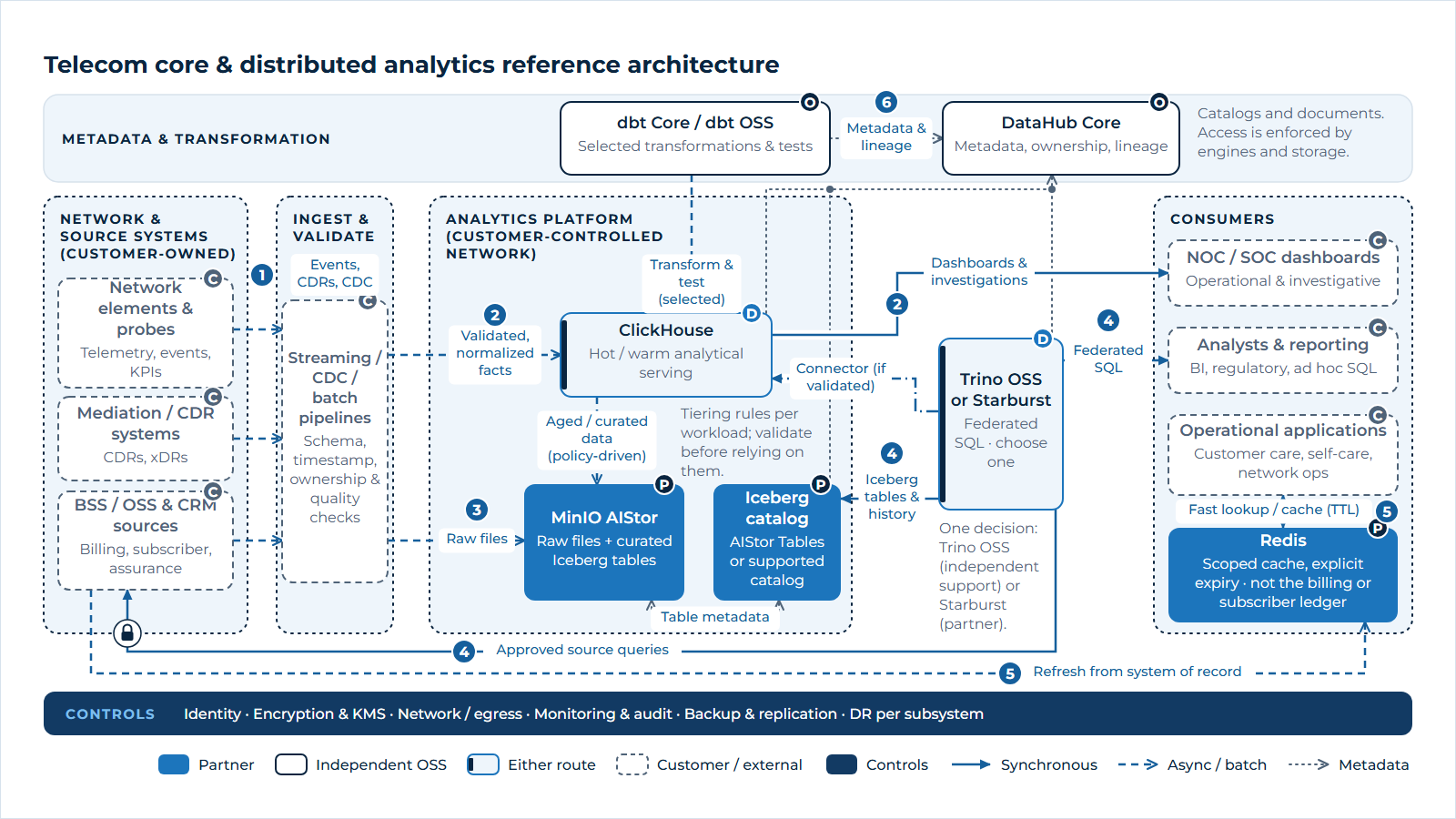
Telecom distributed analytics reference architecture showing network events ingested into ClickHouse and MinIO AIStor, queried through Trino OSS or Starburst, with Redis for scoped caching.
Figure 1. Modern Telco Core & Distributed Analytics reference architecture (conceptual). Colour key: see How to read our diagrams.
Logical Data Path
- IngestNetwork collectors, mediation, streaming/CDC and batch pipelines validate schema, timestamp, source ownership and data quality.
- Hot analyticsClickHouse stores normalized CDR/network facts for investigative and dashboard queries; data models, retention and materializations are workload-specific.
- Durable historyMinIO AIStor stores raw files and curated Iceberg tables when the needed table interfaces and catalog are supported.
- FederationTrino OSS or Starburst queries approved sources and object-based historical datasets through compatible connectors/catalogs.
- Operational stateRedis provides narrowly scoped caching or fast lookups with freshness and expiration rules; do not make it the authoritative billing/subscriber ledger by default.
- Cross-cutting servicesDataHub for metadata visibility, dbt for selected transformations, and enterprise security/observability across all stages.
Conceptual pattern. Connectors, licensed capabilities, versions, security policies and topology are validated in a project-specific architecture.
Last reviewed: — · Version scope: —
COMPONENT ROLES
Who Does What in the Stack
| Component | Classification | Role | Qualification |
|---|---|---|---|
| Ingestion & mediation (collectors, streaming platform, CDC, batch) | Customer-owned or separately selected | Collect, validate and deliver CDRs and network events | Throughput, backpressure, replay and delivery semantics agreed per source |
| ClickHouse | Partner-led or ClickHouse OSS route | Hot and warm analytical serving for investigative and dashboard queries | Data models, partitioning, TTL and materializations designed per workload |
| MinIO AIStor | Strategic partner | Durable object storage for raw files and curated Iceberg tables | Table interfaces and catalog support depend on the selected AIStor release |
| Trino OSS or Starburst | Independent OSS support or strategic partner (choose one) | Federated SQL over approved sources and object-based history | Connector semantics, throughput, tenancy and governance tested per source |
| Redis | Strategic partner | Narrowly scoped caching and fast operational lookups | Freshness and expiry rules defined; not the authoritative billing or subscriber ledger |
| DataHub Core | Independent OSS support | Metadata visibility, ownership and lineage across tiers | Catalogs and documents data; does not enforce access permissions |
| dbt Core / dbt OSS | Independent OSS support | Selected transformations, tests and documentation | Adapter and version compatibility confirmed for the chosen engine |
Links: ClickHouse partner · ClickHouse OSS · MinIO AIStor · Trino OSS · Starburst · Redis · DataHub · dbt
DESIGN TRADEOFFS
Architecture Decisions and How We Validate Them
| Architecture decision | Design alternatives | Validation |
|---|---|---|
| CDR ingest delivery | Streaming platform, micro-batch, or direct ingestion | Throughput, backpressure, replay, exactly-once needs |
| Hot versus historical retention | ClickHouse hot/warm; AIStor archived and Iceberg curated data | Storage cost, retention policy, query freshness |
| Distributed query access | Starburst Enterprise OR Trino OSS for federated workloads | Connector semantics, throughput, tenancy, governance |
| Customer-controlled / isolated delivery | Customer-controlled on-prem/private network topologies | Dependencies, patch import path, telemetry egress |
| Regional availability and DR | Multi-cluster design, backup and replication per system | RPO/RTO by subsystem and failure-domain test |
- ClickHouse and Trino/Starburst are not interchangeable: purpose-built low-latency analytical serving differs from federation across heterogeneous sources.
- Federated SQL access can reduce data duplication for selected queries, but ingestion, modelling, metadata and governance are still required.
- Redis is not a substitute for a durable relational or ledger system. Billing and subscriber records stay in their authoritative systems.
Choosing between Trino OSS and Starburst?
Compare support routes, licensed capabilities and operating responsibilities.
SECURITY & RESILIENCE
Controls Designed Per Tier, Tested as a System
Identity & access
Integrate every query and admin interface with your identity provider. Apply role-based access at the query engine and database level, with service accounts scoped per pipeline.
Subscriber data protection
Classify CDR and subscriber fields, then apply masking, pseudonymisation or column-level controls where the selected engines support them. Design aligned to customer data residency and regulatory requirements.
Encryption & secrets
Encrypt data in transit between tiers and at rest in object storage and databases where supported. Keep credentials and keys in your secrets manager or KMS.
Isolated deployment
Customer-controlled or isolated deployment patterns where supported, with a reviewed dependency list, offline patch import path and controlled telemetry egress.
Backup, replication & DR
Set RPO/RTO by subsystem: ingestion replay, ClickHouse replicas and backups, object-store replication, catalog recovery and query-engine configuration. Test each failure domain.
Observability & audit
Monitor ingest lag, rejected records, query latency percentiles, storage growth and cache hit rates. Retain audit logs for data access according to policy.
PROOF & OUTCOMES
Evidence Before Performance Claims
Benchmark ingest events per second, p95/p99 query latency, network-data completeness, billing-event reconciliation, retention TCO and failure recovery for a known representative workload.
Measurement Plan
| Metric | How it is measured | Target |
|---|---|---|
| Ingest throughput | Sustained and peak events per second with replay after a simulated outage | Forecast peak plus agreed headroom |
| Data age | Time from network event to availability in hot analytics | Agreed per dashboard and use case |
| Dashboard latency | p95 / p99 query latency at agreed concurrency on representative queries | Agreed in PoC acceptance criteria |
| Completeness & reconciliation | Record counts reconciled from source to hot tier and archive; billing-event reconciliation checks | Agreed tolerance per source |
| Cost at target retention | Storage and compute cost modelled for hot, warm and archive tiers at the required retention | Assessed through workload and TCO modelling |
| Failure recovery | RPO/RTO achieved per subsystem in a failure-domain test | Agreed per subsystem |
What You Receive
- Ingestion/retention benchmark for a representative workload
- Dashboard concurrency test results
- Data retention controls and lifecycle policy
- DR plan with tested RPO/RTO per subsystem
- Architecture decision records for ingest, retention and federation choices
Telecom Distributed Analytics FAQs
Why not put all CDR and network data in one platform?
Hot dashboards, investigations, long-term retention, federated reporting and operational lookups have different latency, cost and durability needs. Separating tiers lets each be sized, secured and recovered for its job, while governance links them together.
Why use both ClickHouse and Trino or Starburst?
They solve different problems. ClickHouse is a column-oriented database for high-throughput analytical serving of data loaded into it. Trino OSS or Starburst runs federated SQL across multiple existing sources, including object-based history. Many telecom platforms use both, with clear rules about which queries go where.
Can Redis hold subscriber or billing state?
Redis is used here for narrowly scoped caching and fast lookups with explicit freshness and expiry rules. Authoritative billing and subscriber records stay in their systems of record unless persistence, recovery and consistency requirements have been deliberately designed and validated.
Can this run in a customer-controlled or isolated network?
The pattern can be designed for customer-controlled or isolated deployment where the selected products support it. That requires a dependency and egress assessment, an offline patch and upgrade path, and tested telemetry controls.
What will this cost compared with our current platform?
That depends on volumes, retention, query patterns and licensing. We assess infrastructure economics through workload and TCO modelling against your current baseline rather than quoting a generic saving.
Related Pages
Design a Telecom Analytics Platform.
Share your event sources, volumes, retention obligations and current platforms. We will run a CDR ingestion assessment and define a hot/cold lifecycle and cost baseline.