



Bassirah Technology

TRINO OSS · INDEPENDENT ENGINEERING

Federated SQL Analytics, Without Unnecessary Data Movement.

Build a flexible, open-source distributed SQL query layer across data lakes, warehouses and supported operational databases. Bassirah provides independent Trino OSS architecture, implementation, security and lifecycle support.

Comparing with Starburst Enterprise? Read the decision guide ↓ · Architecture · Connectors & catalogs · Security · Performance · Resilience · Lifecycle

Independent Trino OSS engineering.

These are independent Bassirah engineering and support offerings. They do not imply upstream vendor or foundation endorsement, official vendor support rights, enterprise feature entitlement or maintenance guarantees.

Trino is a trademark of its respective owner. Starburst Enterprise is a separate commercial product, covered on our Strategic Partners page.

WHY IT MATTERS

One SQL Layer Over the Data You Already Own

Trino separates query compute from underlying sources so teams can analyze heterogeneous data using SQL. It can query supported Iceberg and other lakehouse table formats on S3-compatible storage while connecting to databases through purpose-built catalogs.

For an enterprise, that means analysts and applications can reach governed data in object storage, relational databases and other supported systems through one ANSI SQL interface, while each source remains the system of record. Federated access can reduce data duplication for selected queries. It does not remove the need for modeling, metadata, access control or, where performance or source load requires it, curated copies of data.

  • Massively parallel query execution — a coordinator plans queries and distributes work across a pool of workers.
  • Connector-based access — each catalog maps a data source into Trino through a connector, with pushdown behavior that varies by connector.
  • Open table formats — supported lakehouse formats such as Apache Iceberg on S3-compatible object storage.
  • No storage lock-in — Trino stores no data of its own; your sources and object stores remain authoritative.
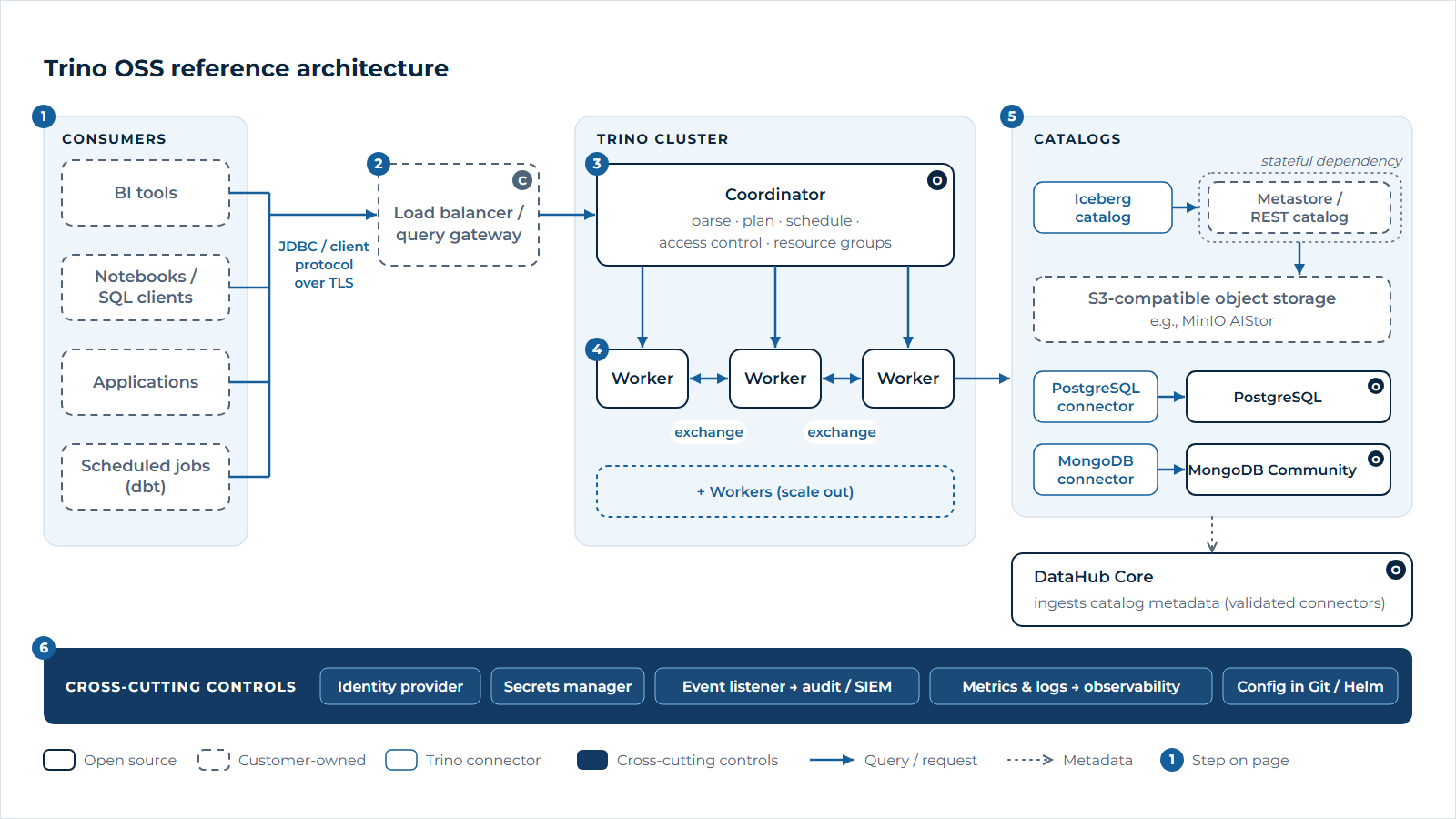
Trino OSS reference architecture: clients connect through a gateway to a coordinator and worker cluster, which queries object-storage tables and operational databases through catalogs, surrounded by identity, secrets, audit and observability controls.

Trino OSS reference architecture

WHAT BASSIRAH DELIVERS

Independent Trino OSS Engineering, End to End

We take Trino from a promising proof of concept to a platform your operations team can run, secure, upgrade and recover.

  • Discovery — Discover workloads, source catalogs, query patterns and storage/topology constraints.
  • Deployment — Deploy coordinator and worker clusters on supported infrastructure, including Kubernetes/Helm where appropriate.
  • Configuration and security — Configure catalogs/connectors, TLS, authentication, authorization, query resource groups and secrets management.
  • Performance — Tune query plans, memory, concurrency, source pushdown and workload isolation.
  • Resilience — Design resilience with coordinator recovery or traffic-management patterns, worker recovery, backups of configuration, multi-site restoration and tested RTO/RPO.
  • Fault-tolerant execution assessment — Assess fault-tolerant execution for eligible queries; we do not represent it as automatic end-to-end site failover.
  • Operations — Implement monitoring, alerting, upgrade testing, security patch process and operational runbooks.

HOW IT FITS

Where Trino Sits in an Enterprise Data Platform

A typical Trino OSS deployment designed by Bassirah follows this path. Every connector, catalog and version is validated in a project-specific architecture before we claim compatibility.

  1. ConsumersBI tools, notebooks, applications and scheduled jobs connect through JDBC, ODBC-compatible drivers, the CLI or the client REST protocol, authenticated through your identity provider.
  2. Access layerA load balancer or query gateway routes sessions to the active cluster and enforces TLS termination policy. This is also where multi-cluster routing and maintenance draining are handled.
  3. CoordinatorParses, plans and optimizes queries, applies access control, and schedules work. Resource groups govern concurrency and memory per workload.
  4. WorkersExecute tasks in parallel, read from sources through connectors, and exchange intermediate data. Workers scale horizontally and can be replaced without data loss.
  5. Catalogs and metadataConnectors to object storage tables (for example, Iceberg through a supported metastore or REST catalog) and to operational databases such as PostgreSQL or MongoDB. Metastores and catalog services are stateful dependencies with their own availability design.
  6. Cross-cutting controlsSecrets management, audit through event listeners, metrics and logs into your observability stack, configuration in version control, and documented backup and restore of everything stateful.

USE CASES

Where Trino OSS Delivers Value

Cross-source SQL federation

Cross-source SQL federation across PostgreSQL, MongoDB and lakehouse data. Join operational records with historical tables without building a pipeline for every question.

Interactive lakehouse analytics

Interactive analytics on Apache Iceberg tables stored on compatible object storage, with table maintenance and statistics designed for predictable performance.

Shared BI and ad hoc query service

BI and ad hoc query services over data shared across departments, with resource groups that keep one team’s workload from starving another’s.

Warehouse offloading

Data warehouse offloading where source/query economics justify it, supported by workload analysis rather than assumption.

Already running Trino?

We will review your configuration, security, performance and recovery readiness.

SECURITY

Secure by Design, Not by Default Settings

A fresh Trino installation is not production-secure. We design and implement the controls your security team expects, then document them for audit and operations.

  • Encryption in transit — TLS for client connections and, where required, for internal cluster communication, with certificate lifecycle managed through your PKI.
  • Authentication — Integration with your identity provider using the authentication methods Trino supports, such as LDAP, OAuth 2.0 / OpenID Connect, Kerberos, JWT or certificates, selected to fit your environment.
  • Authorization — Catalog, schema, table and column-level rules using file-based access control or supported authorization plugins (for example, Open Policy Agent or Apache Ranger integrations where available in your release).
  • Source credentials and secrets — Catalog credentials externalized to a secrets manager or environment injection, never committed to configuration repositories.
  • Impersonation and least privilege — Service accounts scoped per catalog, with user impersonation designed where sources support it.
  • Audit — Query events captured through event listeners and shipped to your logging or SIEM platform.

Authorization in Trino governs access through Trino. Direct access to underlying sources must be controlled at those sources as well.

Abstract illustration of layered access controls around a query engine

PERFORMANCE

Tuned Against Your Workloads, Not Benchmarks

Trino performance depends on connectors, data layout, statistics and concurrency, not on cluster size alone. We start from measured query profiles and change one variable at a time.

Memory and concurrency

Size JVM heap, per-query and per-node memory limits, and worker counts against measured concurrency. Use resource groups to isolate interactive, BI and batch workloads.

Pushdown and data layout

Confirm predicate, projection, aggregation and join pushdown behavior per connector. Design partitioning, file sizes and table statistics so the cost-based optimizer can make good choices.

Lakehouse table hygiene

Plan routine Iceberg table maintenance, such as compaction of small files and snapshot expiry, so query performance does not degrade as tables grow.

What we measure in a performance review
SignalWhy it matters
Query wall time and queued time per resource groupSeparates slow queries from starved queries
Splits, input rows and bytes read per sourceShows whether pushdown and partition pruning work
Peak memory and spill or failure eventsIdentifies under-sized limits and skewed joins
Source system load during federated queriesProtects operational databases from analytical traffic

RESILIENCE

Designing Trino to Recover, Not Just to Run

Trino is a stateless query engine with stateful dependencies. Resilience therefore means handling each failure domain separately: the coordinator, the workers, catalogs and metastores, the data sources, and the controls around them. We design each layer against customer-approved RTO and RPO, then prove it with drills.

Failure domains and how we address them
Failure domainWhat happens on failureDesign patternHow we validate
CoordinatorA Trino cluster has one active coordinator. If it fails, running queries on that cluster fail and new queries cannot start until it is recovered.Fast coordinator replacement through orchestration, or a standby cluster behind a load balancer or query gateway with health-checked routing. Clients configured to retry.Timed coordinator-loss drill; measured time to accept new queries.
WorkersTasks on the lost worker fail. Without fault-tolerant execution, affected queries fail and must be resubmitted.Replaceable workers (for example, Kubernetes pods), graceful shutdown for planned maintenance, and fault-tolerant execution for eligible workloads.Worker termination test under load; review of query failure and retry behavior.
Exchange spooling storage (when fault-tolerant execution is used)Retries depend on spooled intermediate data. If spooling storage is unavailable, retries cannot proceed.Durable, sized spooling storage on supported object or file storage, with lifecycle cleanup.Spooling capacity test; storage outage scenario.
Catalogs and metastoresQueries against affected catalogs fail. Table metadata may become unreachable.Highly available metastore or REST catalog service with its own database backup, replication and restore procedure.Metastore failover and restore test.
Data sources and object storageTrino holds no data; availability and durability belong to each source.Source-level replication and backup; site-local or replicated object storage; catalog definitions per site.Source recovery evidence mapped to RPO.
Configuration, secrets and identityA cluster cannot be rebuilt or authenticate users.Configuration and Helm values in version control; secrets in a managed vault; identity provider and certificates treated as dependencies.Rebuild-from-code exercise in a clean environment.
Site or regionEverything in the failed site is unavailable.Active/passive or workload-partitioned active/active clusters across sites, with DNS or gateway switchover and replicated metadata and data.Documented failover and failback drill against agreed RTO/RPO.

About fault-tolerant execution.

Trino can retry eligible queries or tasks after failures inside a cluster, using a configured retry policy. Task-level retries require an exchange manager with durable spooling storage. This improves resilience for long-running or batch queries, adds overhead, and depends on connector support for the operations involved. It is not coordinator high availability and not automatic end-to-end site failover. We assess whether it suits each workload and design site recovery separately.

Bassirah’s Trino HA/DR deliverables include a failure-mode analysis, a target topology for one or more sites, recovery runbooks for each failure domain, configuration-as-code for rebuilding clusters, and a drill plan with results recorded against your objectives. Recovery objectives are agreed with you; we do not publish generic RTO or RPO values. See HA/DR & Platform Reliability.

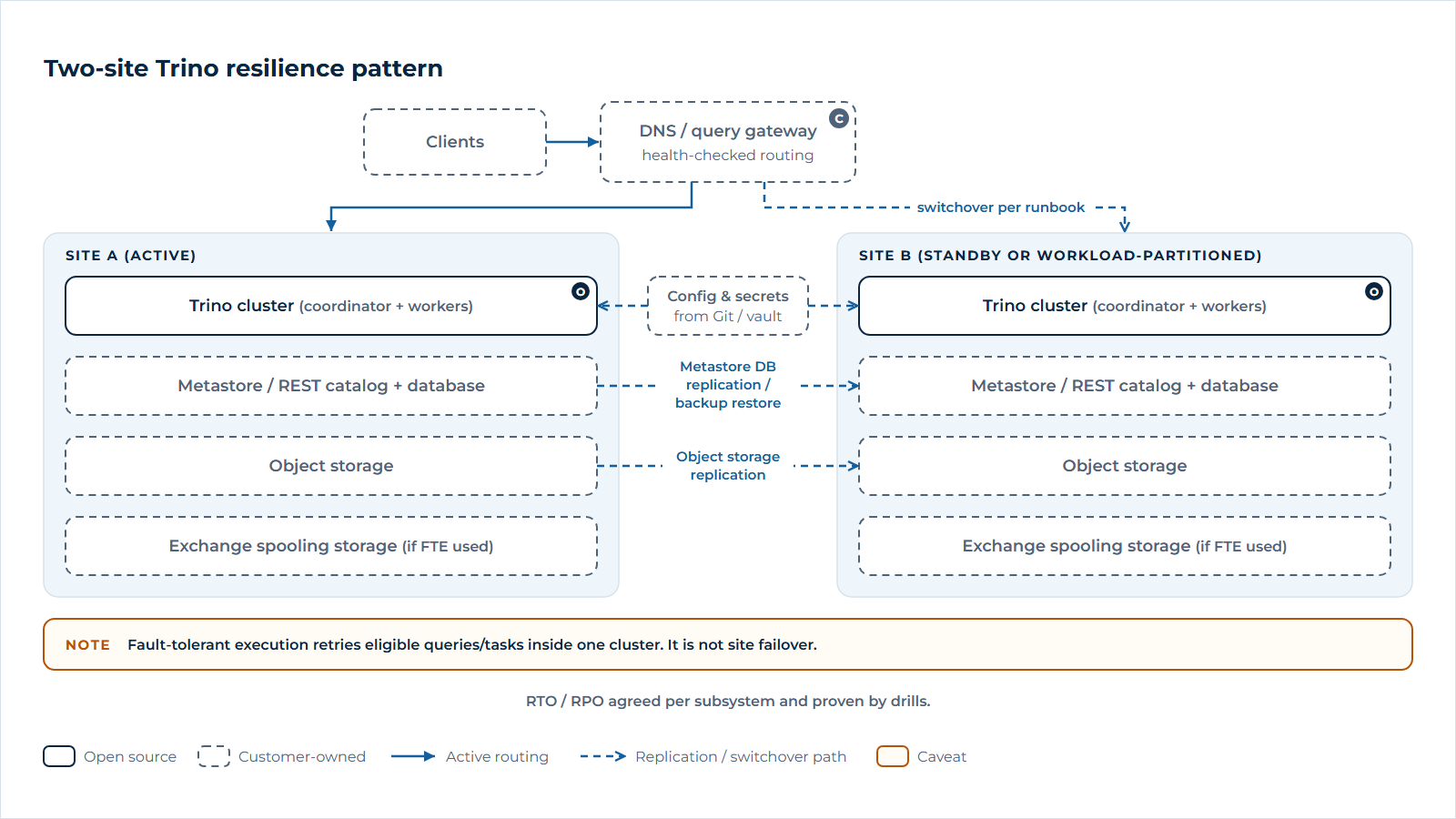
Two-site Trino resilience pattern: clients route through a health-checked gateway to an active site, with replicated object storage, metastore and configuration enabling a documented switchover to a second site.

Two-site Trino resilience pattern

LIFECYCLE

Keep Pace With a Fast-Moving Project, Safely

The Trino project releases frequently, and configuration properties, connector behavior and runtime requirements can change between versions. With the community edition, your organization decides which release to run and when to move. Bassirah turns that responsibility into a repeatable process.

  • Review release notes for your connectors, security settings and deprecated properties before each upgrade.
  • Maintain a supported version matrix for Trino, its runtime, connectors, metastores and client drivers.
  • Run regression query suites and performance comparisons in a staging environment.
  • Track upstream security advisories and plan patch upgrades through your change process.
  • Roll out with canary clusters or blue/green routing through the gateway, with a tested rollback.

Bassirah does not produce official Trino releases or security fixes. We assess, test and roll out upstream releases on your behalf.

TRANSPARENT DECISION GUIDE

Trino OSS or Starburst Enterprise: Which Route Fits?

Trino is the open-source distributed SQL engine. Starburst Enterprise is a commercial distribution based on Trino, with additional product capabilities and vendor support options. Bassirah supports Trino OSS independently and works with Starburst as a Strategic Technology Partner, so we can help you evaluate either route based on your security, connector, operations and commercial requirements.

Trino OSS or Starburst Enterprise: Which Route Fits?
Decision factorTrino OSS (independent support)Starburst Enterprise (partner-led)
Core positioningCommunity distributed SQL engineCommercial, self-hosted Trino distribution with additional capabilities
Software subscriptionCommunity licensing; infrastructure/engineering costs remainCommercial entitlements where applicable, subject to contract
ConnectorsTrino community connectors; test neededAdditional supported integrations/connectors per purchased edition
Security and governanceBuilt-in capabilities, plugins and integrator implementationAdditional enterprise controls and support options per commercial package
Upstream supportCommunity channel; Bassirah contractual engineering supportVendor-backed support per contract, plus Bassirah services
Upgrade managementCustomer/Bassirah validation of release cadence and compatibilityVendor release/support lifecycle according to contract
Operations and resilienceDesigned and operated by your team and/or Bassirah, per agreed support scopeDesigned with Bassirah using vendor-supported features and guidance, per contract
Total cost profileNo license fee; budget for engineering, operations and support timeLicense or subscription fee plus implementation; some engineering effort shifts to vendor-provided capability
Selection ruleChoose when OSS capabilities meet security, support and operating objectivesChoose when commercial controls, tested releases or vendor assurances justify it

How to read this table.

Neither route is “always faster” or “always safer”, and Trino OSS is not “insecure”. The right choice depends on the actual version, connectors, workload, support needs and licensing terms involved. We evaluate those matrices with you before recommending a route. Starburst capabilities and entitlements depend on the purchased edition and contract.

Stay on Trino OSS

Your required connectors and security controls are available in the community edition, your team (or Bassirah) can own operations and upgrades, and you prefer to avoid a software subscription.

Evaluate Starburst Enterprise

You need vendor-backed support, additional enterprise controls or connectors, or a vendor release lifecycle under contract. Bassirah plans coexistence and migration from Trino OSS when commercial enterprise requirements justify it.

Trino OSS and Starburst Enterprise are normally alternatives within one federated-query decision. Running both is a deliberate, phased coexistence strategy, not a default.

WORKS WITH

Trino in the Wider Bassirah Portfolio

Starburst Enterprise is the partner-led commercial Trino distribution route when enterprise capabilities or upstream support are needed. Other platforms complement Trino where compatibility is validated.

MinIO AIStor

Can serve supported S3 and Iceberg patterns as the object and table foundation for Trino queries.

Strategic Partner

DataHub Core

Adds metadata, ownership and lineage context for Trino catalogs and the datasets behind them.

OSS

dbt Core & dbt OSS

Supplies SQL transformations on Trino with verified adapter compatibility.

OSS

Open Iceberg Lakehouse

The reference architecture combining AIStor Tables, Trino OSS or Starburst, dbt and DataHub.

Blueprint

Trino OSS: Frequently Asked Questions

Yes. Bassirah proposes independent engineering services for Trino OSS, including distributed SQL architecture, connector configuration, security hardening, performance tuning, deployment automation and operational resilience planning. Scope and response commitments are defined in the engagement agreement.

Trino is the open-source distributed SQL engine. Starburst Enterprise is a commercial distribution based on Trino, with additional product capabilities and vendor support options. Bassirah can help evaluate either route based on your security, connectors, operations and commercial requirements.

No official upstream support or foundation endorsement is implied by independent Bassirah services. Vendor-backed support applies only where separately covered by an appropriate commercial agreement.

Trino provides connectors and S3-compatible storage integration for suitable lakehouse patterns, including Apache Iceberg. The exact AIStor product configuration, catalog, network and connector compatibility must be validated in the target architecture.

Not by itself. Fault-tolerant execution lets eligible queries or tasks be retried after failures inside a cluster, with spooled intermediate data. It does not remove the coordinator as a single point of failure and does not fail over between sites. Coordinator recovery, catalogs, storage and site switchover are designed separately.

Yes, as an engineering offering subject to the platform’s technical limits and agreed requirements. Trino query retry, coordinator recovery, stateful services, object storage, networking and dependent catalogs must be addressed separately, with customer-approved RTO and RPO and tested procedures.

Make Trino a Platform Your Teams Can Rely On.

Share your sources, workloads and resilience objectives. We will propose an architecture review scope and a practical next step.

Starburst Enterprise

Enterprise Lakehouse & Federation

HA/DR & Platform Reliability

Telco Distributed Analytics

Related Insights