





Bassirah Technology

YUGABYTEDB · INDEPENDENT ENGINEERING

Distributed SQL, Engineered Before It Scales.

Assess, design and operate self-managed YugabyteDB for workloads that need PostgreSQL-compatible SQL across zones or regions, with migrations and recovery tested against your own workloads.

Independent YugabyteDB engineering.

These are independent Bassirah engineering and support offerings. They do not imply upstream vendor or foundation endorsement, official vendor support rights, enterprise feature entitlement or maintenance guarantees.

YugabyteDB is a trademark of YugabyteDB, Inc. Bassirah is not a partner of YugabyteDB, Inc.

Supported releases.

YugabyteDB is developed by YugabyteDB, Inc. and its community. The core database is released under the Apache License 2.0. Bassirah provides independent engineering for the v2025.2 long-term support (LTS) release series and the v2026.1 standard-term support (STS) release series, and plans upgrades for universes on earlier series. The exact versions in scope are named in each statement of work. Last reviewed: 23 October 2026.

Release information from the YugabyteDB GitHub releases page and the project's release documentation, checked on 23 October 2026. Under the project's versioning policy, the first release series of each year is STS and the second is LTS. YugabyteDB, Inc. decides how long each series receives maintenance releases.
Release seriesStatus on 23 October 2026How Bassirah treats it
v2026.1 (STS)First released 29 June 2026; latest release v2026.1.2.0, 22 September 2026Supported where you accept the shorter STS maintenance window and the upgrade cadence it implies
v2025.2 (LTS)First released December 2025; latest release v2025.2.7.0, 5 October 2026Default target for new production deployments and upgrades
v2025.1 (STS)First PostgreSQL 15-based stable series, July 2025Upgrade planning to v2025.2 or v2026.1
v2024.2 (LTS) and earlierPostgreSQL 11-based; latest v2024.2 release v2024.2.11.0, 25 August 2026Upgrade assessment: moving to a PostgreSQL 15-based series requires additional upgrade steps

WHY IT MATTERS

PostgreSQL-Compatible. Distributed by Design. Not the Same Database.

YugabyteDB distributes data and transactions across nodes, zones and regions while offering a PostgreSQL-compatible SQL interface, so teams can scale out and tolerate failures without sharding the application themselves.

Its YSQL interface reuses the PostgreSQL query layer, and the current stable series are based on PostgreSQL 15. Underneath, data is split into shards that are each replicated with the Raft consensus protocol, and transactions span shards and nodes. That design changes the rules for schema keys, query plans, latency between zones and failure handling. Workloads that run well on a single PostgreSQL primary can behave differently once data and transactions are distributed. Bassirah tests that behavior with your own schema and workload before you commit, and engineers the deployment so that it holds up in production.

Abstract illustration of database nodes connected across regions

WHAT BASSIRAH DELIVERS

Independent YugabyteDB Engineering and Operations

  • Fit and architecture — Assess whether distributed SQL fits the workload, then design universe topology, zones, regions and replication settings.
  • Deployment — Deploy self-managed YugabyteDB on Kubernetes, virtual machines or bare metal, with configuration under version control.
  • Migration — Move schemas, code and data from PostgreSQL or other databases, with compatibility testing, reconciliation and rehearsed cutover.
  • Tuning and HA/DR — Tune schema keys, indexes and queries, and design high availability and disaster recovery that is tested, not assumed.
  • Security — TLS for client and internode traffic, authentication, role design with least privilege and audit logging appropriate to your requirements.
  • Upgrades — Rolling upgrades within a release series and planned major upgrades, including PostgreSQL 11-based universes moving to PostgreSQL 15-based series.
  • Observability — Metrics, slow-query analysis, tablet distribution, replication lag and node health with actionable alerts.
  • Troubleshooting and managed support — Incident troubleshooting, health reviews of existing universes and, where you want it, contracted operations under an agreed scope.

FIT FIRST

When Distributed SQL Earns Its Complexity

A distributed database adds moving parts. We recommend YugabyteDB when the workload needs what it provides, and we say so when a well-run PostgreSQL deployment is enough.

When Distributed SQL Earns Its Complexity
RequirementYugabyteDB is worth evaluating when…PostgreSQL alone is often enough when…
ScaleWrite volume or data size is growing beyond what one primary can serve, and you want to scale out by adding nodesOne primary with read replicas and connection pooling serves the workload with headroom
AvailabilityThe service must keep accepting writes when a node or a whole zone fails, without a manual failover stepA tested failover of a primary to a replica meets your recovery objectives
GeographyData must stay in, or be served from, several regions with a single SQL interfaceUsers and data sit in one region
Application changesYou can test the application against YSQL and adjust schema keys, transactions and queries where behavior differsThe application depends on PostgreSQL features or extensions that you cannot change or test
OperationsYour team, or a contracted provider, will operate a distributed systemYou want the smallest possible operational footprint

Considering PostgreSQL instead? See our PostgreSQL engineering page. Compatibility differences between YSQL and PostgreSQL must be tested for each workload: we never assume an application will run unchanged.

TOPOLOGY AND RESILIENCE

Replication and Recovery, Chosen Deliberately

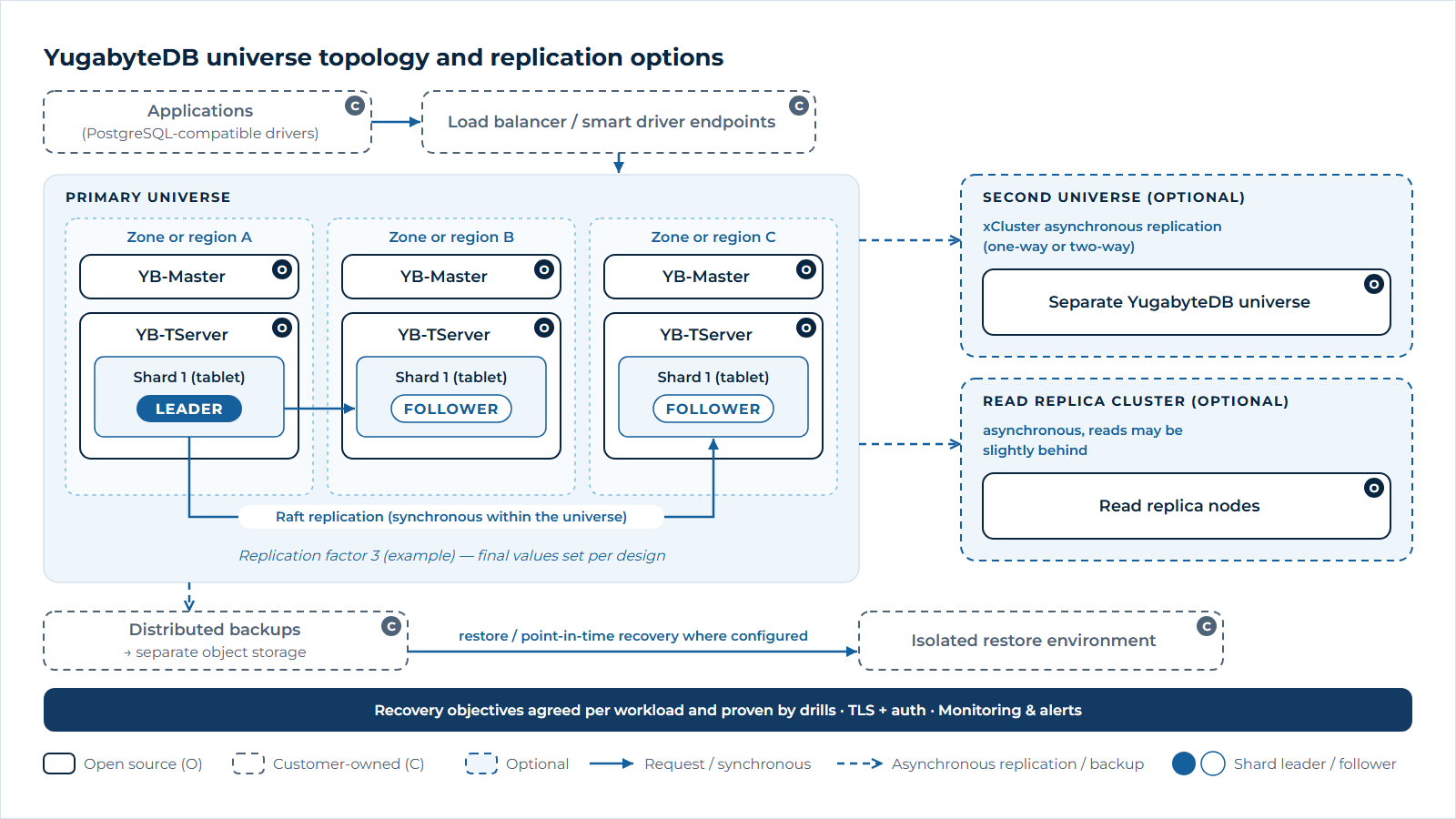
YugabyteDB replicates each shard with Raft consensus inside a universe, can replicate asynchronously between universes with xCluster, and can serve reads from read replicas. Each option trades latency, cost and consistency differently. We choose them per workload, then prove the effect of a node, zone or region failure in tested recovery exercises against objectives you approve.

Replication and Recovery, Chosen Deliberately
DecisionTypical approachTrade-off we make explicit
Replication within a universeRaft-replicated shards spread across zones or regions, with the replication factor set per designWrite latency between zones or regions vs. tolerance of zone or region loss
Leader placementPreferred leaders close to the application, so most reads and writes stay localLower local latency vs. behavior and latency after a leader moves
Replication between universesxCluster asynchronous replication, one-way or two-way, between two universesIndependent universes and lower write latency vs. data that is not yet replicated at the moment of failure
Read scalingRead replicas in remote regions for reads that can accept slightly older dataLocal read latency vs. data freshness
Recovery from data loss or errorDistributed backups to separate object storage, with point-in-time recovery where configuredStorage cost vs. how far back and how precisely you can restore
YugabyteDB topology: applications connect to a universe spread across three zones or regions, where each data shard has a leader and followers kept in step by Raft replication, with optional xCluster asynchronous replication to a second universe, an optional read replica cluster, and distributed backups to separate storage for restores.

YugabyteDB universe topology and replication options

OPERATIONS

Evidence-Led Tuning for a Distributed Database

Abstract illustration of data split evenly across nodes

Schema and key design

Choose hash or range sharding and primary keys so data spreads evenly and the queries that matter read from as few shards as possible.

Abstract illustration of query paths converging on an index

Queries and indexes

Analyze execution plans for the statements that consume the most time, reduce cross-node round trips and add or change indexes based on evidence.

Abstract illustration of a staged path from one release to the next

Upgrades

Rolling upgrades with compatibility checks for drivers, extensions and tooling, rehearsed in staging with a rollback decision point.

Abstract illustration of monitoring panels for a database cluster

Monitoring and backups

Node health, tablet balance, replication lag and slow queries with actionable alerts, plus backup schedules with restore drills.

MIGRATION

Move to YugabyteDB With Traceability and Controlled Risk

Delivered through our migration and modernization practice, from PostgreSQL or from other relational databases.

  1. InventoryCatalog schemas, procedural code, extensions, data types, integrations and workloads.
  2. Assess compatibilityTest schema, code and extensions against YSQL, and identify what runs unchanged, what needs rework and what needs a different design.
  3. Redesign keys and testAdapt primary keys, indexes and transactions for distribution, then test functionality and performance against representative workloads.
  4. Parallel run and reconcileSynchronize data, run in parallel and reconcile results with agreed control checks.
  5. Cut overExecute a rehearsed cutover with explicit rollback decision points, then stabilize and hand over.

Moving from PostgreSQL or another database?

Start with a compatibility test on your own schema and workload.

USE CASES

Where YugabyteDB Fits

Transactional services that must stay available

Transactional services that need to keep serving reads and writes through node or zone failures.

Multi-region applications

Applications serving users in several regions, with data placement designed for latency and data-residency requirements.

PostgreSQL estates outgrowing one primary

PostgreSQL workloads that need to scale out, after compatibility testing confirms the move is worth it.

SUPPORT ROUTES

Community, Independent Support or a Vendor Contract

The YugabyteDB core database is open source. YugabyteDB, Inc. also offers its own commercial products and support: YugabyteDB Anywhere, a self-managed platform for operating universes, and YugabyteDB Aeon, a managed database service. Bassirah supports the open-source database independently and is clear about where its commitments end.

Community, Independent Support or a Vendor Contract
Decision factorCommunity onlyBassirah independent supportVendor contract with YugabyteDB, Inc.
Who operates YugabyteDBYour teamYour team with Bassirah engineering, or Bassirah under a managed scopeYour team with YugabyteDB Anywhere, or the vendor for YugabyteDB Aeon, under the vendor's terms
Help with incidentsPublic community channels, no response commitmentResponse targets per your agreementVendor support under the vendor's own terms
Code defectsReported by you to the projectReproduced, worked around and reported upstream by BassirahHandled by the vendor under its terms
Upstream fixes and releasesOn the project's timelineOn the project's timeline; we track them, test them and apply them through change controlUnder the vendor's terms
Commercial productsNot includedNot included: Bassirah does not resell or license YugabyteDB Anywhere or YugabyteDB AeonContracted directly with YugabyteDB, Inc.

If you need vendor-backed support, YugabyteDB Anywhere or YugabyteDB Aeon, that is contracted with YugabyteDB, Inc. How cases, severities and response targets work for our independent support is set out in our open-source support model. For fully contracted operations, see Managed Services.

WORKS WITH

YugabyteDB in the Wider Portfolio

YugabyteDB is one option in our operational database practice. We place it alongside PostgreSQL, Cassandra and caching where each fits, and test every integration first.

PostgreSQL

A single-primary PostgreSQL deployment, when it meets the scale and availability objectives with less to operate.

OSS

Apache Cassandra

A wide-column alternative for known, partition-based access patterns. YCQL has Cassandra roots, but compatibility must be tested per application.

OSS

Redis

Low-latency caching and session state in front of the database, where measurements justify it.

Strategic Partner

Managed Services

Contracted operations, monitoring and incident handling for YugabyteDB estates.

YugabyteDB: Frequently Asked Questions

Yes. The core database is released under the Apache License 2.0. YugabyteDB Anywhere is licensed separately and YugabyteDB Aeon is a managed service; both are commercial products of YugabyteDB, Inc. Bassirah supports the open-source database and is not endorsed by YugabyteDB, Inc.

Not automatically. YSQL reuses the PostgreSQL query layer, and current stable series are based on PostgreSQL 15, but a distributed database behaves differently in areas such as keys, query plans, latency and some features and extensions. We test your schema, code and workload before recommending a move.

When one primary with replicas meets your scale and recovery objectives, when users and data sit in one region, or when you depend on features you cannot test against YSQL. A well-run PostgreSQL deployment is simpler to operate. See our PostgreSQL page.

We work on the v2025.2 LTS and v2026.1 STS release series, and we plan upgrades for universes on earlier series, including PostgreSQL 11-based v2024.2 universes, which need additional steps to move to a PostgreSQL 15-based series. The versions in scope are confirmed in each statement of work.

No. Bassirah is not a YugabyteDB, Inc. partner and does not provide vendor support, vendor security fixes or vendor escalation. Our services are independent engineering and support, with scope and response targets defined in your agreement. Code fixes and releases follow the project’s timeline. See our support model.

Yes. A universe can span zones or regions with Raft replication, two universes can be linked with xCluster asynchronous replication, and read replicas can serve reads in remote regions. Each choice trades latency against consistency and cost, so we design it for your objectives and test the effect of losing a zone or region.

Make Distributed SQL Predictable.

Tell us about your workloads, topology and recovery objectives. We will scope a fit assessment and a practical next step.

Operational Database Modernization

HA/DR & Platform Reliability

Migration & Modernization

Open-Source Support Model

Related Insights