
ENTERPRISE DATA & AI SOLUTIONS
Integrated Solutions. Built Around Your Business Outcomes.
Enterprise transformation rarely succeeds with one product alone. Bassirah connects storage, SQL access, analytics, governance, operational databases and AI systems through architectures designed for security, performance and long-term operations.
Ten solution areas · Partner-led and open-source routes · One accountable engineering team

OUR APPROACH
Solutions Start with the Workload, Not the Product List.
Each Bassirah solution is a repeatable architecture pattern with clearly separated technology responsibilities, documented design controls and a defined route to proof of concept. We recommend a partner-led route, an open-source route or a deliberate combination only after we understand your data, latency, compliance and operating constraints.
Outcome first
Every solution begins with a business problem and measurable acceptance criteria agreed with your team before platform choices are fixed.
Clear responsibilities
Federation, analytical serving, caching, transformation, metadata and storage each get a defined owner in the architecture, so no product is stretched beyond its role.
Validated, then claimed
Connectors, adapters, versions and performance are tested in your environment or a proof of concept before they are treated as part of the design.
SOLUTION PORTFOLIO
Ten Solution Areas Across Data, Analytics, Operations and AI
Start from the problem you need to solve. Each solution page explains the challenge, the reference architecture, technology roles, design and acceptance controls, and how an engagement runs.
Data Foundation & Access
Enterprise Lakehouse & Federation
Build an open, governed lakehouse and enterprise SQL access model around the data you already own.
Stack: Trino OSS or Starburst · MinIO AIStor / Iceberg · dbt · DataHub
Data Warehouse Modernization
Move beyond monolithic warehouses by separating retained systems, federated access, open storage and specialized analytics.
Stack: Trino OSS or Starburst · MinIO AIStor / Iceberg · ClickHouse · dbt
Operational Database Modernization
Design transactional, document and distributed NoSQL systems with the right consistency, latency and availability model.
Stack: PostgreSQL · YugabyteDB · MongoDB Community · Apache Cassandra · Redis
Analytics & Data Engineering
Real-Time Analytics
Serve dashboards and applications from high-volume event data at workload-appropriate latency.
Stack: ClickHouse · Redis · dbt · DataHub
Analytics Engineering & Transformation
Bring reusable SQL models, tests, documentation and CI/CD discipline to the transformation lifecycle.
Stack: dbt Core / dbt OSS · ClickHouse · Trino or Starburst · DataHub
Data Governance & Catalog
Make ownership, glossary and lineage discoverable and actionable across your data landscape.
Stack: DataHub Core · dbt · query engines and IAM
AI & Platform Operations
Enterprise AI & AgentOps
Take AI applications from prototype to managed production with tracing, evaluation and controlled data access.
Stack: Langfuse · ClickHouse · PostgreSQL · Redis · MinIO AIStor
HA/DR & Platform Reliability
Translate recovery objectives into tested failover, backup and restore patterns for each platform.
Stack: Platform-specific replicas · backup / PITR · observability
Industry Solutions
Fraud & Risk Analytics
Unite real-time decision support, investigation analytics and governed history in an auditable risk data architecture.
Stack: Redis · ClickHouse · Trino or Starburst · DataHub
Telecom Network Analytics
Turn CDRs and network events into operational intelligence, historical investigation and enterprise reporting.
Stack: ClickHouse · MinIO AIStor · Trino or Starburst · Redis
WHERE TO BEGIN
Match the Challenge to the Solution
Most programmes touch more than one area. Use this table to find the best first page, then follow its links to related solutions and blueprints.
| If your challenge is… | Start with | Often combined with |
|---|---|---|
| Data is spread across many stores and every new question needs a new pipeline | Enterprise Lakehouse & Federation | Data Governance & Catalog |
| Dashboards and customer-facing analytics are slow or overload transactional databases | Real-Time Analytics | Operational Database Modernization |
| Nobody can say who owns a dataset or where a reported number came from | Data Governance & Catalog | Analytics Engineering & Transformation |
| Business logic lives in fragile SQL scripts with no tests or version control | Analytics Engineering & Transformation | Data Governance & Catalog |
| A legacy warehouse is costly, saturated or near end of support | Data Warehouse Modernization | Enterprise Lakehouse & Federation |
| Application databases struggle with scale, consistency or availability | Operational Database Modernization | HA/DR & Platform Reliability |
| AI pilots work, but nobody can trace, evaluate or cost them in production | Enterprise AI & AgentOps | HA/DR & Platform Reliability |
| Recovery objectives exist on paper but have never been tested | HA/DR & Platform Reliability | Managed Services |
| Fraud teams need faster insight without weakening audit and governance | Fraud & Risk Analytics | Real-Time Analytics |
| Network event volumes outgrow current analytics and retention budgets | Telecom Network Analytics | Enterprise Lakehouse & Federation |
Not sure where to start?
Bring your top three data challenges and we will map them to a solution and a first step.
INTEGRATED PLATFORM MODEL
One Reference Model Behind Every Solution
Our solutions share a common logical model. Each layer has its own design responsibility, so technology choices in one layer never silently take on the obligations of another.
| Layer | Suggested technologies | Design responsibility |
|---|---|---|
| Experience & consumption | BI tools, APIs, enterprise applications, AI agents | Access patterns, semantic outputs, user experience |
| SQL access & analytical serving | Trino OSS or Starburst; ClickHouse; Redis | Federation versus analytical serving versus cache placement |
| Engineering, governance, observability | dbt OSS / dbt Core; DataHub Core; Langfuse | Models and tests, metadata and lineage, AI evaluation |
| Storage & operational data | MinIO AIStor / Iceberg; PostgreSQL; YugabyteDB; MongoDB Community; Apache Cassandra | Source of truth, consistency, catalogs, encryption and durability |
| Foundational controls | Identity, networking, secrets, observability, backup, runbooks, DR | Security and operational accountability, independent of product selection |
Technologies are listed as candidates, not a mandatory stack. Each project validates versions, connectors, adapters and licensing for the selected route. MongoDB Community Server is source-available (SSPL).
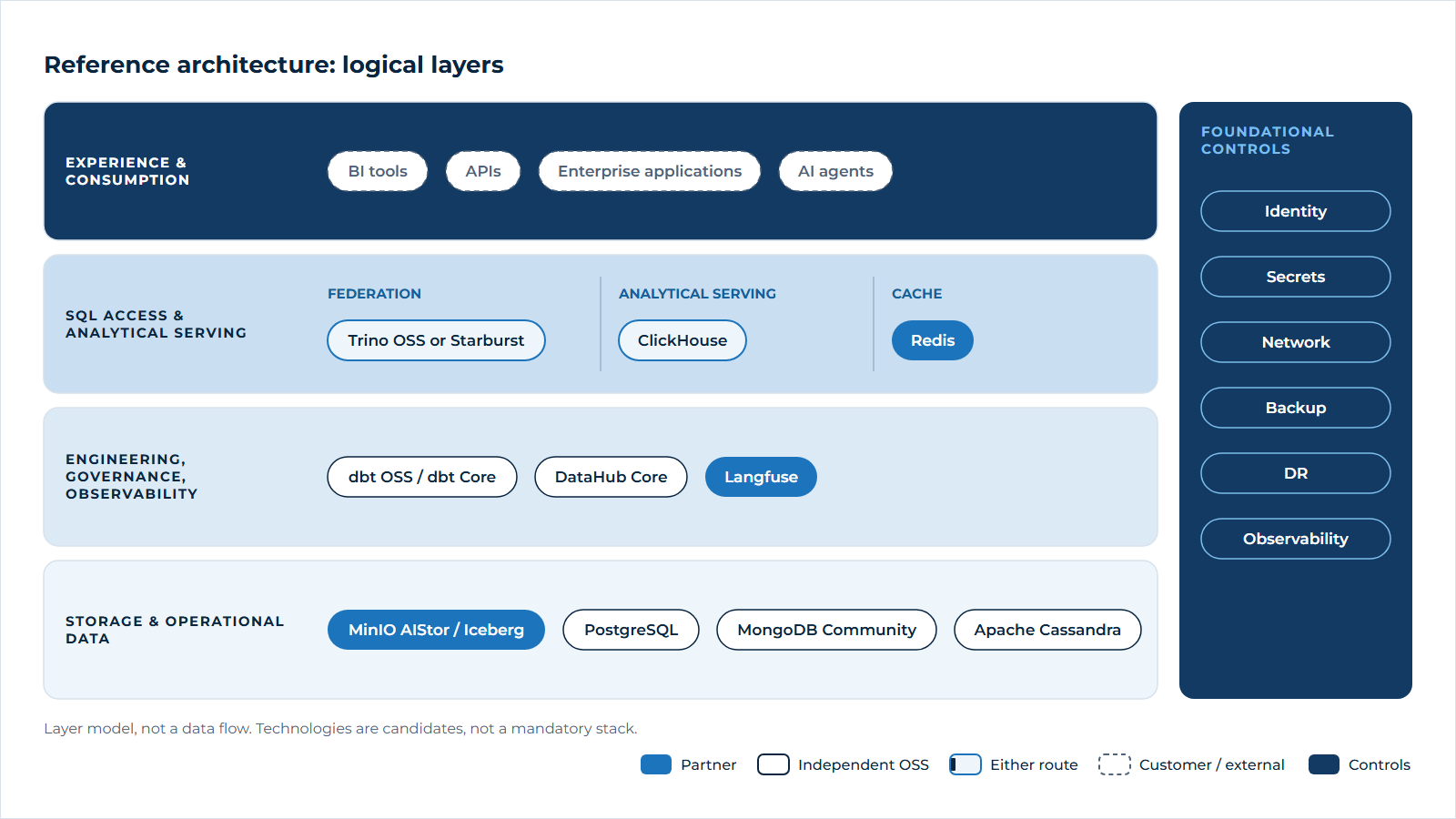
Reference architecture: logical layers
HOW WE CHOOSE
Selection Principles We Apply on Every Engagement
These rules keep architectures honest. They prevent overlapping tools, unproven integrations and support assumptions that do not hold up in production.
- Federation is not analytical serving. Trino or Starburst and ClickHouse are not interchangeable. Querying across heterogeneous sources is a different job from purpose-built, low-latency analytical serving.
- Trino OSS or Starburst, not both by default. For a given federated-query decision they are alternatives. We run both only when a phased coexistence strategy is deliberately required.
- Redis is not a system of record. Redis does not replace a durable relational or document database. Persistence, recovery and consistency expectations are validated for each use.
- DataHub governs metadata, not access. DataHub is the metadata and governance control plane. Data authorization is enforced in the query engines, databases, storage and IAM systems connected to it.
- dbt runs through verified adapters. dbt works through adapters and the underlying SQL engine. We confirm compatibility, packaging and runtime requirements before presenting an integration as ready.
- Licensed capabilities match the licence. MinIO AIStor and other commercial capabilities are matched to the actual licence and deployed release.
- HA/DR is designed per component. Every recovery design treats the coordinator or control plane, catalogs and metadata, data storage, IAM, secrets, networking, monitoring and restore orchestration separately.
Partner-led or open-source?
Strategic partner routes (ClickHouse, Starburst, Redis, Langfuse, MinIO AIStor, MongoDB, Postman, Strategy) add licensed capabilities and vendor-backed support where contracted. Open-source routes (Trino, ClickHouse OSS, dbt, DataHub, PostgreSQL, MongoDB Community, Cassandra, Superset, YugabyteDB) are delivered as independent Bassirah engineering. We document which route applies to each component.
Want to see the principles applied? See the Open Iceberg Lakehouse blueprint →
INDUSTRIES
The Same Patterns, Tuned to Each Sector
Industry pages show which solutions matter most for each sector’s workloads, controls and operating model.
Banking & Financial Services
Real-time risk intelligence without sacrificing governance.
Fraud & Risk Analytics · Real-Time Analytics · Data Governance · HA/DR
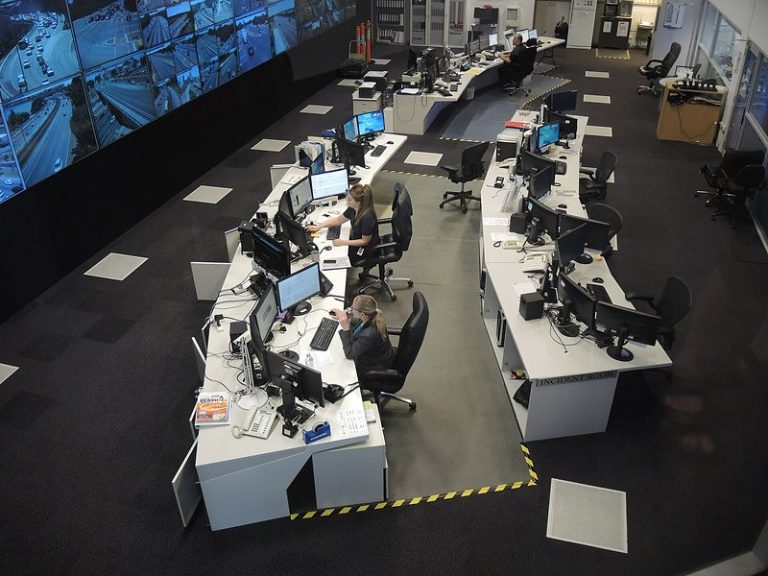
Telecommunications
From network events to actionable operational intelligence.
Telecom Network Analytics · Enterprise Lakehouse · Real-Time Analytics

Digital Natives & SaaS
Fast, secure analytics for products that never stop growing.
Real-Time Analytics · Operational Database Modernization
Government
Secure, interoperable data services for public impact.
Enterprise Lakehouse · Data Governance · Analytics Engineering

Healthcare
Connected data for safer, more efficient care.
Enterprise Lakehouse · Data Governance · Operational Database Modernization
ENGAGEMENT PATH
From First Workshop to Managed Production
Every solution follows the same accountable path. You can engage for one step or the whole journey.
- DiscoverAgree business objectives, current stack, data volumes, security constraints, support needs and success metrics.
- DesignProduce the target architecture, technology roles, decision records and acceptance criteria.
- ProveRun a focused proof of concept against representative data and agreed acceptance tests.
- ImplementBuild, integrate, secure and migrate in controlled waves, with knowledge transfer built in.
- Operate & improveOptimize performance and cost, and run the platform under a contracted managed-service scope if required.
About partner and open-source routes.
Solutions may combine strategic partner technologies with independently supported open-source software. Independent open-source support is Bassirah engineering and does not imply affiliation with, endorsement by, or upstream support from the open-source project or its maintainers. Vendor-backed support applies only where covered by an appropriate commercial agreement. Compatibility, performance and service levels are confirmed per engagement.
Solutions FAQ
What is the difference between a solution and an architecture blueprint?
A solution is a business-outcome offering, such as real-time analytics or warehouse modernization, that we design, deliver and can operate. An architecture blueprint is a detailed reference pattern for a specific scenario, showing data flows, component roles and validation checks. Solution pages link to the blueprints that apply.
Do your solutions require a specific technology stack?
No. Each solution lists candidate technologies, but the final stack follows your workload, latency, compliance, operating model and cost requirements. We may recommend a partner-led route, an open-source route or a deliberate combination.
Can a solution reuse platforms we already run?
Yes. Most engagements start from existing databases, warehouses and storage. Federation, governance and modernization solutions are specifically designed to work with retained systems rather than forcing a single migration.
How do you confirm that technologies will work together?
We validate connectors, adapters, versions, security behaviour and performance during design and proof of concept. Integrations are documented as supported only after they are tested for the target versions and deployment.
What does a first solution engagement usually look like?
A discovery workshop or architecture assessment. It defines objectives, current stack, volumes, security constraints, support needs and success metrics, then recommends a design and a focused proof of concept or implementation plan.
Let's Design the Right Solution for Your Workloads
Tell us your objectives, current platforms and constraints. We will recommend a pragmatic architecture and a focused next step.