




Bassirah Technology

DBT CORE & DBT OSS · INDEPENDENT ENGINEERING

Make Analytics Engineering Repeatable and Trusted.

Build maintainable, testable SQL transformation projects on dbt v1, dbt OSS or the free dbt distribution. Bassirah helps teams adopt modular modeling, testing, documentation, CI/CD and orchestration patterns.

Independent dbt engineering.

These are independent Bassirah engineering and support offerings. Bassirah is not a dbt Labs partner. They do not imply upstream vendor or foundation endorsement, official vendor support rights, enterprise feature entitlement or maintenance guarantees. Fixes to proprietary dbt components and any dbt Labs features come only from dbt Labs. Commercial dbt platform products are not part of this offering.

CLEAR NAMING

dbt Core, dbt OSS and What We Support

dbt Labs renamed its distributions when dbt v2.0 was released in September 2026. The Python-based 1.x line continues as dbt v1 (dbt Core 1.x). dbt Core v2 is now called dbt OSS and is licensed entirely under Apache 2.0. The former dbt Fusion engine is now called dbt: free to use, but not open source. We name the exact version, adapter and distribution in every project.

Supported releases.

Bassirah provides independent engineering for projects on dbt v1 (dbt Core 1.x) and dbt OSS (dbt v2), both licensed under Apache 2.0, and on the free dbt distribution (dbt v2), a dbt Labs product under the dbt Product Licensing Agreement. The adapters in scope are listed in each statement of work. Release scope is reviewed quarterly and when upstream naming, licensing or major versions change. Last reviewed: 20 October 2026.

Naming and licensing as published by dbt Labs on its dbt versions page, licensing FAQ and dbt-core repository, checked on 20 October 2026. dbt v2.0 was first released on 14 September 2026. Not every dbt-branded component is under the same licence, so we confirm the licence of each component you deploy.
Name you may seeWhat it refers toHow Bassirah treats it
dbt v1 / dbt Core 1.xThe Python-based 1.x generation, installed with the dbt-core package. v1.12 is the current minor release; v1.13 is in beta. Licensed under Apache 2.0.Supported for existing projects and planned upgrades, within the release scope above
dbt OSS (formerly dbt Core v2)The dbt v2 distribution built only from the Apache 2.0 source in the dbt-core repositorySupported for new projects and migrations, within the release scope above
dbt (formerly the dbt Fusion engine)The dbt v2 distribution dbt Labs recommends by default. Free to use, but not open source: it includes dbt-specific components under the dbt Product Licensing Agreement.Supported for project engineering, within the release scope above. Fixes to its proprietary components come only from dbt Labs
dbt platformdbt Labs' hosted, commercially licensed productNot covered by this independent offering

WHY IT MATTERS

Software Engineering Discipline for Your Data Transformations

dbt brings software engineering discipline to data transformation and enables standardized models and dependable deployment processes.

Instead of fragile scripts and undocumented stored procedures, dbt projects express transformations as version-controlled SQL models with declared dependencies, data tests and generated documentation. That makes changes reviewable, failures visible before they reach reports, and lineage clear from source to dashboard.

The tool alone does not create that discipline. Project structure, naming conventions, testing policy, environment promotion and ownership determine whether a dbt project stays maintainable at hundreds of models. That is where Bassirah helps.

Analytics engineers reviewing transformation work together

WHAT BASSIRAH DELIVERS

Independent dbt Engineering, From Assessment to Production

  • Distribution and adapter assessment — Assess dbt v1, dbt OSS and the free dbt distribution, and their adapters, for your target engines, and record the licence of each component.
  • Project design — Design project structure, environments, naming, packages, tests and documentation.
  • Model implementation — Implement source-to-target models and incremental transformation strategies.
  • Pipelines and quality — Integrate build pipelines, scheduling, lineage and model quality controls.
  • Migration — Move legacy SQL jobs or stored procedures into dbt models, with reconciled control totals before cutover.
  • Upgrade planning — Plan moves between dbt releases, including dbt v1 to dbt v2 (dbt OSS or the free dbt distribution), adapter compatibility, package parsing and deprecated features.
  • Performance and cost — Tune materializations, incremental logic and model selection to reduce runtime and engine load.
  • Enablement — Coding standards, review checklists and hands-on sessions for your analytics engineers.

DELIVERY PATTERN

From Pull Request to Trusted Production Data

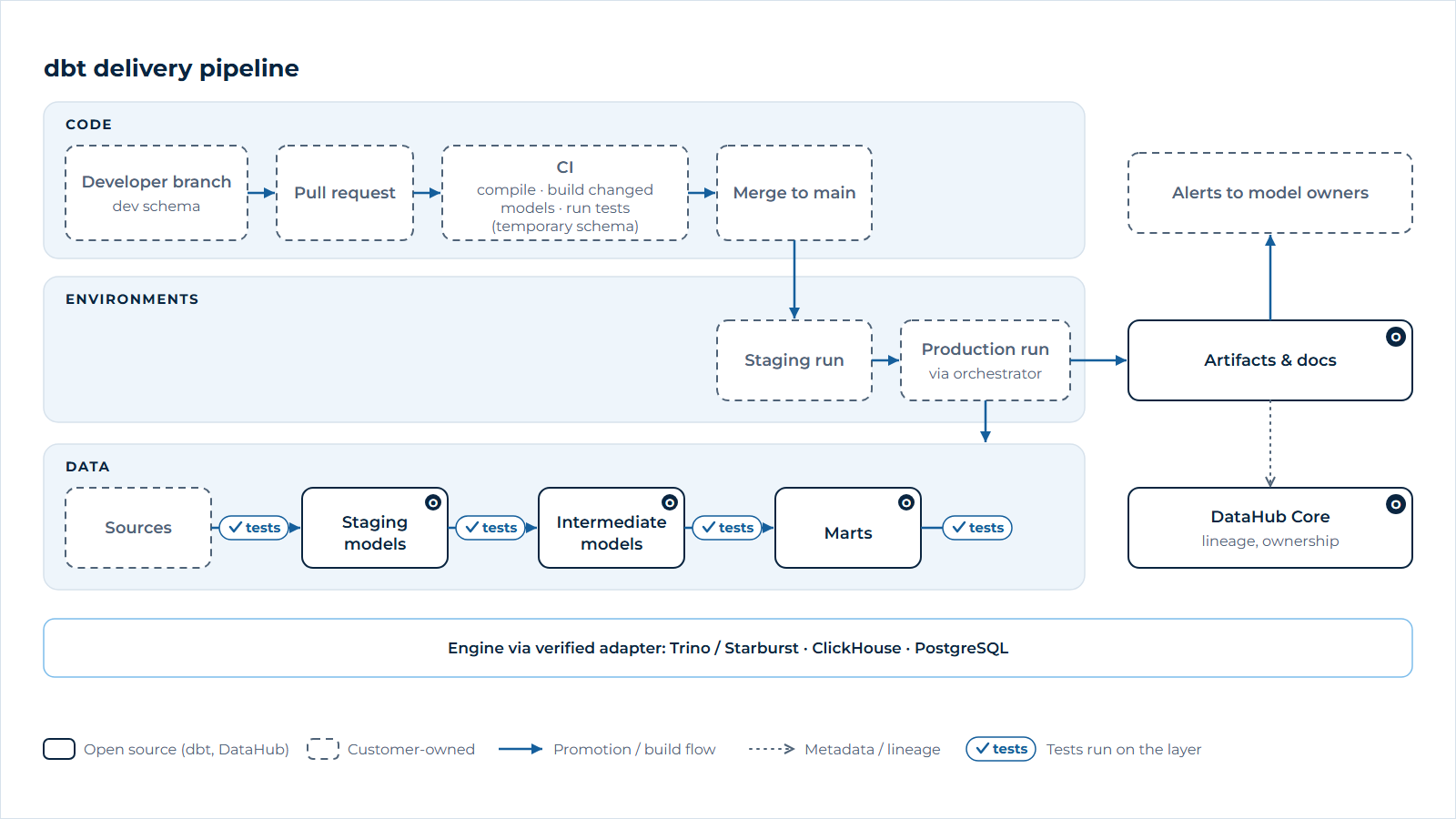
  1. DevelopEngineers build models on a branch against an isolated development schema, using shared conventions and packages.
  2. ReviewA pull request triggers continuous integration: compile, build changed models and their dependents, and run data tests in a temporary CI schema.
  3. ApproveReviewers check SQL, tests, documentation and lineage impact before merging.
  4. DeployThe merged project runs in staging, then production, through your orchestrator on a schedule or event trigger.
  5. Test in productionFreshness checks and data tests run with every build; failures alert the model owner before downstream reports refresh.
  6. Document and catalogGenerated documentation and artifacts feed lineage and ownership into DataHub where integrated.
dbt delivery pipeline: changes move from a developer branch through pull-request CI tests to staging and production runs, transforming sources into tested marts, with documentation and lineage sent to DataHub.

dbt delivery pipeline

Is your dbt project hard to change safely?

We will review structure, tests and CI/CD and prioritize fixes.

USE CASES

Where dbt Engineering Pays Off

Medallion-aligned transformations

Medallion-aligned analytics transformations, from raw sources through cleaned and conformed layers to business-ready marts.

Abstract illustration of reconciled financial data

Finance and management reporting

Management reporting and finance reconciliation pipelines with tested control totals and documented logic.

Governed metrics and dimensions

Governed metric models and reusable dimensional datasets that give every team the same definitions.

COMPATIBILITY

dbt Runs Through Adapters. We Verify Each One.

dbt works through adapters for each SQL engine, and adapters are released and maintained separately from dbt itself. Before we advertise an integration, we confirm adapter version, supported materializations and runtime requirements for your target engine.

Product naming and supported adapters must be checked for each project.
Target engineTypical roleWhat we validate
Trino OSS or StarburstTransformations over federated sources and lakehouse tablesAdapter release vs. dbt release, supported materializations, catalog and table-format behavior
ClickHouseTransformations for analytical serving tablesAdapter release, incremental strategies, engine and cluster settings for model tables
PostgreSQLTransformations for operational reporting and smaller martsAdapter release, transaction behavior, load on production instances
Other enginesProject-specificCompatibility, licensing and support status before commitment

WORKS WITH

dbt in the Wider Portfolio

ClickHouse or Trino/Starburst as query engines where current adapters work; DataHub for lineage and documentation ingestion.

DataHub Core

Ingest dbt models, tests and lineage into a searchable catalog with ownership.

OSS

Trino OSS

Run dbt transformations across federated sources and Iceberg tables.

OSS

ClickHouse OSS

Build analytical serving tables with tested, versioned models.

OSS

Analytics Engineering & Transformation

The full solution pattern, from source mapping to governed marts.

Solution

dbt Core & dbt OSS: Frequently Asked Questions

Only for the 1.x line. Since dbt v2.0 (September 2026), dbt Labs calls the Apache 2.0 v2 distribution dbt OSS (formerly dbt Core v2) and the free, proprietary-licensed v2 distribution dbt (formerly the dbt Fusion engine). The 1.x line continues as dbt v1, also known as dbt Core 1.x. Bassirah names the exact version, adapter and distribution supported in every project.

Our current release scope is shown in the supported-releases note on this page and confirmed in each statement of work, together with the adapters in scope. We review it quarterly and whenever upstream naming, licensing or major versions change.

No. Bassirah is not a dbt Labs partner. Our dbt services are independent engineering and support for projects on dbt v1, dbt OSS and the free dbt distribution. They do not include vendor support or entitlements: fixes to proprietary dbt components and any dbt Labs features come only from dbt Labs, and commercial dbt platform products are not covered.

Yes. We inventory existing logic, map it to modular models, add tests, and run old and new pipelines in parallel until control totals reconcile. Cutover happens only after agreed validation.

No. dbt defines and tests transformations. Scheduling runs through your orchestrator, and enterprise discovery and ownership are better served by a catalog such as DataHub, which can ingest dbt metadata and lineage.

Turn Transformation Code Into a Trusted Product.

Tell us about your engines, models and delivery process. We will scope an assessment and a practical next step.

Analytics Engineering & Transformation

Data Governance & Catalog

Open Iceberg Lakehouse

Data Warehouse Modernization

Related Insights