
ENTERPRISE LAKEHOUSE & FEDERATION
Modernize Analytics Without Creating Another Data Silo.
Build an open, governed lakehouse and enterprise SQL access model around the data you already own. Bassirah combines federated SQL, open table storage, analytics engineering and metadata governance into one architecture, validated against your sources, security model and workloads.
Trino OSS or Starburst · MinIO AIStor / Iceberg · dbt Core / dbt OSS · DataHub Core

THE CHALLENGE
More Data Platforms Should Not Mean More Data Silos
Most enterprises already run several warehouses, operational databases, file shares and cloud stores. Each new analytics request tends to trigger another extract, another copy and another place where definitions drift. Moving everything into a single new repository rarely works either: it is slow, expensive and often blocked by ownership, residency or source-system constraints.
- Analysts wait for pipelines before they can ask cross-source questions.
- The same data is copied into several stores, each with its own security rules.
- Proprietary storage formats make it hard to change engines or add new workloads.
- Nobody can easily see which tables exist, who owns them or how they were derived.
- Lakehouse pilots stall when catalog, access control and table-lifecycle decisions are left for later.
A lakehouse succeeds when access, storage, modeling and governance are designed together, not bolted on in sequence.

OUTCOMES
Open Access, Open Storage, Governed Use
Federated SQL access
Query permitted sources through one SQL layer, reducing data duplication for selected queries while keeping authoritative systems in place.
Open table storage
Land curated datasets in Apache Iceberg tables on S3-compatible object storage, so engines can change without rewriting the data.
Engineered models
Build transformations as version-controlled, tested dbt models with clear ownership and promotion between environments.
Discoverable, traceable data
Catalog datasets, owners, glossary terms and lineage in DataHub so users can find and trust what they query.
REFERENCE ARCHITECTURE
How the Lakehouse and Federation Layers Fit Together
This is a conceptual pattern. Every connector, catalog, licensed capability and version is validated in a project-specific design before it is treated as supported.
- Connect sourcesOperational databases, existing warehouses and files are registered as catalogs in Trino OSS or Starburst through verified connectors, with credentials held in the enterprise secrets store.
- Federate selectivelyAnalysts and tools query permitted sources in place for exploration and lower-frequency questions. Heavy or repeated workloads are identified for landing rather than federated indefinitely.
- Land and curateApproved datasets are ingested into customer-controlled MinIO AIStor object storage and organized as Apache Iceberg tables, using AIStor Tables or another supported Iceberg catalog as validated for the selected release.
- Model and testdbt Core or dbt OSS, running through a verified adapter for the chosen engine, builds layered models (raw, standardized, business-ready) with data tests, documentation and CI/CD promotion.
- Catalog and traceDataHub Core ingests metadata from the query engine, dbt and sources through supported connectors, recording ownership, glossary terms and lineage.
- Enforce and operateAuthorization is enforced in the query engine, storage and IAM layers. Resource isolation, catalog availability, snapshots, backup, restore and monitoring are designed as separate concerns.
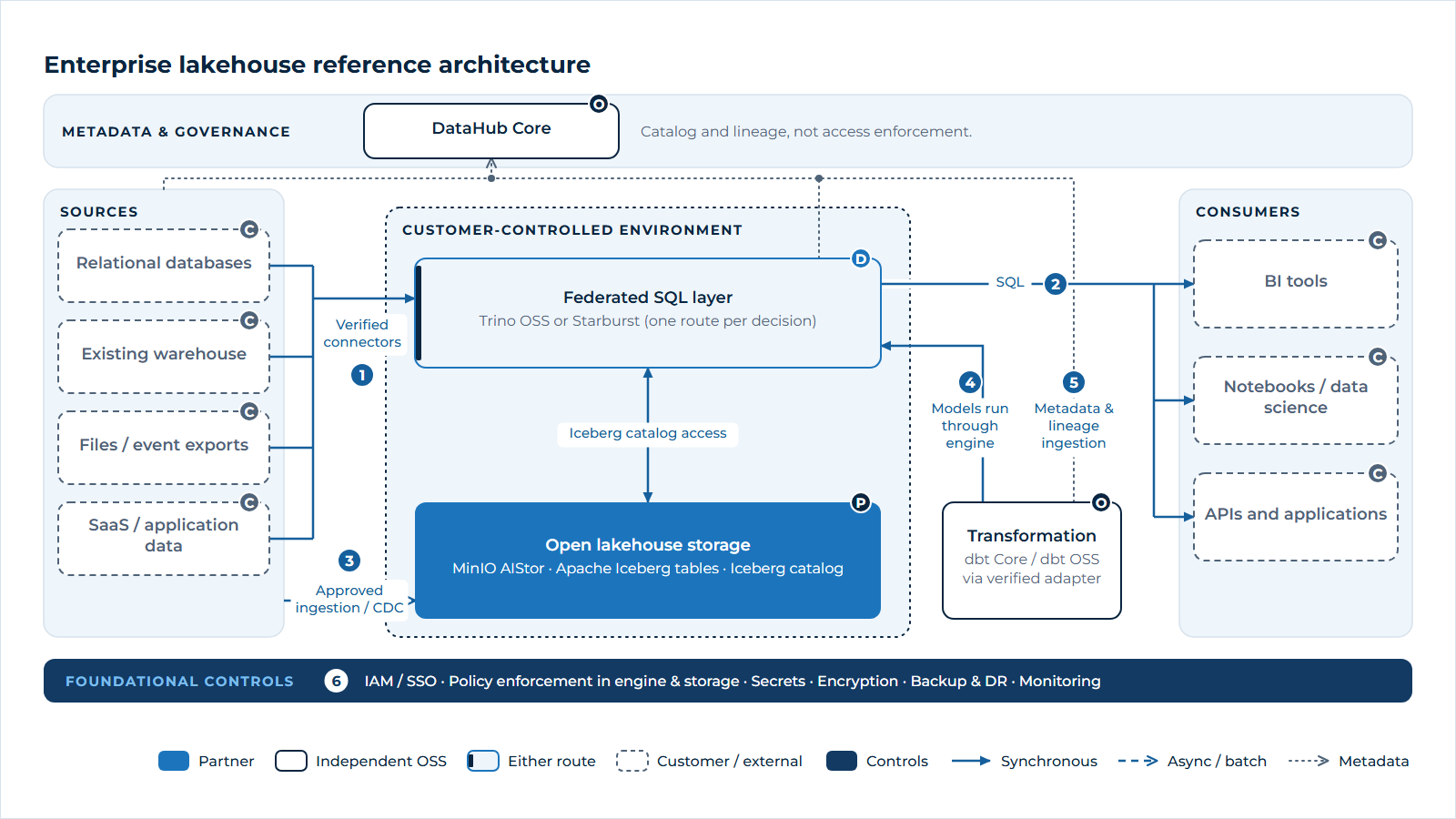
Enterprise lakehouse reference architecture
TECHNOLOGY ROLES
Each Component Has One Clear Job
| Component | Role in this solution | Route | Qualification |
|---|---|---|---|
| Trino OSS | Distributed SQL engine for federation and lakehouse queries | Independent Bassirah open-source engineering | Connector and security features validated per version; no upstream support implied |
| Starburst Enterprise | Commercial Trino-based distribution for the same role | Strategic partner (licensed) | Capabilities depend on edition and entitlement; an alternative to Trino OSS, not a second layer |
| MinIO AIStor | S3-compatible object storage and Iceberg table services | Strategic partner (licensed) | AIStor Tables and catalog behaviour validated against the deployed release and licence |
| Apache Iceberg | Open table format for curated, engine-independent datasets | Open standard | Table maintenance, snapshot and schema-evolution policies defined per domain |
| dbt Core / dbt OSS | SQL transformation, tests, documentation and deployment discipline | Independent open-source engineering | Runs through a verified adapter; exact dbt release and adapter named per project |
| DataHub Core | Metadata catalog, ownership, glossary and lineage | Independent open-source engineering | Governance control plane only; authorization stays in engines, storage and IAM |
| Enterprise IAM, secrets, monitoring | Identity, credentials, audit and operations | Customer platform | Integration patterns agreed with security owners |
Partner-led components are delivered within each vendor’s commercial program. See Starburst, MinIO AIStor, Trino OSS, dbt and DataHub.
CHOOSING YOUR ROUTE
Open-Source-First or Partner-Led: A Transparent Comparison
Both routes use the same lakehouse principles. The difference is in licensing, support and enterprise capabilities. We help you choose using your actual connector, security, operations and commercial requirements, never assumptions about one being “faster” or “safer”.
| Decision | Open-source-first path | Partner-led enterprise path |
|---|---|---|
| Distributed SQL | Trino OSS, operated by Bassirah under an independent contract | Starburst Enterprise, subject to product licensing and entitlements |
| Operational support | Bassirah incident response, without implied upstream SLA | Vendor-aligned escalation where explicitly contracted |
| Storage and table services | MinIO AIStor S3 / Iceberg; required release and API behaviour validated | Same AIStor patterns with supported Starburst interoperability |
| Metadata and models | DataHub and dbt with tested connectors and adapters | Same tools where compatible, possibly plus commercial controls |
| Choose when | Open-source capabilities meet your security, support and operating objectives | Commercial controls, tested releases or vendor assurances justify the licence |
Independent open-source support.
Trino OSS, dbt and DataHub services are independent Bassirah engineering. They do not imply affiliation with, endorsement by, or upstream support from the Trino, dbt or DataHub projects or their maintainers. Starburst and MinIO AIStor capabilities depend on the licence and release you deploy. Trino OSS and Starburst are offered as alternatives for a given workload; we run both only when a phased coexistence plan is deliberately agreed.
Weighing Trino OSS against Starburst?
We will compare both routes against your connectors, security and support needs.
USE CASES
Where Enterprise Lakehouse & Federation Delivers Value
Data access modernization
Give analysts one governed SQL entry point across existing databases and warehouses, reducing the number of one-off extracts needed for cross-source questions.
Lakehouse migration
Move selected workloads from proprietary or saturated platforms into open Iceberg tables in controlled waves, with reconciliation at each step.
Governed self-service analytics
Let business teams discover certified datasets in a catalog and query them with consistent definitions, ownership and access rules.
DESIGN & ACCEPTANCE CONTROLS
What We Define, and How We Prove It
Each control has an owner and an acceptance check agreed before go-live.
| Control | What we define | Acceptance evidence |
|---|---|---|
| Catalog access controls | Which identities can see which catalogs, schemas, tables and columns, and where each rule is enforced | Positive and negative access tests per role, reviewed by the security owner |
| Table-format strategy | Iceberg catalog choice, partitioning, compaction, snapshot retention and schema evolution rules | Table maintenance runbook; schema-change test on a representative table |
| Source pushdown | Which predicates and aggregations push down to each source, and which workloads must be landed instead | Query plans and source-load measurements for representative queries |
| Catalog lifecycle | How catalogs are added, versioned, deprecated and secured | Documented onboarding procedure exercised for at least one new source |
| Metadata synchronization | Ingestion schedule and coverage for engine, dbt and source metadata in DataHub | Lineage and ownership coverage report for in-scope datasets |
| Performance | Representative query set, concurrency profile and target response ranges agreed with you | Benchmark report from the PoC or pre-production environment |
| Audit | Query and access logging, retention and integration with enterprise monitoring | Sample audit trail retrieved for a test query |
WHY BASSIRAH
One Team From Decision to Operation
Bassirah brings discovery, architecture decisions, implementation services, integration validation, knowledge transfer and operational support into one managed engagement. Technology selection follows measurable workload and compliance requirements.
- Transparent choice between Trino OSS and Starburst, documented in an architecture decision record.
- Experience across the full stack: federation, object storage, Iceberg tables, dbt modeling and DataHub metadata.
- Integration validation for connectors, adapters and catalog behaviour on your target versions.
- Security design that names the enforcement point for every access rule.
- Phased migration plans with reconciliation and rollback at every wave.
- Knowledge transfer and runbooks so your team can operate the platform, with optional managed services.
ENGAGEMENT PATH
How a Lakehouse Engagement Runs
- Lakehouse workshopMap sources, consumers, access rules, priority workloads and success criteria.
- Architecture & route decisionTarget architecture, Trino OSS or Starburst decision, catalog and table strategy.
- Proof of conceptRepresentative sources, queries and access tests against agreed acceptance criteria.
- Implementation & migration wavesPlatform build, dbt models, DataHub ingestion and workload moves with reconciliation.
- Optimize & operatePerformance and cost tuning, then contracted managed operations if required.
Enterprise Lakehouse & Federation FAQ
Does data federation remove the need for ETL?
No. Federated SQL access can reduce data duplication for selected queries, but some ETL or ELT remains necessary. Heavy, repeated or latency-sensitive workloads are usually better served by landing curated data in the lakehouse.
Should we choose Trino OSS or Starburst Enterprise?
They are alternatives for the same role. Trino OSS suits teams whose security, support and operating needs are met by the open-source engine with independent engineering support. Starburst Enterprise suits teams that need its licensed capabilities or vendor-aligned support. We assess both against your actual requirements.
Can Trino or Starburst query Iceberg tables stored in MinIO AIStor?
Trino-based engines provide connectors for S3-compatible storage and Apache Iceberg. The exact AIStor configuration, Iceberg catalog, network and connector compatibility must be validated in your target architecture and release.
Does DataHub control who can access lakehouse data?
No. DataHub Core provides metadata discovery, ownership and lineage. Authorization is enforced in the query engine, object storage and IAM systems. Our designs state which system is the policy decision and enforcement point for each rule. See Data Governance & Catalog →
Do we have to migrate everything into the lakehouse?
No. Many architectures keep authoritative systems in place, federate where it makes sense and land only the datasets that benefit from open, curated storage. The balance is set by workload, cost and governance requirements.
Related Pages
Plan Your Enterprise Lakehouse
Bring your source landscape and priority workloads. We will outline a target architecture, route decision and proof-of-concept scope.