
ENTERPRISE AI & AGENTOPS
Take Enterprise AI from Prototype to Managed Production.
Build an accountable AI application operating model with prompt and evaluation discipline, trace telemetry, data access and appropriate context architecture. Bassirah combines Langfuse expertise with fit-for-purpose relational, analytical, object and caching technologies, so your AI teams can see what applications and agents are doing, measure quality and cost, and operate them like any other critical service.
Langfuse · ClickHouse · PostgreSQL · Redis · MinIO AIStor

A HORIZONTAL PRACTICE, ACROSS EVERY INDUSTRY
Operate AI with Visibility, Control and Engineering Discipline.
Bassirah designs the infrastructure that surrounds production AI: model and agent telemetry, tracing, evaluation, data storage, contextual retrieval and reliable operations. We combine Langfuse expertise with fit-for-purpose relational, analytical, object and caching technologies, while preserving a clear distinction between observability and model accuracy guarantees.
See
Trace every request, tool call and agent step with the context needed to debug it.
Measure
Evaluate quality, cost and latency against agreed datasets and thresholds.
Operate
Run the AI platform with security, retention, recovery and runbooks like any critical system.
THE CHALLENGE
AI Demos Are Easy. Production AI Needs an Operating Model.
Most organizations can build a convincing prototype. The hard part comes later: understanding why an agent behaved the way it did, knowing whether a prompt change made things better or worse, controlling token spend, and protecting sensitive data in prompts and traces.
Limited visibility into behavior
Multi-step agents call models, tools and retrieval layers. Without structured traces, teams cannot see where a response went wrong or why latency spiked.
Changes without evidence
Prompts, models and retrieval settings change often. Without evaluation datasets and scores, regressions reach users before anyone notices.
Unclear cost per outcome
Token usage and model calls grow with adoption. Leaders need cost visibility per application, team and use case to make sound decisions.
Sensitive data in the loop
Prompts and traces can contain personal or confidential information. Masking, retention, access control and data location must be designed in, not added later.
REFERENCE ARCHITECTURE
The Platform Around Your Models.
This conceptual pattern shows where Langfuse, ClickHouse, PostgreSQL, Redis and MinIO AIStor fit, and where LLM inference, retrieval, permissions and application orchestration remain separate decisions. Exact components depend on the Langfuse release and deployment model you select.
- Application or agent orchestratorCalls an LLM or retrieval layer. The model provider or self-hosted inference service is external to Langfuse.
- Application SDKEmits traces, observations, scores and evaluations into the Langfuse web and API service. Privacy controls mask or filter sensitive content before it is stored.
- Langfuse workerProcesses asynchronous work. Redis, or a compatible cache and queue, supports event buffering and background jobs.
- Storage tierClickHouse stores trace, observation and score analytics; PostgreSQL holds transactional application metadata and configuration; S3-compatible MinIO AIStor stores event blobs and multimodal assets.
- Optional semantic cacheA separate Redis deployment may accelerate retrieval or repeated prompts for the AI application itself. It is designed independently from the Redis instance Langfuse uses for queueing and caching.
- Foundational controlsIdentity, networking, secrets, encryption, retention, backup and restore, alerting, and deployment-specific high availability and disaster recovery protect the full system.
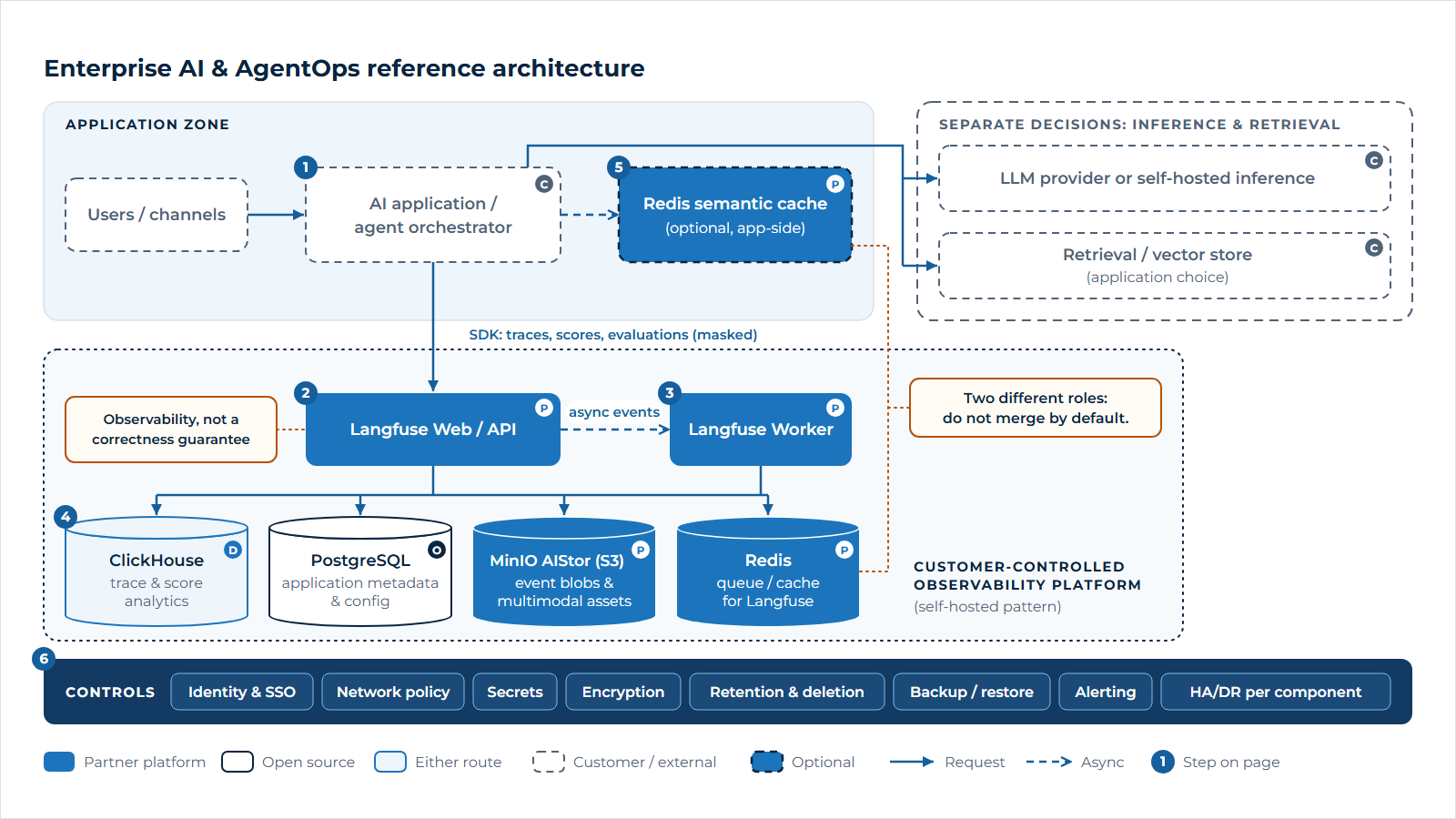
Enterprise AI & AgentOps reference architecture
TECHNOLOGY ROLES
Clear Responsibilities for Every Component.
| Component | Role in the solution | Qualification |
|---|---|---|
| Langfuse | Instrument, trace and evaluate AI applications and agents; manage prompt-related workflows | Exact features depend on the deployed version and edition |
| ClickHouse | Analytical store for Langfuse trace, observation and score data, and query serving | Do not write custom events directly into Langfuse internal tables |
| PostgreSQL | Transactional application state and configuration for Langfuse | Required in supported self-hosted patterns; needs backup and recovery design |
| Redis (or compatible) | Ingestion queue and cache for Langfuse; optionally a separate semantic cache for the AI application | Queue durability, eviction policy and sizing require design; Redis is not the durable record of AI activity |
| MinIO AIStor | S3-compatible storage for event blobs, raw and multimodal assets | Validate object-store configuration, entitlement and data residency requirements |
| AI runtime and vector retrieval | Model inference, embeddings and retrieval chosen by the application team | Not provided by the Langfuse observability platform; selected and secured separately |
USE CASES
Where AgentOps Makes the Difference.
Retrieval-augmented generation (RAG) applications
Trace retrieval and generation steps, compare retrieval settings with evaluation datasets, and monitor answer quality signals over time.

Internal knowledge assistants
Give business teams assistants built on enterprise content while tracking usage, cost and feedback, with masking for sensitive inputs.
Agent observability and evaluation
Follow multi-step agent runs across tool calls, spot loops and failures, and score outcomes against agreed criteria before and after release.
Prompt and model change control
Version prompts, run evaluations in CI/CD and compare releases so changes are promoted on evidence rather than intuition.
DESIGN & ACCEPTANCE CONTROLS
Production Readiness You Can Verify.
We turn AI governance expectations into concrete engineering checks. Thresholds are set with your teams for each application.
| Control area | What we define with you | Acceptance evidence |
|---|---|---|
| Privacy and PII handling | Masking and filtering rules for prompts, outputs and metadata; data classification | Redaction tests on representative payloads; reviewed data-flow diagram |
| Retention and deletion | Retention periods for traces, blobs and scores; deletion procedures | Retention policies configured and a deletion request tested end to end |
| Trace coverage | Which applications, agents, tools and steps must be instrumented | Coverage report against the agreed instrumentation list |
| Evaluation sets | Datasets, scoring methods and pass thresholds per use case | Baseline evaluation run recorded; thresholds documented |
| Model and prompt regressions | Release gates for prompt, model and retrieval changes | CI/CD pipeline runs evaluations and blocks releases that miss thresholds |
| LLM cost visibility | Cost attribution by application, team or tenant | Cost dashboards reconciled against provider usage reports |
| Tenant and access isolation | Projects, roles, SSO and separation between teams or tenants | Access tests confirming users see only permitted projects |
| Ingest capacity | Expected trace volume and peak load | High-throughput ingest load test on the target deployment |
| Resilience | Backup and restore for PostgreSQL, ClickHouse, Redis and object storage; upgrade path | Restore drill and upgrade rehearsal completed; rollback documented |
| Runbooks | Incident, upgrade, scaling and data-location procedures | Runbooks reviewed and walked through with the operations team |
Need an evaluation baseline before your next release?
We will help define datasets, scores and release gates.
Notice — observability is not a correctness guarantee.
Tracing, evaluation and monitoring help teams understand, measure and improve AI application behavior. They do not guarantee that model outputs are accurate, complete or free from errors, and they do not replace human review where decisions carry material risk. Langfuse is one of Bassirah’s eight Strategic Technology Partners; available features depend on the Langfuse version and edition you deploy. Customer-controlled or isolated deployment patterns are designed where supported and validated per engagement.
What Bassirah Delivers
- AI platform assessment: applications, agents, models, data sources and current telemetry.
- Langfuse deployment architecture, self-hosted or hosted where applicable, sized to the selected release.
- SDK instrumentation patterns for applications, agents and tool calls.
- Evaluation datasets, scoring approaches and CI/CD release gates.
- Privacy controls: masking, retention, access and data-location review.
- Design and operation of ClickHouse, PostgreSQL, Redis and MinIO AIStor dependencies.
- Optional semantic caching and retrieval data services, designed separately.
- Runbooks, knowledge transfer and contracted managed operations.
Why Bassirah
Bassirah brings discovery, architecture decisions, implementation services, integration validation, knowledge transfer and operational support into one managed engagement. Technology selection follows measurable workload and compliance requirements.
Production AI depends on the same disciplines as any critical platform: databases that recover, storage that is governed, and operations that are rehearsed. Our data infrastructure practice and our Langfuse partnership sit in the same team, so the observability platform and the systems underneath it are designed together.
HOW WE ENGAGE
From First Trace to Managed AI Operations.
- AgentOps Architecture WorkshopMap your AI applications, data sensitivity, deployment constraints and success measures. Output: target architecture and prioritized backlog. Consulting & Architecture →
- Instrument & EvaluateDeploy Langfuse and its dependencies in a pilot, instrument priority applications and establish baseline evaluations. Implementation & Integration →
- Harden for ProductionApply privacy, retention, access, resilience and load-test controls; integrate evaluations into release pipelines. Optimization →
- Operate & ImproveHand over runbooks and training, or engage contracted managed operations with scope agreed in the statement of work. Managed Services →
Enterprise AI & AgentOps FAQs
What is AgentOps?
AgentOps is the set of engineering and operating practices that make AI agents and LLM applications observable, measurable and manageable in production. It covers tracing, evaluation, prompt and release management, cost visibility, data protection and incident response.
Can Langfuse guarantee that AI answers are correct?
No. Langfuse helps teams trace, evaluate and monitor AI application behavior, which makes problems easier to find and fix. It does not guarantee the accuracy of model outputs. Quality depends on models, retrieval design, evaluation practice and human oversight.
Which components does a self-hosted Langfuse deployment need?
Supported self-hosted patterns use PostgreSQL for application state, ClickHouse for trace and score analytics, Redis or a compatible service for queueing and caching, and S3-compatible object storage such as MinIO AIStor for blobs. Exact requirements depend on the Langfuse release you select.
Does Langfuse provide the model or the vector database?
No. Model inference, embeddings and retrieval stores are separate choices made by the application team. Bassirah can help design them, but they are not part of the Langfuse observability platform.
How do you protect sensitive data in traces?
We design masking and filtering in the SDK and application layer, set retention and deletion policies, restrict access by project and role, and review where data is stored and whether any leaves your environment.
Is Enterprise AI an industry offering?
It is a horizontal practice. We apply it across financial services, telecommunications, government, healthcare and digital-native organizations, adapting controls to each sector’s requirements.
Related Pages
GenBI (Chat With Your Data)
Bassirah’s conversational analytics in Arabic and English, with a trust label on every answer.
Ready to Run AI Like a Production Service?
Tell us about your AI applications, data constraints and deployment model. We will design the observability, evaluation and data platform around them.