





Bassirah Technology

DATAHUB CORE · INDEPENDENT ENGINEERING

Make Enterprise Data Discoverable and Governable.

Establish a metadata catalog and operational governance foundation using DataHub Core. Bassirah connects technical metadata with ownership, glossary terms, lineage and quality context.

Independent DataHub Core engineering.

These are independent Bassirah engineering and support offerings. They do not imply upstream vendor or foundation endorsement, official vendor support rights, enterprise feature entitlement or maintenance guarantees. Commercial DataHub offerings are not part of this service.

WHY IT MATTERS

Know What Data You Have, Who Owns It and What Depends on It

Reliable discovery and lineage improve transparency, stewardship and change management across an enterprise data estate.

When analysts cannot find trusted datasets, they rebuild them. When engineers cannot see downstream dependencies, a schema change breaks a regulatory report. A metadata platform such as DataHub Core brings datasets, dashboards, pipelines, owners, glossary terms and lineage into one searchable place.

Technology is only half of the outcome. A catalog stays useful when ingestion runs reliably, ownership is assigned, and stewardship is part of how teams work. Bassirah engineers both sides.

Data team reviewing a map of data assets and their relationships

Want DataHub Ready to Run, With Quality and Master Data?

Data Quality & MDM for DataHub is a Bassirah product built on open-source DataHub, Great Expectations and Splink.

WHAT BASSIRAH DELIVERS

Independent DataHub Core Engineering and Governance Enablement

  • Platform — Deploy, secure and operate the applicable OSS DataHub architecture.
  • Ingestion — Ingest and normalize metadata from available sources and transformation tools.
  • Governance model — Configure domains, ownership, tags, glossary, lineage and access governance patterns.
  • Operating process — Connect operating processes for stewardship, quality and data product accountability.
  • Identity integration — Single sign-on through your identity provider, with roles and metadata access policies inside DataHub.
  • Ingestion operations — Scheduled, monitored ingestion with secrets handled outside recipe files and alerts on failed runs.
  • Upgrades — Release review, staging upgrades and rollback planning for DataHub and its dependencies.
  • Adoption — Search, documentation and ownership onboarding for stewards and data consumers.

ARCHITECTURE

A Catalog Is a Production System, Too

A DataHub Core deployment runs several services and depends on stateful infrastructure. We design each for availability, backup and capacity, typically on Kubernetes with Helm where appropriate.

A Catalog Is a Production System, Too
ComponentRoleBassirah design focus
Web frontend and metadata serviceUser interface, APIs and the core metadata store logicSizing, SSO, TLS, horizontal scaling
Relational databasePrimary storage for metadataBackups, replication, restore testing
Search and index clusterSearch and graph-style queries over metadataCapacity, index rebuild procedures
Messaging layerStreams metadata change events between servicesRetention, partitioning, monitoring
Ingestion frameworkPulls metadata from sources on a schedule or via pushRecipes in version control, secrets management, failure alerting
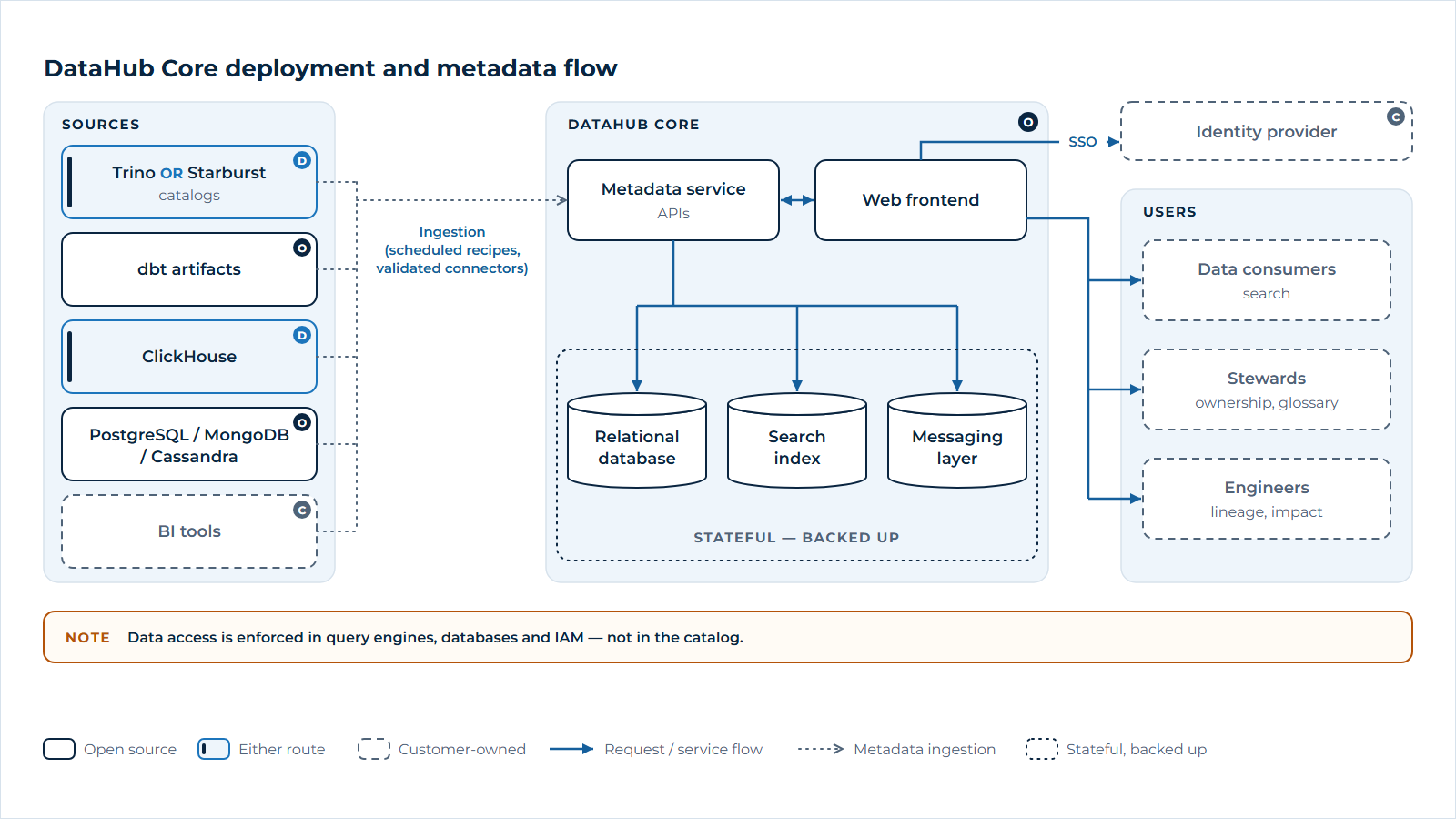
DataHub Core deployment: metadata from query engines, dbt, databases and BI tools is ingested into DataHub services backed by a database, search index and messaging layer, serving consumers, stewards and engineers, while data access remains enforced in the source platforms.

DataHub Core deployment and metadata flow

CLEAR RESPONSIBILITIES

DataHub Governs Metadata. Your Platforms Enforce Access.

DataHub Core provides metadata discovery, lineage and governance workflows, but actual data authorization is generally enforced in the connected query engines, databases and security systems. Every Bassirah design defines which system is the policy decision point and which is the enforcement point.

DataHub Governs Metadata. Your Platforms Enforce Access.
ConcernWhere it livesExample
Who may see or edit metadata in the catalogDataHub Core roles and policiesA steward may edit glossary terms in their domain
Who may query the data itselfQuery engines, databases, storage and IAMTrino access control, PostgreSQL roles, object storage policies
How classification informs access rulesDesigned process linking catalog tags to platform policiesA "restricted" tag triggers a review of engine-level rules

Not sure where your policies should be enforced?

We will map decision and enforcement points across your platforms.

USE CASES

Where DataHub Core Creates Value

Enterprise data catalog

Enterprise data catalog and asset ownership, so people can find trusted data and know who to ask.

Aerial view of a river winding through a deep valley

Impact analysis and lineage

Impact analysis and lineage for governed reporting, showing which reports and models a change will affect.

Data product discovery

Domain-oriented data product discovery, with ownership, documentation and quality context per domain.

HOW WE ROLL IT OUT

From Empty Catalog to Everyday Habit

  1. PrioritizeChoose the domains, sources and reports that matter most, and agree success measures such as ownership and documentation coverage.
  2. ConnectIngest metadata from the first sources and transformation tools through validated connectors.
  3. AssignSet owners, domains and glossary terms for priority assets, and agree stewardship responsibilities.
  4. EmbedAdd catalog checks to change processes, for example lineage review before schema changes.
  5. Expand and measureOnboard further domains and track coverage, freshness of ingestion and usage.

WORKS WITH

DataHub Core in the Wider Portfolio

Metadata from Trino/Starburst, dbt, ClickHouse, operational databases and open lakehouse sources, subject to connector support and permissions.

dbt Core & dbt OSS

Bring models, tests and model-level lineage into the catalog.

OSS

Trino OSS

Catalog datasets exposed through Trino catalogs.

OSS

Starburst

Metadata for governed federation on the partner-led route.

Strategic Partner

Data Governance & Catalog

The full governance solution, from ownership model to lineage acceptance metrics.

Solution

DataHub Core: Frequently Asked Questions

DataHub Core provides metadata discovery, lineage and governance workflows, but actual data authorization is generally enforced in the connected query engines, databases and security systems. Designs must define which system is the policy decision and enforcement point.

DataHub provides ingestion connectors for many databases, query engines, transformation tools and BI platforms. Coverage and depth vary by connector and release, so we validate each required source, including lineage behavior and permissions, before committing scope.

No. Our DataHub Core services are independent engineering and support. They do not include vendor support or commercial DataHub features.

It depends on the number of sources, security integration and the governance questions you want to answer. We agree scope, sources and success criteria up front, and size the PoC accordingly.

No. A catalog improves visibility, ownership and traceability, which supports compliance work. Regulatory obligations still depend on your controls, processes and platforms, and are validated separately.

Make Ownership and Lineage Part of Everyday Work.

Tell us about your sources, priority domains and governance goals. We will scope a workshop or proof of concept.

Data Governance & Catalog

Open Iceberg Lakehouse

Banking Fraud & Risk

Lineage

Government

Data Quality & MDM for DataHub

Bassirah’s governed DataHub catalogue with quality gates and master data management.

Related Insights