
BANKING & FINTECH SOLUTIONS
Faster Fraud Insights. Defensible Risk Decisions.
Bassirah helps financial institutions design high-volume, auditable risk data architectures that unite historical analysis, governed access and carefully engineered real-time decision support. We optimize each workload for its correctness, latency, security and audit requirements, not for a fixed vendor stack.
Redis · ClickHouse · Trino / Starburst · PostgreSQL · DataHub · dbt
THE APPROACH
Real-Time Risk Intelligence Without Sacrificing Governance.
Bring together transaction events, customer context and historical risk signals through an architecture that separates low-latency operational decisions from investigations and analytical reporting. Bassirah helps teams define where Redis, ClickHouse, Trino or Starburst, PostgreSQL, and metadata governance each belong, and where a dedicated scoring service or streaming pipeline remains essential.
Real-Time Decisioning Patterns
Architect a reliable boundary between transaction-scoring services and online feature and data access. Define latency budgets, risk-event contracts, freshness policies and fallback behavior.
Investigation & Regulatory Analytics
Use fit-for-purpose SQL engines and analytical stores for alert investigations, monitoring, trend analysis and historical reporting.
Governance and Operations
Establish source ownership, metadata visibility, lineage capture, security controls, disaster recovery tests and incident playbooks.
THE CHALLENGE
Fraud Moves Fast. Risk Data Platforms Often Don't.
Fraud and financial-crime teams need fast decisions at the transaction, deep context for investigations and evidence that stands up to audit. When one platform is asked to do all three, each job suffers.
Decision paths without a latency budget
Scoring calls depend on several data lookups, but no one owns the end-to-end budget per stage, so slowdowns are hard to locate and fix.
Analytics in the transaction path
Analytical databases and federated queries end up in the synchronous decision path, adding latency and operational risk to every payment.
Investigators working across silos
Alerts, transactions, customer data and case history live in different systems, so investigations take longer and lose context.
Weak lineage for regulatory questions
When a regulator or auditor asks how a figure or decision was produced, data ownership and lineage are hard to demonstrate.
REFERENCE ARCHITECTURE
Design Fraud Analytics Around the Decision Path.
This conceptual pattern separates real-time decisions, operational data access, investigative analytics and governed history, with explicit ownership of scoring logic, feature freshness, query performance and incident handling. Every connector, version and topology is validated in a project-specific design.
- Transaction gateway or core systemSubmits an event to a risk decision application. Approval logic and model scoring remain owned by the financial institution or its designated application.
- Fast online feature retrievalMay use Redis under strict consistency, access and expiration policies. Source-of-truth data stays in authoritative operational systems such as PostgreSQL, never in the cache by default.
- Events and historical activityFeed ClickHouse for fraud investigations, monitoring and trend analysis, outside the synchronous transaction decision path.
- Trino OSS or StarburstMay connect governed risk and history sources for exploratory and regulatory queries. Federation is kept out of latency-critical scoring.
- DataHub lineage and dbt-tested data modelsImprove analytical trust where integrated. Permissions are still enforced in the underlying systems and query access control points.
- Operational controlsCover identity, encryption, audit logging, evidence retention, monitoring, per-component recovery and incident playbooks across every layer.
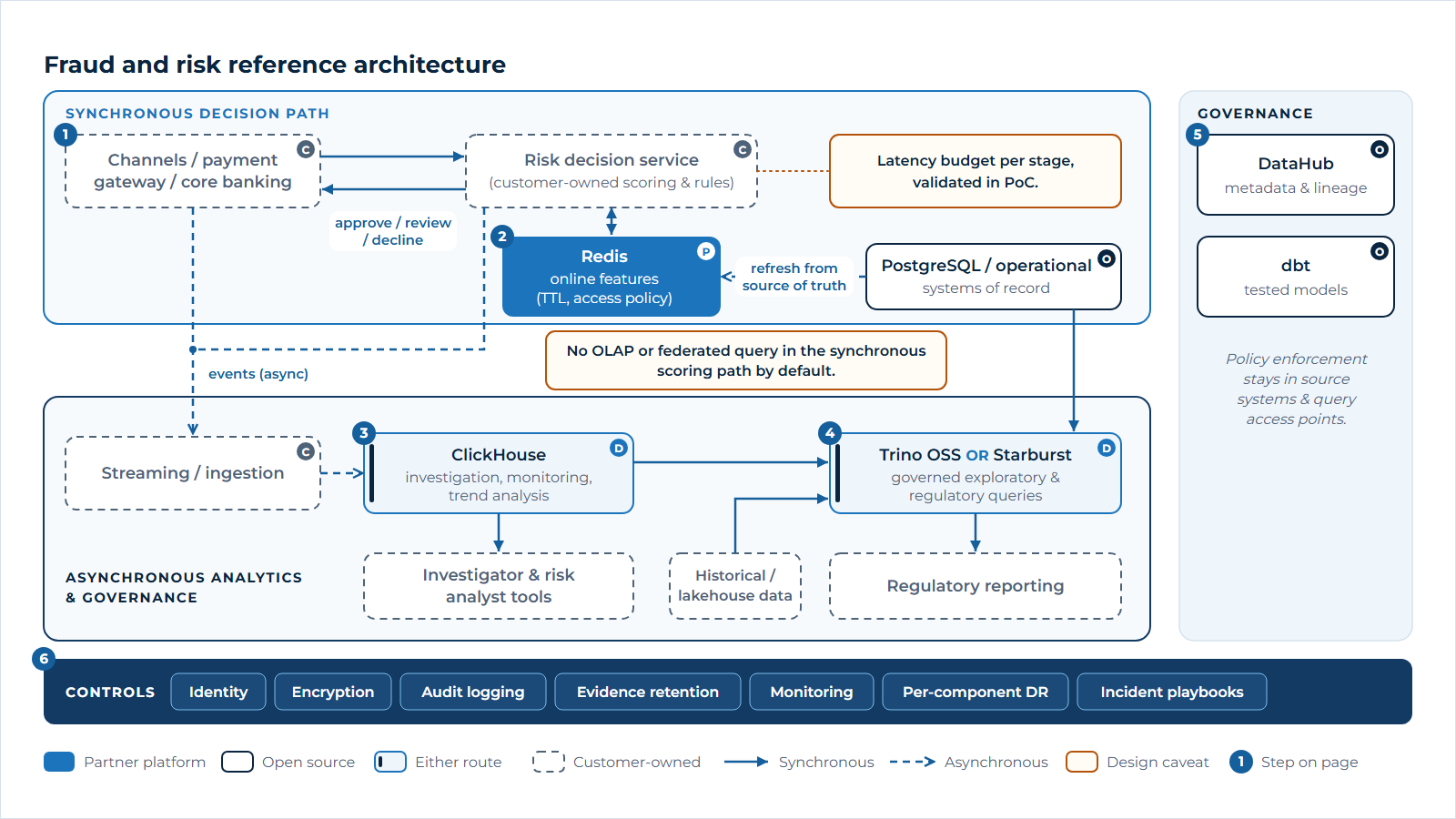
Fraud and risk reference architecture
Where does your decision path spend its time?
Start with transaction-path profiling.
TECHNOLOGY ROLES
Each Technology Has One Clear Job.
| Component | Role in the solution | Qualification |
|---|---|---|
| Risk decision service (customer-owned) | Executes scoring models and rules and returns the decision | Owned by the institution or its chosen application; Bassirah designs the data access around it |
| Redis | Online feature and context lookup for the decision service | Strict consistency, access and expiry policies; not the source of truth or a durable ledger |
| PostgreSQL and other systems of record | Authoritative customer, account and reference data | Durability, PITR and access controls designed per system |
| ClickHouse (partner · OSS) | Investigation, monitoring and trend analytics over events and history | Kept out of the synchronous decision path unless a validated design proves otherwise |
| Trino OSS or Starburst | Federated, governed access to risk, history and lakehouse sources | Alternatives per decision; avoided for latency-critical scoring |
| DataHub Core | Metadata, ownership and lineage across the risk data estate | Governance control plane; not an automatic authorization enforcement point |
| dbt Core / dbt OSS | Tested, documented models for risk marts and regulatory datasets | Adapter and version compatibility confirmed per engine |
USE CASES
Where This Architecture Helps.
Card and payment fraud decisioning
Engineer the data access around your scoring service, with latency budgets per stage and defined fallback behavior when a dependency is slow.

Alert investigation
Give investigators fast access to transaction history, related entities and prior alerts in an analytical store built for exploration.

Financial-crime and regulatory reporting
Build governed, lineage-tracked datasets for AML monitoring support, regulatory queries and internal audit.
Risk monitoring and model oversight
Track alert volumes, decision outcomes, feature freshness and data drift so risk and model teams can act early.
DEFINITION OF SUCCESS
Measurable Criteria, Agreed Before You Build.
We agree what success means for your environment and prove it in a phased PoC. Targets are set with your teams and validated on your own scoring and data-access path.
| Control area | What we define with you | Acceptance evidence |
|---|---|---|
| End-to-end risk API SLO | Service objective for the decision API | SLO documented and monitored in the PoC environment |
| Latency budget per stage | p95 and p99 budgets for each hop: gateway, feature lookup, scoring, response | Measured percentiles per stage on representative traffic |
| Decision quality | Model precision and recall measures, owned by the institution | Baseline captured; measurement method agreed with risk owners |
| Decision correctness | Correct features and versions used for each decision | Reconciliation of sampled decisions against source data |
| Feature freshness | Maximum acceptable age per feature; expiry and refresh rules | Freshness monitoring with alerts on breach |
| Fallback behavior | What happens when a dependency is slow or unavailable | Failure-injection tests showing the agreed fallback |
| Investigation turnaround | Query responsiveness and data completeness for analysts | Investigator acceptance test on agreed scenarios |
| Data drift | Drift thresholds and monitoring ownership | Drift dashboards and alert routing in place |
| Evidence retention | Retention periods and audit trail for decisions and data | Retention configured; audit retrieval test passed |
| Resilience | Per-component recovery for decision-path and analytics systems | Failover and restore drills recorded against agreed objectives |
Notice — validated per environment.
Architecture alone does not prove end-to-end latency. Latency targets are validated on the customer’s scoring and data-access path during a proof of concept. Designs are aligned to the customer’s data residency and regulatory requirements; compliance outcomes depend on the institution’s own controls and assessments. Model scoring and approval logic remain owned by the financial institution.
What Bassirah Delivers
- Fraud and risk data architecture workshop.
- Transaction-path profiling: dependencies, latency per stage and failure modes.
- Online feature-serving design with Redis, including consistency, expiry and access policies.
- Compliance-aware historical analytics design on ClickHouse and Trino OSS or Starburst.
- Lineage and governance with DataHub and tested dbt models.
- Security, audit logging and evidence-retention design.
- Per-component HA/DR design and incident playbooks.
- Phased PoC, implementation and contracted managed operations.
Your Proof Package
Each engagement produces evidence your architecture, risk and audit teams can review:
- Architecture decision record
- Target SLOs and per-stage latency budgets
- Secure data-flow model
- Phased PoC acceptance criteria
Why Bassirah
Bassirah brings discovery, architecture decisions, implementation services, integration validation, knowledge transfer and operational support into one managed engagement. Technology selection follows measurable workload and compliance requirements.
Modernizing risk data across the bank?
HOW WE ENGAGE
From Workshop to Proven Decision Path.
- Fraud Data Architecture WorkshopMap transaction flows, decision services, data sources, regulatory constraints and pain points. Output: target architecture outline. Consulting & Architecture →
- Transaction-Path ProfilingMeasure the current decision path stage by stage and agree SLOs, latency budgets and fallback rules. Optimization →
- Phased Proof of ConceptProve feature serving, investigation analytics and lineage against the agreed acceptance criteria. Implementation & Integration →
- Build & OperateImplement in phases, then hand over or run the platform under contracted managed operations. Managed Services →
Fraud & Risk Analytics FAQs
Can you guarantee a specific fraud-scoring response time?
No architecture can guarantee end-to-end latency on its own. We agree an SLO and per-stage latency budgets with you, then validate them on your scoring and data-access path during a proof of concept.
Should our analytical database sit in the transaction decision path?
Usually not. We keep ClickHouse and federated queries in the investigation and reporting lanes, and design fast, narrowly scoped feature lookups for the synchronous path. Any exception is justified by measurements.
Is Redis used as the system of record for features or balances?
No. Redis serves online features under strict consistency, access and expiry policies. Authoritative data stays in your operational systems of record.
Do you build or own the fraud scoring models?
Model scoring and approval logic remain owned by your institution or its chosen decision application. Bassirah designs and operates the data architecture around them.
How do you support regulatory and audit questions?
We design lineage with DataHub, tested models with dbt, audit logging and evidence retention, so teams can show where data came from and how datasets were produced. Compliance outcomes depend on your own controls and assessments.
Related Pages
Make Every Risk Decision Faster to Reach and Easier to Defend.
Tell us about your transaction flows, decision services and investigation needs. We will propose an architecture, success criteria and a phased PoC.