
BASSIRAH DATA INTELLIGENCE SUITE · GENBI
Chat With Your Data, in Arabic or English, and Know How Far to Trust the Answer.
GenBI is Bassirah’s conversational analytics product for banking data. Ask about payments, fraud or ingestion health the way you would ask a colleague. GenBI finds the right governed data, runs a read-only query as you, and replies with a summary, a chart and a plain account of how it got there.
Engineered by Bassirah · Runs on your infrastructure · Read-only by design

OVERVIEW
From a Question to a Number You Can Defend
GenBI is built for the questions that matter most to a payments bank, such as real-time fraud and the health of batch and streaming ingestion. It runs entirely inside your environment: questions and data are processed on your own infrastructure.
- Ask in your own wordsType a question in English, Modern Standard Arabic, Egyptian dialect or Franco-Arabic.
- GenBI picks the safest routeReviewed queries and governed metric definitions come first. The model writes its own SQL only when nothing reviewed fits.
- It queries as youA single read-only query runs under your identity, against approved governed tables only.
- You get the answer and the methodA summary, a chart, a trust label and a plain description of what was counted, over which period, grouped how.
KEY CAPABILITIES
Conversational Analytics With Governance Built In
Governed answers first
Answers come from reviewed metric definitions and verified queries before the model writes any SQL of its own, and every answer states which route it took.
Why did that change?
Compares two periods and attributes the change across banks, flags, indicators and rule versions. The attribution is computed from the data, never guessed.
Proactive alerts
Watches for seasonal spikes, agreed limits and each table’s freshness target, and raises one inbox item when something changes and one when it resolves.
Asks before it guesses
If a term is ambiguous, such as two tables sharing a name or “recently” with no window, GenBI asks. Otherwise it answers and says which reading it took.
Arabic and English
Understands Modern Standard Arabic, Egyptian dialect and Franco-Arabic, including Egyptian bank names in their different spellings, and answers in Arabic with a right-to-left interface.
Boards and reports
Save answers to boards that refresh on a schedule, share a link to an answer, export a Markdown report or publish a whole board as a Superset dashboard.
Charts and hand-off
Chooses a chart that fits the result, supports cross-filtering and export, and opens any chart in Apache Superset in one click.
Catalogue-aware
Shows what DataHub knows about the data behind an answer, including sensitivity, freshness target and lineage, and answers lineage questions straight from the catalogue.
Learns from your stewards
A thumbs-down with a corrected query becomes verified knowledge once a steward approves it, so accuracy improves with use, under human control.
Your business vocabulary
Terms such as “blocked”, “declined” or a bank’s short name are read in your organisation’s own meaning, maintained by stewards in the admin console.
Fast repeat answers
Answers are cached by access level, so the same question from someone with the same permissions returns from cache.
ANSWERS YOU CAN TRUST
Every Answer Carries a Trust Label
The label tells the reader how much to rely on an answer, so a quick exploration is never mistaken for a reviewed number.
| Trust label | How the answer was produced | Relative speed |
|---|---|---|
| Verified query | Reviewed SQL: a curated question, or one a steward approved from feedback. | Fastest |
| From DataHub lineage | Answered from the catalogue, with no query against the data. | Fastest |
| Governed metrics | Compiled by code from governed metric definitions. The model only chooses from a fixed list of options. | Fast |
| Generated, unverified | The model wrote the SQL for this question and nobody has reviewed it yet. Clearly marked on the answer. | Slowest |
Under each answer GenBI also states in plain words what it did, for example: counted HOLD alerts, fraud risk scores, last 24 hours, by sender bank, top 15.
CONTROL AND PRIVACY
Built for a Regulated Bank's Controls
Runs on your premises
A locally served language model handles generation and embeddings, so questions and data stay on your infrastructure.
Read-only by design
GenBI runs a single read-only SELECT with a row limit, only against an approved list of governed tables. Write requests and identity-lookup requests are refused before anything runs.
Knows who is asking
People sign in through Keycloak and queries run under their own identity. With a query engine that enforces grants and masking, each person sees only what they are entitled to, and the audit log names them.
Measured accuracy
A benchmark of test questions runs every night, and a regression fails the run, so answer quality is monitored rather than assumed.
Administered by stewards
An admin console manages business terms, verified queries, feedback review, model settings, question visibility by group, the benchmark, and usage by topic and person.
A record of who asked what
Every answer states its method and trust label, and the log records who asked each question.
QUESTIONS PEOPLE ASK
Real Questions From Payments, Fraud and Operations Teams
- “How many payments were put on HOLD in the last 24 hours, by sender bank?”
- “Why did the flag rate change this week?”
- “What breaks downstream if the silver payments table is late?”
- “Show me the payments that reached the review queue, and chart them by hour.”
- The same questions in Modern Standard Arabic, Egyptian dialect or Franco-Arabic.
HOW IT FITS
Built on Your Lakehouse, Not Beside It
GenBI runs on the components of an open lakehouse, so it inherits your catalogue, your access controls and your BI tools rather than copying data into a separate system.
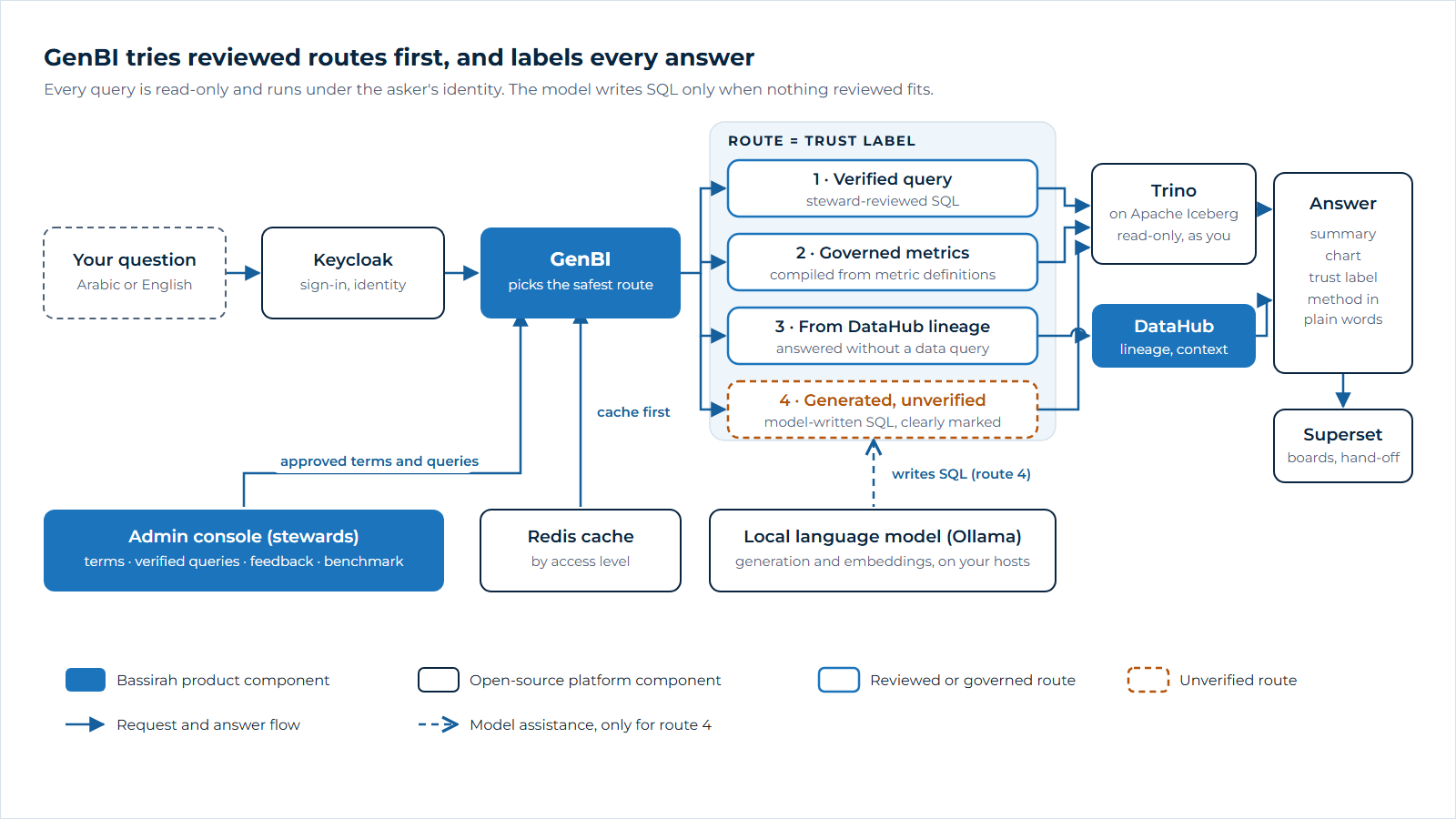
How GenBI answers a question: four routes, each with its own trust label
| Component | Role in GenBI |
|---|---|
| Language model | Qwen2.5-Coder 7B served locally through Ollama, with nomic-embed-text for embeddings |
| Query engine | Trino over Apache Iceberg tables on object storage |
| Catalogue | DataHub for lineage, sensitivity, freshness and ownership context |
| Cache | Redis, partitioned by access level |
| Identity | Keycloak sign-in with identity passthrough |
| Visualisation | Apache Superset for hand-off, boards and dashboards |
WHO BENEFITS
Answers for Every Team That Depends on Payments Data
Fraud analysts
Get from a hunch to a number quickly, and ask why a rate moved.
Operations teams
See ingestion health and freshness without waiting for an engineer.
Compliance and audit
Get answers that state their method and trust level, with a log of who asked what.
Executives
Follow boards that refresh on a schedule, in Arabic or English.
Frequently Asked Questions
Does our data leave our environment?
No. GenBI runs on your infrastructure, and the language model used for generation and embeddings is served locally, so questions and data are processed on your own hosts.
Can GenBI change or delete data?
No. It runs a single read-only SELECT with a row limit against an approved list of governed tables, and refuses write requests before anything runs.
How do we know whether to trust an answer?
Every answer carries a trust label (verified query, governed metrics, from DataHub lineage, or generated and unverified) and states in plain words what it counted, over which period and how it grouped the result.
Does it respect our access controls?
Yes. People sign in through Keycloak and queries run under their identity. Where the query engine enforces grants and masking, each person sees only the data they are entitled to.
Which languages does it support?
English, Modern Standard Arabic, Egyptian dialect and Franco-Arabic, with Arabic answers shown in a right-to-left interface.
Do we need DataHub to use GenBI?
GenBI is most useful on top of a governed catalogue, which is why we show it together with Data Quality & MDM for DataHub. The catalogue supplies lineage, sensitivity, freshness and ownership context for answers.
Ask Your Payments Data a Question
Book a demo of GenBI, shown together with Data Quality & MDM for DataHub on the same reference platform.