
BASSIRAH REFERENCE ARCHITECTURES
Enterprise Data & AI Architectures, Designed for Real-World Constraints.
Explore practical architecture patterns for real-time analytics, governed lakehouses, distributed SQL, operational databases and production AI. Each blueprint explains the problem, design choices, technology responsibilities, security and resilience controls, and a practical route to proof of concept.
Five reference patterns · Partner and open-source routes shown separately · Validated per project

ARCHITECTURE LIBRARY
Five Patterns. Clear Responsibilities. No Forced Stack.
Every pattern separates what each technology is responsible for, where the trust boundaries sit and what must be proven in your environment before anyone promises a result.

The Enterprise AI & LLMOps Stack
Observe and improve AI applications with Langfuse while designing the databases, message/queue infrastructure, object storage and inference dependencies required for enterprise operations.
LangfuseClickHousePostgreSQLRedisMinIO AIStor

Modern Telco Core & Distributed Analytics
Connect network events and CDRs to low-latency analytical stores, durable retention and federated access without assuming every data flow belongs in one system.
ClickHouseMinIO AIStorTrino OSS or StarburstRedis
Banking Fraud & Risk Data Platform
Separate real-time decisioning, fast feature lookup, analytical investigation and governed reporting while defining measurable end-to-end latency targets.
RedisClickHouseTrino OSS or StarburstDataHubdbt

Embedded Analytics for SaaS
Design high-concurrency, multi-tenant analytical applications around isolation, secure query access, cost management and latency objectives.
ClickHouseRedisPostgreSQLMongoDB Community
Open Iceberg Lakehouse
Combine AIStor Tables, Trino OSS or Starburst, dbt modeling and DataHub metadata where compatibility and operating assumptions have been validated.
MinIO AIStorTrino OSS or StarburstdbtDataHub
CONSISTENT, REVIEWABLE STRUCTURE
Every Blueprint Answers the Same Eight Questions.
Our blueprints follow one modular template so architects can compare patterns quickly and reviewers can see where assumptions end and validation begins.
- HeroThe proposition, the target personas and the next step. No benchmark appears without proof.
- ChallengeThe operational pain, data landscape and constraints specific to the industry or workload.
- Architecture overviewAn accessible diagram, the primary components, the trust boundaries and the logical data or request flow.
- Component rolesEach product’s responsibility, clearly separated, with partner and open-source classifications stated accurately.
- Design tradeoffsChoice and exclusion logic, limitations and alternatives. No forced stack and no artificial native-integration claims.
- Security & resilienceIdentity, encryption, logging, RPO/RTO, retention and egress, described as conditions to design for your environment.
- Proof & outcomesA representative measurement plan and validation checklist. No fictional case studies or generic percentage promises.
- Next stepTechnical review, proof of concept, workshop or discovery, routed to the right Bassirah team.
DIAGRAM CONVENTIONS
One Visual Language Across Every Pattern.
Every architecture diagram on this site uses the same colour key, so you can see at a glance which components are delivered through a strategic technology partner, which are supported by Bassirah as independent open-source engineering, and which remain owned by your organisation.
- Strategic technology partner — delivered within the vendor’s commercial program, where licensed capabilities and vendor-backed support may apply. Strategic Partners →
- Independent open-source / community — independent Bassirah engineering. No vendor endorsement or upstream support rights are implied. Open-Source Support →
- Partner or open-source route — the same technology can be delivered either way (for example ClickHouse, or the Trino OSS or Starburst decision). The route is chosen per project.
- Customer-owned or external — your applications, source systems, identity provider, model providers and networks. Bassirah integrates with them; it does not replace them.
- Cross-cutting controls — identity, secrets, encryption, observability, backup and DR, applied across every layer.
- Trust boundary — a dotted outline marks where data crosses a network, tenant or ownership boundary and must be authenticated, authorised and logged.
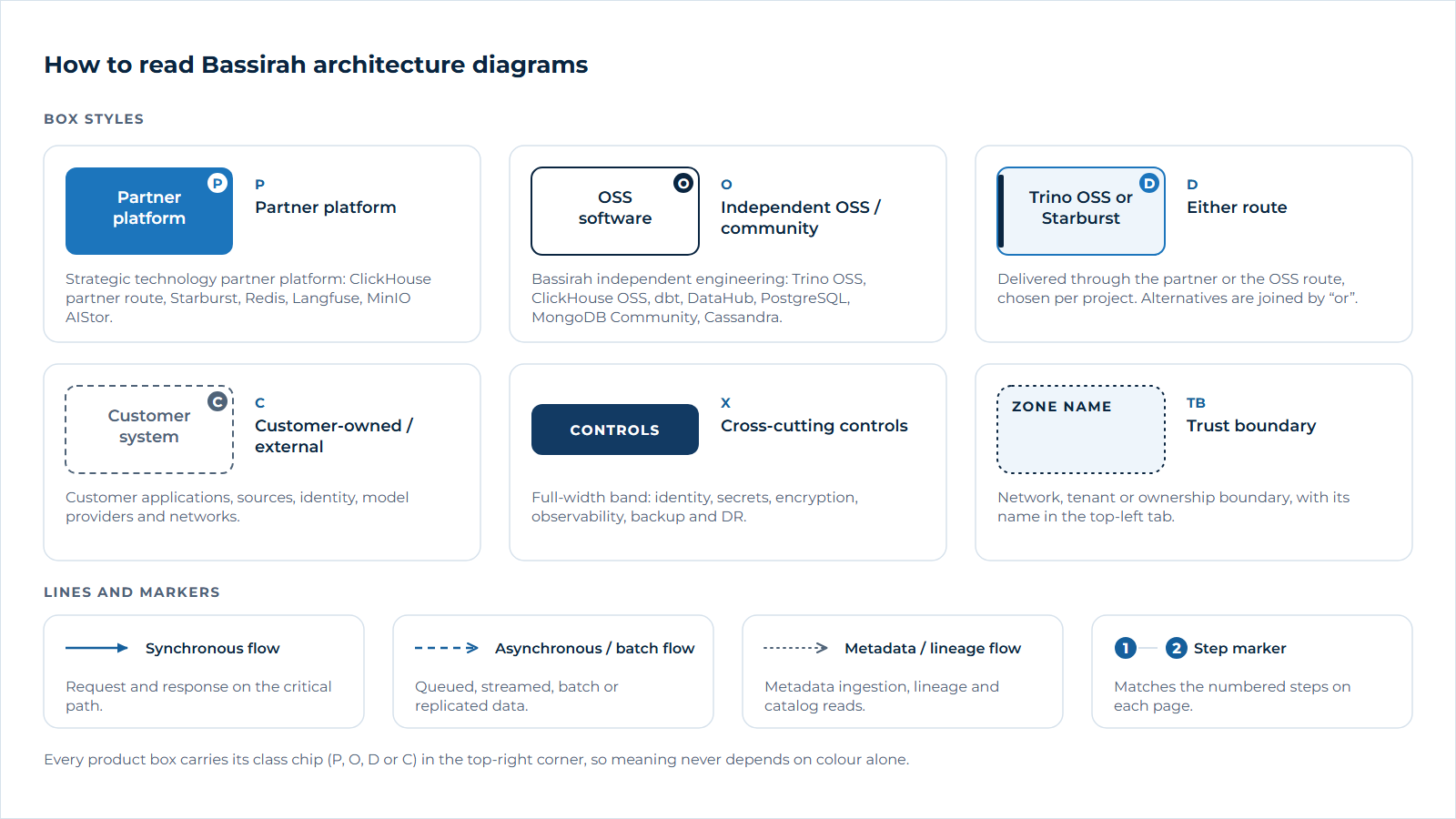
Diagram legend showing the colour and line styles used in Bassirah architecture diagrams
WHERE TO START
Match the Pattern to the Problem.
| If your main question is… | Start with | Typical industries | Related solution |
|---|---|---|---|
| How do we run LLM applications and agents in production with visibility into quality, cost and behaviour? | Enterprise AI & LLMOps Stack | Cross-industry | Enterprise AI & AgentOps |
| How do we turn CDRs and network telemetry into timely analytics without one system holding everything? | Modern Telco Core & Distributed Analytics | Telecommunications | Telecom Network Analytics |
| How do we keep the transaction decision path fast while still investigating and reporting on risk? | Banking Fraud & Risk Data Platform | Banking & Financial Services | Fraud & Risk Analytics |
| How do we serve customer-facing dashboards to many tenants securely and economically? | Embedded Analytics for SaaS | Digital Natives & SaaS | Real-Time Analytics |
| How do we build an open, portable lakehouse with governed SQL access and trusted models? | Open Iceberg Lakehouse | Government, Healthcare, cross-industry | Enterprise Lakehouse & Federation |
Not sure? Most organisations combine two patterns. An architecture review maps your workloads to the right starting point.
Running more than one of these patterns?
We will show how they share storage, identity and governance.
HOW WE PUBLISH ARCHITECTURE
Conceptual Patterns, Validated for Your Environment.
Conceptual pattern. Connectors, licensed capabilities, versions, security policies and topology are validated in a project-specific architecture.
- Roles before products. Each technology is shown with the responsibility it is good at, and where it should not be used.
- Partner and open-source routes kept separate. Trino OSS and Starburst are alternatives within a federated-query decision. ClickHouse OSS and partner-led ClickHouse are different support propositions.
- No unproven numbers. Latency, throughput and cost outcomes are measured in a proof of concept against your workload, not promised on a web page.
- Reviewed and versioned. Every blueprint shows its last review date and the software versions in scope, and is re-checked quarterly or after a breaking upstream change.
ENGAGEMENT OPTIONS
Turn a Blueprint Into a Decision.
Use a blueprint as the starting point for a focused conversation with Bassirah architects.
Architecture Review
Map a blueprint to your current stack, constraints and operating model, and leave with a documented target architecture.
Proof of Concept
Agree acceptance criteria, then measure the pattern against a representative workload in your environment.
Implementation & Integration
Deploy, integrate and harden the selected components with documented runbooks and knowledge transfer.
Managed Operations
Operate the resulting platform with defined responsibilities, monitoring and incident procedures.
Architecture Blueprint FAQs
Are these blueprints ready-made products?
No. They are conceptual reference patterns. Each one shows component responsibilities, data flows and controls. Connectors, licensed capabilities, software versions, security policies and topology are validated in a project-specific architecture before anything is built.
Do I have to use every technology shown in a blueprint?
No. Components are shown with their responsibilities so you can include, replace or exclude them. Many organisations already run part of a pattern and add only the missing layers. Each blueprint’s design-tradeoffs section explains when a component is not the right fit.
Why do some blueprints show "Trino OSS or Starburst"?
Both provide distributed SQL. Starburst is a commercial Trino-based platform delivered as a strategic partner solution, with licensed capabilities and vendor support. Trino OSS is supported independently by Bassirah. They are alternatives within one federated-query decision, unless a phased coexistence is deliberately planned.
Can you publish performance or cost figures for these patterns?
Only after they have been measured. Latency, throughput and cost depend on your workload, data model, hardware and network. Each blueprint includes a measurement plan so these numbers can be established in a proof of concept rather than assumed.
How current are the blueprints?
Each page shows a “Last reviewed” date and the version scope it was written against. Pages are reviewed quarterly and after significant upstream releases, licensing changes or partner-status changes.
Related Pages
Bring Your Constraints. We Will Bring the Pattern.
Share your workloads, data volumes, security requirements and current platforms. We will map them to a reference architecture and a practical proof-of-concept plan.