



Bassirah Technology

STRATEGIC TECHNOLOGY PARTNER · MINIO AISTOR

Build an AI-Ready Enterprise Data Foundation.

Use MinIO AIStor to support object and AI data workloads with performance, governance and open-data architecture in mind. Bassirah designs the storage layer as part of the complete platform.

MinIO is one of Bassirah’s Strategic Technology Partners for MinIO AIStor. Our relationship is subject to the applicable MinIO program and agreement. Implementation scope, resell rights and support entitlements are confirmed in each customer engagement. AIStor capabilities are matched to the customer’s license and deployed release.

WHY MINIO AISTOR

The Storage Layer Your Data and AI Platforms Depend On

Establish scalable S3-compatible access and, where product and architecture requirements align, an Apache Iceberg-based lakehouse foundation.

AI and analytics platforms are only as dependable as the storage beneath them. Training datasets, model artifacts, lakehouse tables, logs and long-term analytical history all need durable, secure and well-governed storage that many engines can reach through a common interface.

MinIO AIStor is MinIO’s commercial object storage platform for AI and data workloads, built around S3-compatible access. Where the selected release and table interface support it, AIStor can also provide native Apache Iceberg table services for open lakehouse designs. Bassirah designs AIStor as part of the complete platform: capacity and network, data protection, access policies, and the query engines, catalogs and pipelines that use it.

  • One S3-compatible storage foundation for AI, analytics and retention workloads.
  • Open table formats that keep data portable across compatible engines.
  • Customer-controlled or isolated deployment patterns where supported.
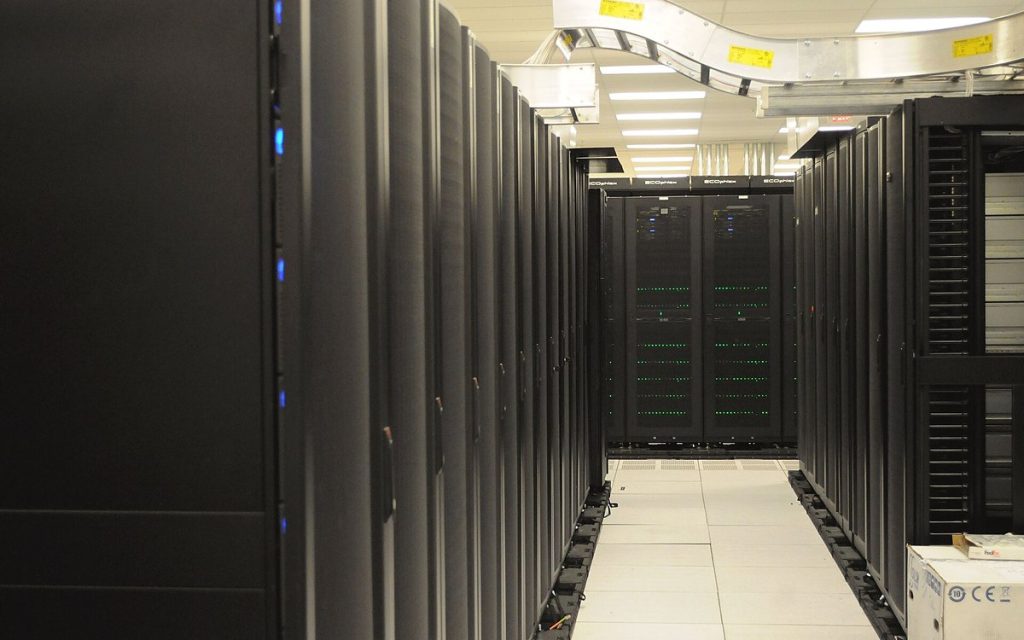
Long aisle between rows of black server racks in a brightly lit data center

WHAT BASSIRAH DELIVERS

From Capacity Planning to an Open Data Foundation

Our AIStor engagements treat storage as an engineered platform, not a commodity purchase.

  • Assess storage capacity, network, namespace and data lifecycle requirements.
  • Design access policies, encryption, data protection and multi-site resilience.
  • Integrate compatible query engines, catalogs and ingestion pipelines.
  • Size hardware, drives and network for throughput, capacity growth and failure tolerance.
  • Design bucket structure, tenancy, identity integration and least-privilege policies.
  • Configure lifecycle rules, versioning and immutability where retention requirements call for them.
  • Prepare monitoring, expansion procedures, upgrade plans and operational runbooks.

USE CASES

Where MinIO AIStor Fits

Solution concepts. Each design is validated against your workload.

Illustration of training data flowing from storage into an AI training cluster

AI training and inference data and model artifacts

Store and serve datasets, checkpoints, feature files and model artifacts for AI pipelines running on your infrastructure.

Lakehouse object and structured data foundation

Hold raw files and curated Apache Iceberg tables that Trino OSS or Starburst can query, where integrations are validated.

Enterprise analytic data retention and sharing

Retain analytical history, logs and telemetry durably, and share governed datasets across teams and engines.

ARCHITECTURE DISCIPLINE

The Decisions Behind a Dependable Storage Foundation

Object storage outcomes depend on infrastructure and policy design. We document each decision and test it before production.

Throughput and capacity targets are defined with you and validated against your workload. We do not publish generic performance figures.
Design areaWhat we decideHow we validate
Capacity and layoutNodes, drives, data protection settings and expansion approachCapacity model at target retention and growth
Network and throughputNetwork bandwidth, client concurrency and workload separationThroughput test with representative object sizes
Access and identityIdentity provider integration, bucket policies, service accounts and tenancyAccess tests for each role
Encryption and keysEncryption at rest and in transit, key management integrationKey rotation and recovery rehearsal
Lifecycle and retentionVersioning, lifecycle rules, immutability where requiredPolicy tests on sample datasets
ResilienceReplication between sites, failure-domain design, recovery objectivesSite or node failure drill with agreed RPO and RTO

OPEN DATA ARCHITECTURE

From Objects to Governed Iceberg Tables

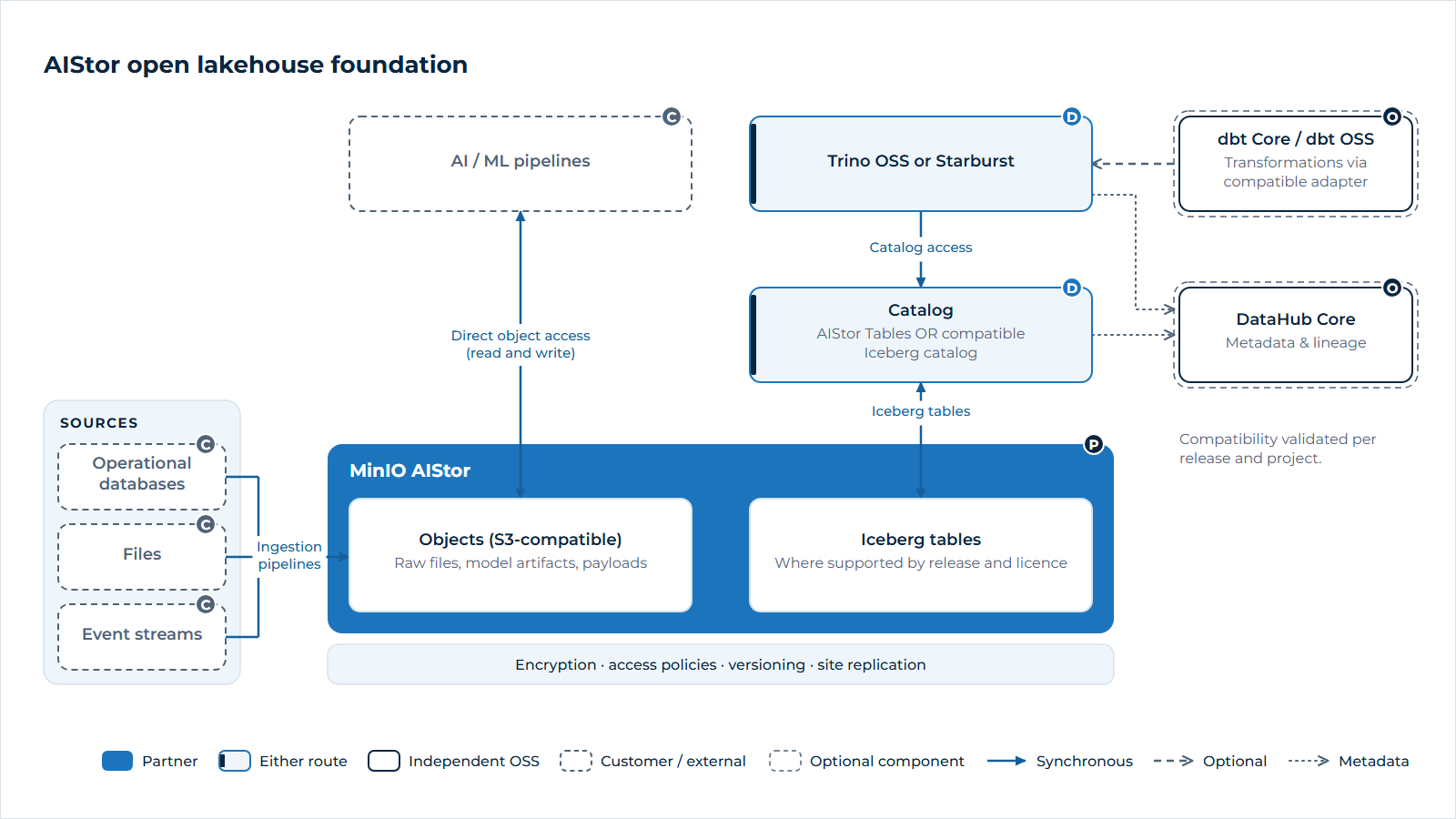
Data from databases, files and event streams lands in MinIO AIStor as objects and Iceberg tables; a catalog exposes the tables to Trino OSS or Starburst, AI pipelines read and write objects directly, and dbt Core / dbt OSS and DataHub Core add transformations and metadata.

AIStor open lakehouse foundation

Many lakehouse designs combine raw object storage with Apache Iceberg tables, a catalog, a SQL engine, transformation tooling and a metadata platform. AIStor can serve as the object and, where supported by the selected release, native Iceberg table foundation for that design. Bassirah validates every connection: the catalog interface, authentication, engine version and feature behavior.

  1. LandLand approved datasets from operational platforms, files or event streams into customer-controlled object storage.
  2. OrganizeOrganize curated data as Apache Iceberg tables using AIStor table services or a compatible catalog, as supported.
  3. QueryQuery permitted tables with Trino OSS or Starburst through supported catalog mechanisms.
  4. TransformTransform and test models with dbt Core or dbt OSS where compatible adapters exist.
  5. CatalogCapture metadata, ownership and lineage in DataHub Core. Data authorization stays enforced in the query engine, storage or adjacent control points.

Iceberg table services, catalog interfaces and engine interoperability vary by AIStor release and license. Bassirah confirms compatibility in a project-specific architecture before relying on it.

Planning an open lakehouse?

We will validate AIStor, catalog and query-engine compatibility for your target design.

WORKS WELL WITH

MinIO AIStor in an Integrated Platform

Trino OSS or Starburst

SQL over supported lakehouse tables, through the partner-led or independent OSS route.

Starburst → · Trino OSS →

dbt Core / dbt OSS

Transformations and data tests over lakehouse tables, where adapters support the engine.

DataHub Core

Metadata, ownership and lineage for lakehouse datasets.

Langfuse

Object storage for AI telemetry payloads and retention patterns.

SEE IT IN CONTEXT

Where MinIO AIStor Fits in Our Reference Blueprints

Open Iceberg Lakehouse

AIStor for objects and, where supported, native Iceberg tables, with Trino OSS or Starburst, dbt Core / dbt OSS and DataHub Core.

Modern Telco Core & Distributed Analytics

Durable history: raw files and curated Iceberg tables for network data.

Enterprise AI & LLMOps Stack

S3-compatible storage for Langfuse event payloads and multimodal assets.

HOW WE ENGAGE

A Clear Path From Design to Operations

  1. Foundation workshopReview data types, volumes, growth, workloads, consumers and residency requirements. Example deliverables: Requirements and non-functional requirements summary.
  2. DesignDefine topology, data protection, network, security, lifecycle and integrations; confirm entitlement scope. Example deliverables: Architecture decision record, capacity model, reference design.
  3. ValidateTest throughput, failure tolerance and engine or catalog integrations. Example deliverables: Validation report with measured results.
  4. ImplementationDeploy, secure and integrate with identity, key management, monitoring and pipelines. Example deliverables: Working deployment, test results, runbooks.
  5. Operate and expandHand over, or continue with contracted managed support, capacity reviews and upgrades. Example deliverables: Expansion plan, operational handover, improvement backlog.

MinIO AIStor: Frequently Asked Questions

MinIO AIStor is MinIO’s commercial object storage platform for AI and data workloads, with S3-compatible access. Depending on the release and license, it also offers additional capabilities such as native Apache Iceberg table services. Bassirah matches capabilities to your entitlement and deployed release.

Trino OSS and Starburst provide connectors for S3-compatible storage and Apache Iceberg tables. The exact AIStor configuration, catalog, network setup and connector compatibility must be validated in the target architecture.

No. Object storage holds files, objects and table data for engines to read. Transactional workloads still need an operational database, and low-latency analytical serving may need an engine such as ClickHouse. AIStor provides the durable foundation beneath them.

AIStor is designed to run on infrastructure you control. Isolated deployment patterns are designed and validated per engagement, including dependencies, license activation requirements, upgrade paths and telemetry egress.

We design encryption at rest and in transit with your key management system, least-privilege access policies, versioning and immutability where required, replication between sites and tested recovery procedures.

Features depend on the AIStor release you deploy and the license you purchase. We confirm entitlement during design and do not plan around capabilities that are not included.

Continue Exploring

Enterprise Lakehouse & Federation

The solution where AIStor provides the storage layer.

Starburst

Partner-led SQL over lakehouse tables.

HA/DR & Platform Reliability

Resilience across storage, catalogs and engines.

All Strategic Partners

Explore the full partner portfolio.

Related Insights

Build the Foundation Your AI and Analytics Depend On.

Tell us about your data, workloads and resilience requirements. We will help you design and operate the right AIStor architecture.