





Bassirah Technology

STRATEGIC TECHNOLOGY PARTNER · REDIS

Accelerate Real-Time Applications and AI Context.

Build responsive experiences and low-latency access patterns with Redis, guided by careful architecture, memory sizing, high availability and security.

Redis is one of Bassirah’s Strategic Technology Partners. Our relationship is subject to the applicable Redis program and agreement. Implementation scope, resell rights and support entitlements are confirmed in each customer engagement.

WHY REDIS

Fast Access Where Every Interaction Counts

Use Redis for caching, transient application state, messaging patterns and AI workloads where low-latency access is material.

Redis is an in-memory data platform. Keeping frequently accessed data in memory lets applications serve sessions, lookups, counters and cached results quickly, and reduces load on the databases behind them. Redis also supports data structures for queues, streams and pub/sub messaging, and search and vector capabilities for AI use cases, depending on the version and edition deployed.

Speed in memory comes with design choices. Memory is finite and more expensive than disk, persistence and replication settings affect durability, and cache invalidation affects correctness. Bassirah makes these tradeoffs explicit and designs Redis as one part of a complete application and data architecture.

  • Designed for low-latency workloads, validated against your performance targets.
  • Reduced pressure on systems of record through deliberate caching patterns.
  • High availability, security and recovery planned from the start.
Person with a backpack using a smartphone, face out of frame

WHAT BASSIRAH DELIVERS

From Access Patterns to Resilient Operations

Our Redis engagements cover architecture, application integration, performance and operational readiness.

  • Assess caching, persistence and data consistency tradeoffs.
  • Design security, scaling, clustering, monitoring and application integration.
  • Tune performance and evaluate vector search or semantic caching where relevant.
  • Prepare operational recovery, capacity and incident runbooks.
  • Model memory requirements from key counts, value sizes, data structures and growth.
  • Define key naming, expiration (TTL) and eviction policies that match each use case.
  • Integrate access control lists, TLS, network isolation and secrets management.
  • Plan high availability and, where the selected edition supports it, multi-region topologies.

USE CASES

Where Redis Delivers Value

Solution concepts. Each design is validated against your workload.

Digital channel session and cache acceleration

Keep mobile and web channels responsive by caching sessions, profiles and frequently requested data in front of core systems.

Low-latency personalization and API backends

Serve feature lookups, rate limits, counters and personalization data to APIs with predictable access patterns.

Vector search and AI context integration

Store embeddings and retrieve context for AI applications, or cache repeated responses, where Redis suits the workload.

ARCHITECTURE DISCIPLINE

The Decisions Behind a Reliable Redis Platform

Redis is simple to start and demanding to run at scale. We document each decision and test it before production.

Latency targets are defined with you and measured in a proof of concept. We do not publish generic latency figures.
Design areaWhat we decideHow we validate
Role of RedisCache, session store, queue, feature store or vector index, and which system remains the source of truthData-flow review with application owners
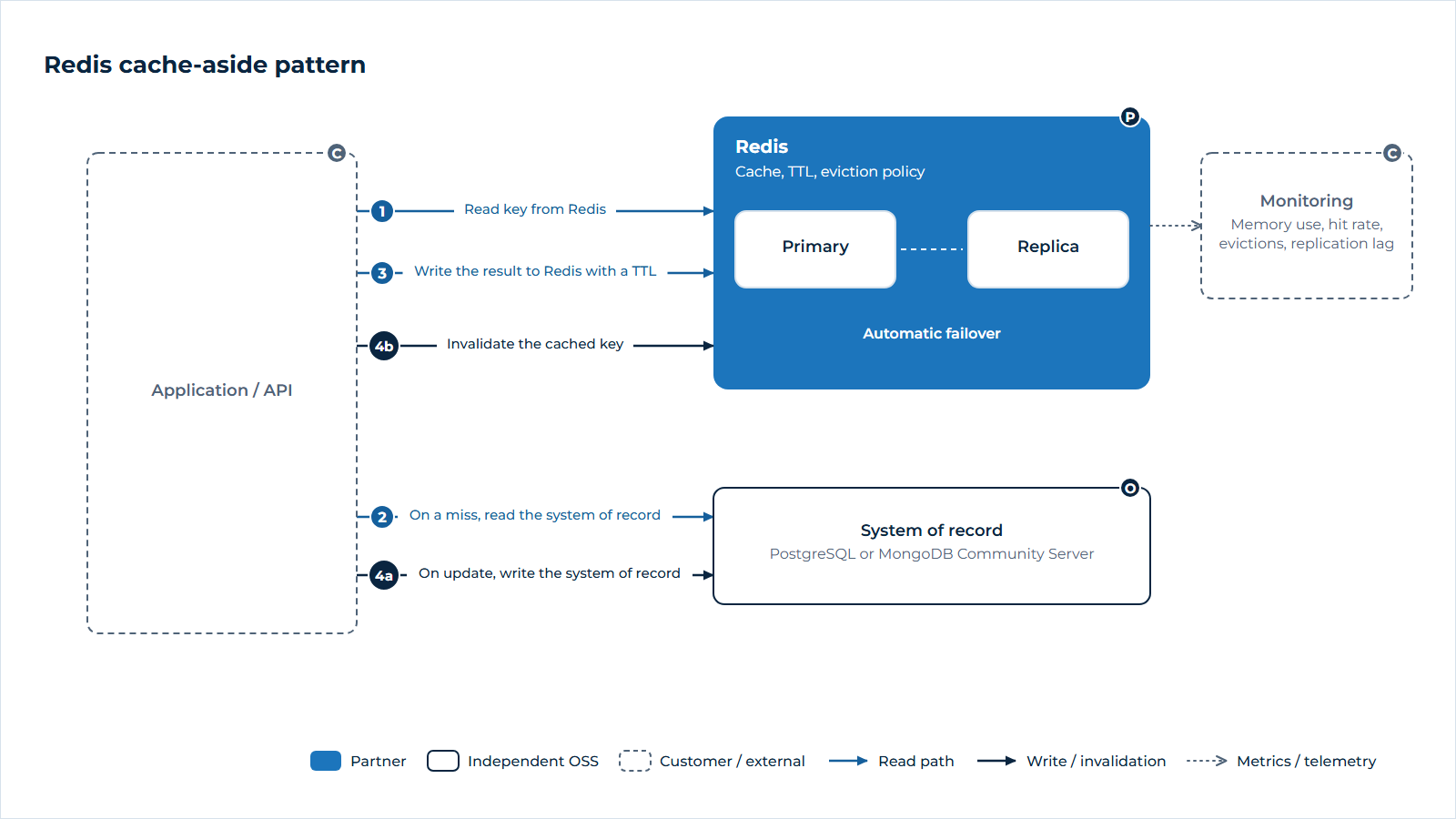
Caching patternCache-aside, write-through or read-through; invalidation and expiration rulesFreshness and correctness tests on stale data scenarios
DurabilityPersistence mode (snapshots, append-only log or none) per datasetRestart and recovery tests against agreed data-loss tolerance
Memory and evictionMemory limits, eviction policy, data structure choiceLoad test at projected key counts and growth
Availability and scaleReplication, failover, clustering and sharding strategyNode failure and failover drills
SecurityAuthentication, access control lists, TLS, network segmentationConfiguration review and access tests
Cache-aside pattern: the application reads from Redis, falls back to the system of record on a miss, stores the result in Redis with an expiry, and on an update writes the system of record first (4a) and then invalidates the cached key (4b).

Redis cache-aside pattern

Is your cache helping or hiding a problem?

We will review your Redis design, memory use and failover behavior.

AI CONTEXT

Fast Context for AI Applications, Used Where It Fits

Illustration of vector embeddings being retrieved as context for an AI application

AI applications often need quick access to context: conversation state, user features, retrieved documents or previously computed answers. Redis can store and query vector embeddings and serve as a semantic cache for repeated prompts, depending on the version and edition deployed. Bassirah evaluates whether Redis is the right retrieval layer for your data volumes, filtering needs and update patterns, or whether a different store is a better fit.

  • Vector search for retrieval-augmented generation, where the dataset and query patterns suit it.
  • Semantic caching to reduce repeated model calls, with explicit freshness rules.
  • Short-term agent and session memory with clear expiration policies.

A Redis semantic cache or vector index for your AI application is separate from the Redis queue and cache that a self-hosted Langfuse deployment requires. We design and size them as distinct components.

WORKS WELL WITH

Redis in an Integrated Platform

ClickHouse

Analytical history and investigation behind fast operational lookups.

Langfuse

LLM quality telemetry for the AI applications Redis helps serve.

PostgreSQL

Durable relational system of record behind Redis caches.

MongoDB Community Server

Durable document store for operational data (source-available, SSPL).

SEE IT IN CONTEXT

Where Redis Fits in Real Architectures

Banking Fraud & Risk Data Platform

Fast online feature retrieval under strict consistency, access and expiration policies.

Embedded Analytics for SaaS

Bounded, invalidatable result caching where measurements justify it.

Enterprise AI & LLMOps Stack

Langfuse queue and cache, plus an optional, separate semantic cache.

Modern Telco Core & Distributed Analytics

Narrowly scoped caching and fast lookups with freshness rules.

HOW WE ENGAGE

A Clear Path From Assessment to Production

  1. Architecture discussionReview application access patterns, data sources, consistency needs and current caching approach. Example deliverables: Use-case and requirements summary.
  2. DesignSelect edition and topology; define data structures, persistence, eviction, security and HA. Example deliverables: Architecture decision record, memory sizing model.
  3. Performance validationLoad-test representative traffic against agreed latency and throughput targets. Example deliverables: PoC report with measured results against agreed criteria.
  4. ImplementationDeploy, secure and integrate with applications and monitoring. Example deliverables: Working deployment, test results, runbooks.
  5. Operate and optimizeHand over, or continue with contracted managed support, capacity reviews and tuning. Example deliverables: Capacity plan, incident runbooks, optimization backlog.

Redis: Frequently Asked Questions

Redis is not a general substitute for a durable relational or document database. It can persist data, but persistence, recovery and consistency behavior must be validated against your requirements. In most enterprise designs, PostgreSQL, MongoDB Community Server or another system remains the source of truth, and Redis accelerates access.

We define a caching pattern and invalidation strategy for each dataset, including expiration (TTL) values, update triggers and acceptable staleness. We then test freshness and correctness scenarios before production.

Behavior depends on the configured memory limit and eviction policy: Redis either evicts keys according to the policy or rejects writes. We size memory from measured data, choose the policy per use case and set alerts well before limits are reached.

Yes, depending on the Redis version and edition deployed. We evaluate whether Redis fits your embedding volumes, filtering needs and update patterns, and compare it with alternative retrieval stores where relevant.

We design replication, automatic failover and clustering appropriate to the selected edition, place replicas across failure domains and test failover. Multi-region or active-active topologies are designed only where the edition and contract support them.

We implement the Redis offering that fits your requirements and agreement. Edition, licensing and support entitlements are confirmed in each engagement. Bassirah does not promise edition-specific features until the entitlement is confirmed.

Continue Exploring

Real-Time Analytics

Redis alongside ClickHouse for fast analytical experiences.

Enterprise AI & AgentOps

Production AI with observability and context services.

Operational Database Modernization

Durable stores that Redis accelerates.

All Strategic Partners

Explore the full partner portfolio.

Related Insights

Design Redis Around Your Applications and Access Patterns.

Tell us about your applications, traffic patterns and resilience requirements. We will help you design and operate the right Redis architecture.