







Bassirah Technology

METABASE OPEN SOURCE · INDEPENDENT ENGINEERING

Self-Hosted Metabase, Ready for Production.

Deploy, secure and operate Metabase Open Source Edition on infrastructure you control, from a PostgreSQL application database to rehearsed upgrades on the long-term support releases.

Independent Metabase engineering.

These are independent Bassirah engineering and support offerings for Metabase Open Source Edition. They do not imply vendor endorsement, official vendor support rights, Pro or Enterprise feature entitlement, licenses or maintenance guarantees.

Metabase is a trademark of Metabase, Inc. Bassirah is not a partner of Metabase, Inc.

Editions are distinct.

Metabase Open Source Edition is offered under the GNU Affero General Public License (AGPL). Metabase Pro and Enterprise run the Enterprise Edition, which is source available but released under the Metabase Commercial Software License; its features need a commercial license from Metabase, Inc. Metabase Cloud is a hosted service run by Metabase, Inc. Bassirah works with the Open Source Edition and does not sell, license or unlock Pro or Enterprise features.

Supported releases.

Metabase is developed by Metabase, Inc. and its community. Bassirah provides independent engineering for the Metabase 64 and Metabase 58 long-term support (LTS) releases of the Open Source Edition, and plans upgrades for instances on standard releases and on releases past end of life. The exact versions in scope are named in each statement of work. Last reviewed: 26 October 2026.

Release information from the Metabase version support page and the metabase/metabase GitHub releases, accessed 26 October 2026. Metabase states that every release receives bug fixes and security updates until its end-of-life date, that LTS releases are supported for 14 months, and that other releases usually reach end of life after 2 months. Metabase, Inc. sets these dates; Bassirah does not extend them.
ReleaseStatus on 26 October 2026How Bassirah treats it
Metabase 65 (standard)Beta: v0.65.0-beta published 13 October 2026; end of life listed as January 1, 2027Upgrade testing in staging only, until a stable release is published
Metabase 64 (LTS)Released September 16, 2026 (first stable v0.64.1 on GitHub, 7 October 2026); end of life December 1, 2027Default target for new deployments and upgrades
Metabase 63 (standard)End of life November 1, 2026Upgrade planning to Metabase 64 LTS now
Metabase 58 (LTS)Released December 17, 2025; end of life February 17, 2027Supported, with an upgrade plan to Metabase 64 before its end of life
Metabase 59 to 62, and 57 or earlierEnd of life (September 1, 2026 for 59 to 62; May 31, 2026 for 54 to 57)Upgrade assessment: no further updates from Metabase

WHY IT MATTERS

Quick to Start. Worth Engineering Before It Matters.

Metabase lets people explore data with point-and-click questions or SQL and share the results as dashboards, on top of the databases you already run. The Open Source Edition is self-hosted and free to use under the AGPL.

That speed of setup hides some production decisions. Out of the box, Metabase stores its users, questions, dashboards and collections in an embedded H2 application database, which the Metabase documentation says to avoid in production. Production needs a separate application database such as PostgreSQL, backups and restore tests, an encryption key for stored connection details, and upgrades that follow the release lifecycle. Bassirah sets up and documents those parts, so a tool that started as a quick win can be relied on.

Abstract illustration of questions and dashboards built on one application database

WHAT BASSIRAH DELIVERS

Independent Metabase Engineering and Operations

  • Assessment and architecture — Review how Metabase is used and run today, then design the deployment, application database, networking and identity integration.
  • Production deployment — Deploy the Open Source Edition from the official JAR or container image, pinned to an exact version, with configuration under version control.
  • Application database — Set up PostgreSQL as the application database, or migrate an existing H2 instance to it with the documented load-from-h2 process.
  • Security — Least-privilege service accounts for each data source, an encryption key for stored connection details, TLS and network controls.
  • Upgrades — Plan and rehearse upgrades onto LTS releases, with an application database backup and a rollback decision point before every change.
  • Data sources and performance — Connect and test the databases Metabase queries, and work with your data team on the models and queries behind slow dashboards.
  • Embedding design — Help you understand which embedding options the Open Source Edition and its license allow, and design guest embeds where they fit.
  • Troubleshooting and managed support — Incident troubleshooting, health reviews of existing instances and, where you want it, contracted operations under an agreed scope.

FIT FIRST

Two Open-Source BI Tools, Different Trade-Offs

Our BI & Visualization practice supports both Metabase and Apache Superset. Neither is the right answer for every team. We compare them against your users, data sources, skills and license requirements, and we recommend the one that fits.

Two Open-Source BI Tools, Different Trade-Offs
ConsiderationMetabase Open Source often fits when…Apache Superset often fits when…
Who builds the questionsBusiness users explore with point-and-click questions, and analysts add SQL where neededAnalysts and engineers work mostly in SQL and curated datasets
Operating footprintYou want a single application (JAR or container) plus an application databaseYou can operate a web tier with a metadata database, cache, Celery workers and a scheduler
Data sourcesYour databases are among Metabase's officially maintained driversYou need a database reached through a Python DB-API driver and SQLAlchemy dialect
LicenseThe AGPL, or the embedding license terms, suit how you deploy and embed itYou prefer the Apache License 2.0 of an Apache Software Foundation project
Features you needYour needs are met without the Pro or Enterprise features, or you will license them from Metabase, Inc.You will design roles and row level security in the open-source product yourselves

Compare with our Apache Superset engineering page. License fit is a legal question: review the AGPL, the Metabase license page and your embedding plans with your own counsel before choosing.

PRODUCTION ARCHITECTURE

The Parts a Production Metabase Depends On

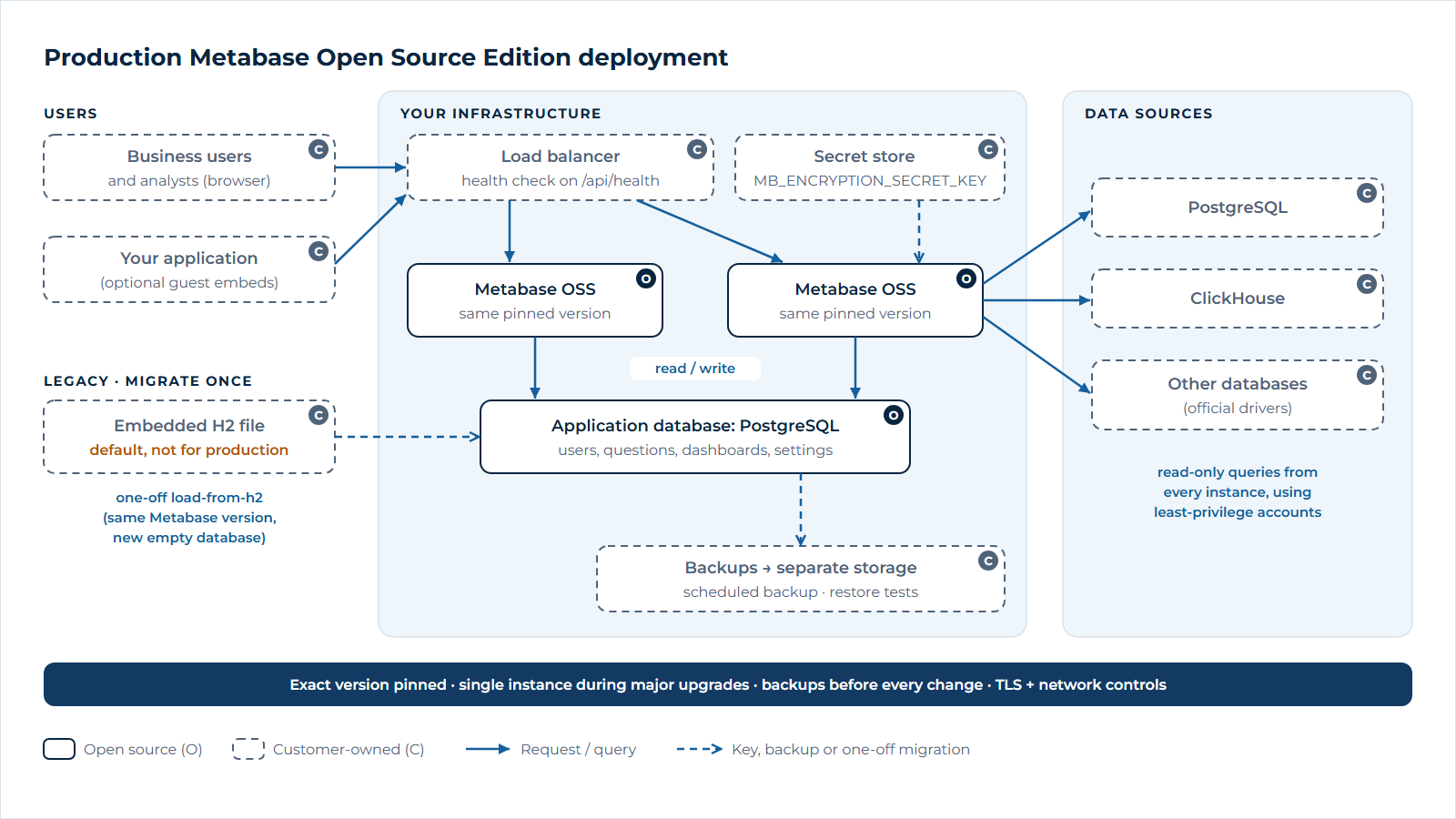
Metabase keeps all of its runtime application data in a single SQL database, separate from the databases it queries. In production that application database should be PostgreSQL, MySQL or MariaDB, not the embedded H2 file. Several Metabase instances of the same version can share one application database behind a load balancer. We design each part for your environment, then prove backups and restores in tested recovery exercises against objectives you approve.

The Parts a Production Metabase Depends On
ComponentRoleWhat we decide with you
Metabase Open Source EditionServes questions, dashboards and the admin interfaceOfficial JAR or container image, pinned to an exact version; the documentation advises against mutable .x tags in production
Application databaseStores users, questions, dashboards, collections and settingsPostgreSQL in a supported version, with backups, restore tests and access limited to Metabase
Encryption keyEncrypts stored connection details for data sourcesMB_ENCRYPTION_SECRET_KEY held in a secret store, with a recorded rotation procedure; losing it means re-entering every connection
Load balancer (optional)Spreads users across several instancesHealth checks on /api/health, and a single instance during major upgrades
Data sourcesThe databases Metabase queriesOfficially maintained drivers where possible, least-privilege read accounts and tested versions
Production Metabase deployment: users and an optional embedding application reach Metabase Open Source instances of the same pinned version through a load balancer. The instances share a PostgreSQL application database that is backed up to separate storage, read the encryption key from a secret store, and query PostgreSQL, ClickHouse and other databases with read-only accounts. An embedded H2 file is migrated once to PostgreSQL with load-from-h2.

Production Metabase Open Source Edition deployment

OPERATIONS

Run Metabase Like a Production Service

Abstract illustration of an application database with backups

Application database care

Back up the application database on a schedule, test restores and keep the H2 file from any migration until the new setup is proven.

Abstract illustration of a staged upgrade path

Upgrades on the LTS releases

Track end-of-life dates, rehearse each upgrade in staging, scale to a single instance for major upgrades and keep a tested backup to roll back to.

Abstract illustration of protected credentials for data sources

Secrets and access

Manage the encryption key and data-source credentials in a secret store, with read-only accounts scoped to what each team needs.

Abstract illustration of monitoring panels for an analytics service

Monitoring

Instance health, application database health and slow dashboards, with alerts that reach the people who can act.

MIGRATION

Move Metabase From H2 to PostgreSQL Without Losing Content

Many Metabase instances start on the embedded H2 file and are still running on it when people depend on them. We follow the documented migration path, delivered through our migration and modernization practice.

  1. InventoryConfirm the current Metabase version and application database, and list users, collections, dashboards, data sources and integrations.
  2. Prepare PostgreSQLProvision a new, empty PostgreSQL database for Metabase, with access, backups and monitoring in place.
  3. RehearseRun load-from-h2 with the same Metabase version against a copy of the H2 file in a test environment, and check the result.
  4. MigrateStop Metabase, back up the H2 file, run the migration, then start Metabase on PostgreSQL and verify content and logins.
  5. Upgrade separatelyOnly after the migration is accepted, plan the upgrade to an LTS release as its own change.

Still running Metabase on H2?

Start with a rehearsal of the migration on a copy of your application data.

USE CASES

Where Metabase Fits

Self-service questions for business teams

Teams that want to answer routine questions themselves, on governed data models prepared by the data team.

Dashboards on an existing warehouse

Shared dashboards on PostgreSQL, ClickHouse or other databases with officially maintained drivers.

Analytics inside your product

Embedded dashboards for your own users, after the edition and license questions are settled.

SUPPORT ROUTES

Community, Independent Support or Metabase, Inc.

Metabase Open Source Edition is free to self-host under the AGPL. Metabase, Inc. also offers its own routes: the Pro and Enterprise plans, which add commercially licensed features and vendor support, and Metabase Cloud, a hosted service. Bassirah supports the Open Source Edition independently, is not a Metabase, Inc. partner and is clear about where its commitments end.

Community, Independent Support or Metabase, Inc.
Decision factorCommunity onlyBassirah independent supportMetabase, Inc. (Pro, Enterprise or Cloud)
EditionOpen Source EditionOpen Source EditionEnterprise Edition under a commercial license, self-hosted or on Metabase Cloud
Who operates MetabaseYour teamYour team with Bassirah engineering, or Bassirah under a managed scopeYour team for self-hosted Pro or Enterprise; Metabase, Inc. for Metabase Cloud
Help with incidentsPublic community channels, no response commitmentResponse targets per your agreementVendor support under Metabase's own terms
Code defects and security fixesReported by you to the projectReproduced, worked around and reported upstream by Bassirah; fixes arrive in Metabase releasesHandled by the vendor under its terms
Pro and Enterprise featuresNot includedNot included: Bassirah does not resell, license or enable themLicensed directly from Metabase, Inc.

If you need Pro or Enterprise features, vendor support or a hosted service, contract them with Metabase, Inc. How cases, severities and response targets work for our independent support is set out in our open-source support model. For fully contracted operations, see Managed Services.

WORKS WITH

Metabase in the Wider Portfolio

Metabase is one option in our BI & Visualization practice. We place it alongside Apache Superset, the databases it runs on and the models it queries, and test every integration first.

Apache Superset

The other open-source BI tool in our practice, for SQL-centric teams and Apache-licensed deployments.

OSS

PostgreSQL

The recommended production application database for Metabase, and a common data source for it.

OSS

ClickHouse

An analytical database that Metabase can query through its officially maintained ClickHouse driver, tested against your versions.

Strategic Partner

Analytics Engineering

Tested, documented data models, so dashboards in Metabase rest on agreed definitions.

Metabase: Frequently Asked Questions

The Metabase Open Source Edition is offered under the AGPL. The Enterprise Edition used for the Pro and Enterprise plans is source available but released under the Metabase Commercial Software License, and its features need a commercial license. Metabase Cloud is a hosted service. Bassirah supports the Open Source Edition and is not endorsed by Metabase, Inc.

Not for production. The Metabase documentation says to avoid the embedded H2 database in production and recommends PostgreSQL. Metabase documents a load-from-h2 command for moving to PostgreSQL, MySQL or MariaDB, run with the same Metabase version and against a new, empty database.

We work on the Metabase 64 and Metabase 58 LTS releases of the Open Source Edition, and we plan upgrades for instances on standard releases or releases past end of life. Metabase lists end-of-life dates of December 1, 2027 for 64 and February 17, 2027 for 58. The versions in scope are confirmed in each statement of work.

It depends on who builds the questions, which databases you use, what you can operate and which license suits you. We support both and compare them against your requirements. See our Apache Superset page.

No. Bassirah is not a Metabase, Inc. partner and does not provide vendor support, vendor security fixes, licenses or Pro and Enterprise features. Our services are independent engineering and support, with scope and response targets defined in your agreement. Fixes arrive in Metabase releases. See our support model.

Embedding options differ by edition and license. Metabase documents guest embeds as working on all plans, including Open Source, while SSO-based embedding needs Pro or Enterprise. Its license page sets out when the AGPL, the Embedding License or a commercial license applies. Check your license with Metabase, Inc. and your counsel; we then design the embedding that fits it.

Make Self-Hosted Metabase Dependable.

Tell us how Metabase is deployed and used today. We will scope an assessment and a practical next step.

Analytics Engineering

SaaS Embedded Analytics

PostgreSQL Engineering

Open-Source Support Model

Related Insights