
TELECOMMUNICATIONS SOLUTIONS
Analytics for High-Volume Network Events and Customer Experience.
Design a reliable path from CDRs and network events to low-latency operational intelligence, historical investigation and enterprise reporting. Bassirah supports workload profiling, platform selection, data engineering and multi-site operational design.
ClickHouse · MinIO AIStor · Trino / Starburst · Redis · DataHub · dbt

THE APPROACH
From Network Events to Actionable Operational Intelligence.
Handle the volume and variety of CDRs, network telemetry and service-quality data with ingestion, analytical serving, governed federation and retention tiers designed independently. Use ClickHouse for high-throughput analytical workloads, MinIO AIStor for durable data assets, and Trino or Starburst where federated SQL access fits the workload. Apply Redis to appropriately scoped hot operational lookup and session workloads.
High-Throughput Analytical Serving
Design and measure ClickHouse-based hot analytics for appropriate time-series and event workloads.
Lakehouse Retention and SQL Federation
Manage historical network datasets with object storage and supported Iceberg table patterns; query permitted sources with Starburst or Trino.
Managed Production Operations
Define ingestion replay, data retention, operational ownership, capacity thresholds, on-call arrangements and measured DR objectives.
THE CHALLENGE
Network Data Grows Faster Than the Platforms Built to Use It.
Operators generate continuous streams of CDRs, probe data, counters and alarms. Network operations, customer experience, revenue assurance and planning teams all need that data, but at different speeds, depths and retention periods.
Volume and variety
CDRs, telemetry and service-quality data arrive in different formats and rates, and ingestion must cope with bursts, late events and replay.
Stale operational views
When analytics lag behind the network, operations teams react to incidents and customer complaints after the fact.
Retention costs that keep rising
Keeping long histories in a single hot tier is expensive, but moving data to cheaper storage often makes it hard to query.
Control-plane and analytics coupled
Subscriber and billing systems get pulled into analytical workloads, creating risk for services that must stay authoritative and stable.
REFERENCE ARCHITECTURE
Turn Network Telemetry into Trusted, Timely Intelligence.
This multi-tier pattern connects telecom network events, CDRs and service metrics to efficient analytical serving, lower-cost retention, federated access and selective operational caching, without coupling subscriber control-plane state to large-scale historical analytics.
- IngestNetwork collectors, mediation, streaming or CDC and batch pipelines validate schema, timestamp, source ownership and data quality.
- Hot analyticsClickHouse stores normalized CDR and network facts for investigative and dashboard queries. Data models, retention and materializations are workload-specific.
- Durable historyMinIO AIStor stores raw files and curated Iceberg tables where the required table interfaces and catalog are supported.
- FederationTrino OSS or Starburst queries approved sources and object-based historical datasets through compatible connectors and catalogs.
- Operational stateRedis provides narrowly scoped caching or fast lookups with freshness and expiration rules. It is not the authoritative billing or subscriber ledger.
- Cross-cutting servicesDataHub for metadata visibility, dbt for selected transformations, and enterprise security and observability across all stages.
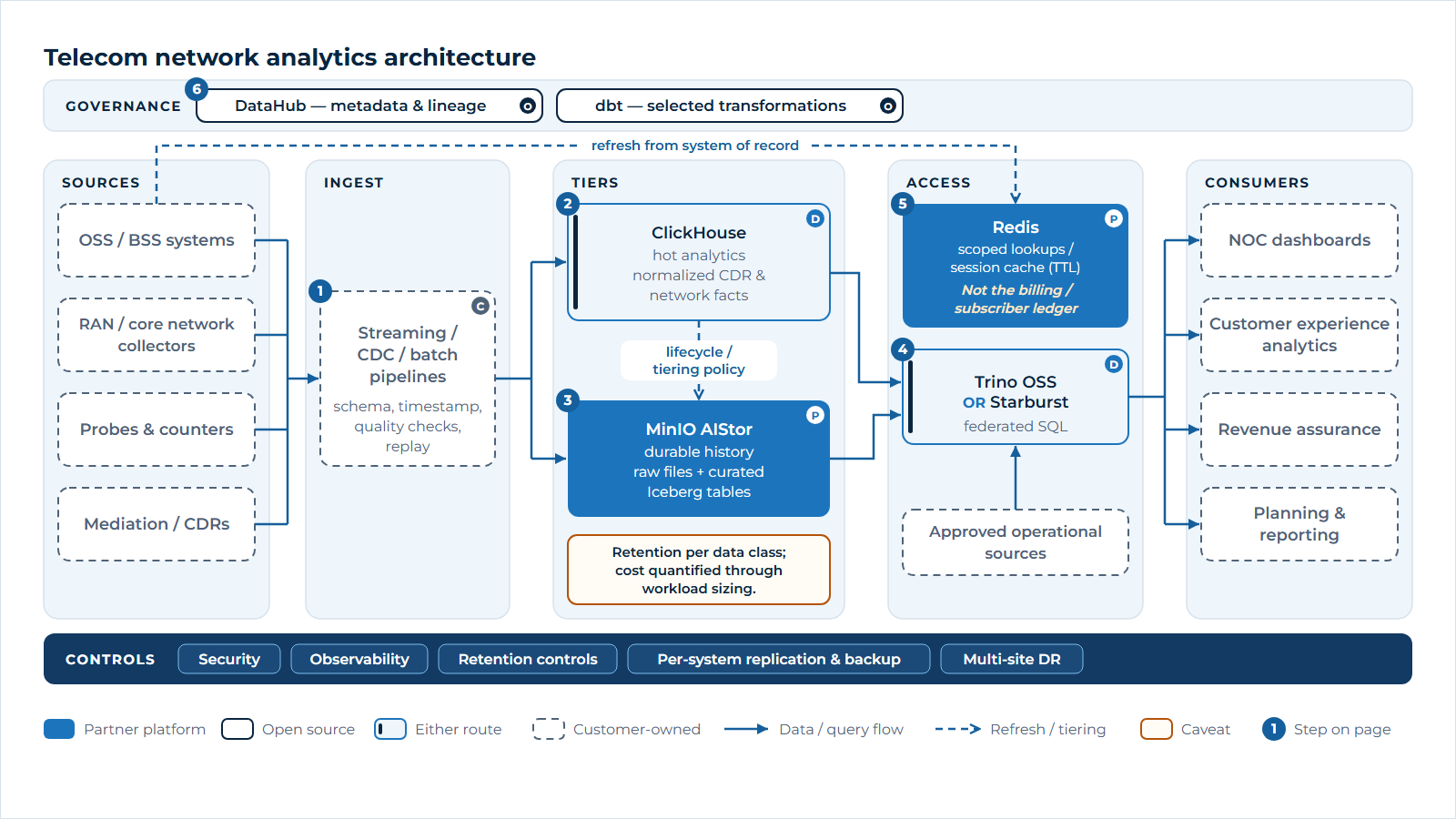
Telecom network analytics architecture
Planning a new network analytics platform?
We will help you design each tier around your workload.
TECHNOLOGY ROLES
Separate Tiers, Clear Responsibilities.
| Component | Role in the solution | Qualification |
|---|---|---|
| Ingestion layer (streaming, CDC, batch) | Collect, validate and deliver CDRs and network events | Throughput, backpressure, replay and delivery semantics validated per source |
| ClickHouse (partner · OSS) | Hot analytical serving for investigative and dashboard queries | Data models, retention and materializations designed per workload |
| MinIO AIStor | Durable storage for raw files and curated Iceberg tables | Table interfaces and catalog support confirmed for the selected release and entitlement |
| Trino OSS or Starburst | Federated SQL over approved sources and historical datasets | Alternatives per decision; connector semantics, tenancy and governance tested |
| Redis | Narrowly scoped hot lookups and session caching | Freshness and expiry rules; not the authoritative billing or subscriber ledger |
| DataHub Core | Metadata visibility, ownership and lineage | Governance control plane; access is enforced in engines and storage |
| dbt Core / dbt OSS | Selected transformations and tested models | Adapter compatibility confirmed per engine and version |
DESIGN TRADEOFFS
Decisions We Make With You, Not For You.
| Architecture decision | Design alternatives | How we validate |
|---|---|---|
| CDR ingest delivery | Streaming platform, micro-batch or direct ingestion | Throughput, backpressure, replay and exactly-once needs |
| Hot versus historical retention | ClickHouse for hot and warm data; AIStor for archived and curated Iceberg data | Storage cost, retention policy and query freshness |
| Distributed query access | Starburst Enterprise or Trino OSS for federated workloads | Connector semantics, throughput, tenancy and governance |
| Customer-controlled or isolated delivery | On-premises or private-network topologies, where supported | Dependencies, patch import path and telemetry egress review |
| Regional availability and DR | Multi-cluster design, with backup and replication per system | RPO and RTO by subsystem, and failure-domain tests |
USE CASES
Where Telecom Network Analytics Delivers Value.
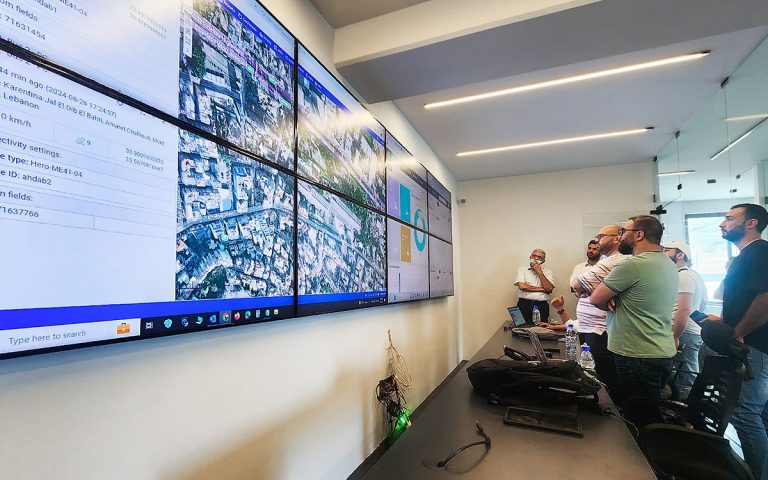
Network performance and anomaly analysis
Query recent network facts quickly to spot degradation, correlate alarms and support troubleshooting.
Customer experience analytics
Combine CDRs and service-quality data to understand experience by region, device, service or segment.
Revenue assurance and CDR investigation
Investigate usage records and reconcile billing events against network data with governed access to history.
Capacity planning and historical reporting
Analyze long-term trends from durable, queryable history without keeping everything in the hot tier.
DESIGN & ACCEPTANCE CONTROLS
Evidence Before Performance Claims.
We benchmark against a known, representative workload before anyone quotes performance or savings. Targets are agreed with your teams.
| Control area | What we define with you | Acceptance evidence |
|---|---|---|
| Ingest throughput | Expected events per second, peaks and growth | Benchmark of ingest events per second on representative data |
| Data freshness | Maximum acceptable data age per use case | Measured ingest-to-query lag |
| Query performance | p95 and p99 latency targets for dashboards and investigations | Percentile measurements under agreed concurrency |
| Dashboard concurrency | Concurrent users and query shapes | Concurrency test results on target hardware |
| Data completeness | Expected record counts and gap detection | Network-data completeness checks |
| Billing-event reconciliation | Reconciliation rules between network and billing data | Reconciliation report on sample periods |
| Retention and cost | Retention per data class; storage and compute model | Retention controls configured; cost baseline from comparative workload sizing |
| Replay and recovery | Ingestion replay, backup and multi-site recovery per system | Replay test and DR drill recorded against agreed RPO and RTO |
Want numbers you can trust?
Benchmark on your own representative data.
Notice — measured, not assumed.
Performance and cost outcomes depend on workload, data model, hardware and retention policy. Bassirah optimizes storage and compute economics and quantifies them through comparative workload sizing and benchmarks on a representative workload; we do not publish generic savings or throughput claims. Customer-controlled or isolated deployment patterns are designed where supported and verified through dependency and egress review. MinIO AIStor and Starburst capabilities depend on the deployed release and entitlement.
WHAT BASSIRAH DELIVERS
What Bassirah Delivers
- Telco analytics architecture workshop.
- CDR ingestion assessment: sources, formats, volumes, quality and replay.
- Hot and cold data lifecycle design with a cost baseline.
- ClickHouse data modeling, materializations and performance engineering.
- MinIO AIStor retention and Iceberg table design where supported.
- Federated SQL with Trino OSS or Starburst on validated connectors.
- Metadata, lineage and transformations with DataHub and dbt.
- Multi-site operational design, runbooks and contracted managed operations.
Your Proof Package
- Ingestion and retention benchmark
- Dashboard concurrency tests
- Data retention controls
- DR plan with RPO and RTO per subsystem
Why Bassirah
Bassirah brings discovery, architecture decisions, implementation services, integration validation, knowledge transfer and operational support into one managed engagement. Technology selection follows measurable workload and compliance requirements.
HOW WE ENGAGE
From Workload Profile to Operated Platform.
- Telco Analytics WorkshopMap sources, consumers, retention needs and operating constraints. Output: target architecture outline and priorities. Consulting & Architecture →
- Workload Profiling & BaselineProfile CDR ingestion and query patterns; build the hot/cold lifecycle and cost baseline. Optimization →
- Benchmark & PoCProve ingest, query, concurrency and retention on a representative workload against agreed criteria. Implementation & Integration →
- Build & OperateImplement in phases with multi-site design, then hand over or run under contracted managed operations. Managed Services →
Telecom Network Analytics FAQs
Why separate hot analytics from long-term retention?
Recent network data needs fast, frequent queries, while long histories are queried less often but must be kept affordably. Separating ClickHouse hot analytics from durable object storage and Iceberg tables lets each tier be sized and costed for its job.
How much can we save on total cost of ownership?
That depends on your workload, retention policy and current platform. We build a cost baseline and quantify options through comparative workload sizing rather than quoting generic percentages.
Should we use Trino OSS or Starburst?
Both can provide federated SQL. Trino OSS suits teams whose security, support and operating needs are met by community capabilities with independent engineering support. Starburst suits teams that need its commercial controls, tested releases or vendor assurances. We help you evaluate both against your requirements.
Can Redis hold subscriber or billing state?
Not as the authoritative record. Redis is used for narrowly scoped lookups and session caching with freshness and expiry rules; billing and subscriber systems of record remain the source of truth.
Can the platform run in a customer-controlled or isolated network?
We design customer-controlled or isolated deployment patterns where the selected technologies support them, and verify dependencies, patch import paths and telemetry egress for each engagement.
Related Pages
Turn Network Data into Decisions Your Teams Can Act On.
Share your data sources, volumes and retention needs. We will propose a tiered architecture, a cost baseline and a benchmark plan.