
HA/DR & PLATFORM RELIABILITY
Design Data Platforms to Recover, Not Just to Run.
Translate availability and recovery objectives into tested technical and operating patterns for critical open-source and partner-led platforms. Different technologies fail, and recover, in different ways. Bassirah designs each component’s resilience on its own terms, connects them through recovery orchestration, and proves the result with drills.
Explicit RTO/RPO · Per-component design · Tested failover playbooks
THE CHALLENGE
Availability Diagrams Are Not Recovery Plans.
Many data platforms look resilient on paper: replicas exist, backups run nightly, and a second site is provisioned. Under real failure, recovery depends on details that diagrams hide: which component holds state, which catalog must come back first, and who decides to fail over.
Objectives that were never agreed
Recovery time (RTO) and recovery point (RPO) targets are assumed rather than agreed per service, so designs cannot be tested against them.
One pattern for every technology
Query engines, analytical databases, transactional databases and object stores each need different failover approaches. A single “active-passive” label hides those differences.
Hidden dependencies
Recovery stalls on identity providers, secrets, DNS, certificates, catalogs or metadata stores that were never part of the DR plan.
Playbooks that were never run
Failover and restore procedures exist as documents but have not been rehearsed, so timings and responsibilities are unknown.
TECHNOLOGY ROLES
Every Technology Recovers Differently.
Platform-specific replica and cluster design, backup and point-in-time recovery, site recovery orchestration and observability come together in one plan, but each component is designed on its own terms.
| Component | Resilience building blocks | What we design and test | Common misconception |
|---|---|---|---|
| Trino OSS / Starburst (coordinator, workers) | Coordinator recovery or traffic-management patterns, worker replacement, configuration backup, multi-site restoration | Coordinator failure handling, catalog and secret availability, restoration at a second site | Fault-tolerant execution can retry eligible queries; it is not automatic end-to-end site failover |
| ClickHouse (partner · OSS) | Replicated tables, coordination quorum, sharding, backup and restore | Replica and shard layout, coordination-service placement, restore of large tables within objectives | Replication alone is not a backup; accidental deletes and corruption replicate too |
| PostgreSQL | Streaming replication, failover tooling, backup with point-in-time recovery (PITR) | Failover automation, split-brain protection, timed PITR restore | A replica is not a substitute for tested PITR |
| YugabyteDB | Raft replication of each shard across zones or regions within a universe, xCluster asynchronous replication between universes, read replicas, distributed backups with point-in-time recovery where configured | Replication factor and placement per zone or region, leader placement, xCluster direction and failover runbook, behavior when a node, zone or region is lost, timed restore | Raft replication tolerates the loss of a node or zone but is not a backup; xCluster is asynchronous, so the most recent writes may not have reached the other universe when one fails |
| Apache Cassandra | Multi-datacenter replication, consistency levels, repair, snapshots | Replication factors per datacenter, consistency choices, repair schedules, snapshot restore | Multi-DC replication does not remove the need for backups and repair discipline |
| MongoDB Community Server | Replica sets, sharding, backup procedures | Election behavior, write concern, restore testing | Read and write concern settings decide what "durable" means |
| Redis | Replication, persistence options, clustering | Whether data can be rebuilt from durable sources, warm-up and failover behavior | Redis is not a durable ledger; recovery design starts from the system of record |
| MinIO AIStor | Data protection and replication features as supported by the deployed release and entitlement | Object protection, replication scope, bucket and policy recovery, Iceberg catalog dependencies | Object durability does not by itself recover catalogs, keys or access policies |
| Shared services | Identity, secrets, DNS, certificates, networking, monitoring | Availability of dependencies at the recovery site and their restore order | DR plans often omit the services every platform depends on |
Running Trino across two sites?
Get a recovery design that covers coordinators, catalogs and dependencies.
REFERENCE ARCHITECTURE
A Recovery Pattern Built Layer by Layer.
This conceptual pattern shows how a two-site data platform is protected. It treats control planes, catalogs and metadata, data storage, identity, secrets, networking, monitoring and restore orchestration as separate concerns, each with its own recovery design.
- Define objectives per service.Agree RTO and RPO for each business service, then map every component and dependency that service relies on.
- Protect state where it lives.Configure replication, backups and PITR for each stateful system (PostgreSQL, YugabyteDB, ClickHouse, Cassandra, MongoDB Community, object storage), using the native pattern for that technology.
- Recover control planes and catalogs.Plan coordinator recovery for query engines, and protect metadata stores, table catalogs and configuration so engines can resume at the recovery site.
- Make dependencies available.Ensure identity, secrets, certificates, DNS and network paths exist, and are tested, at the recovery site.
- Orchestrate failover and failback.Write runbooks with decision criteria, ordered steps, owners and verification checks, then automate the steps that can be automated safely.
- Observe and rehearse.Monitor replication lag, backup success and restore times; run scheduled drills and record results against objectives.
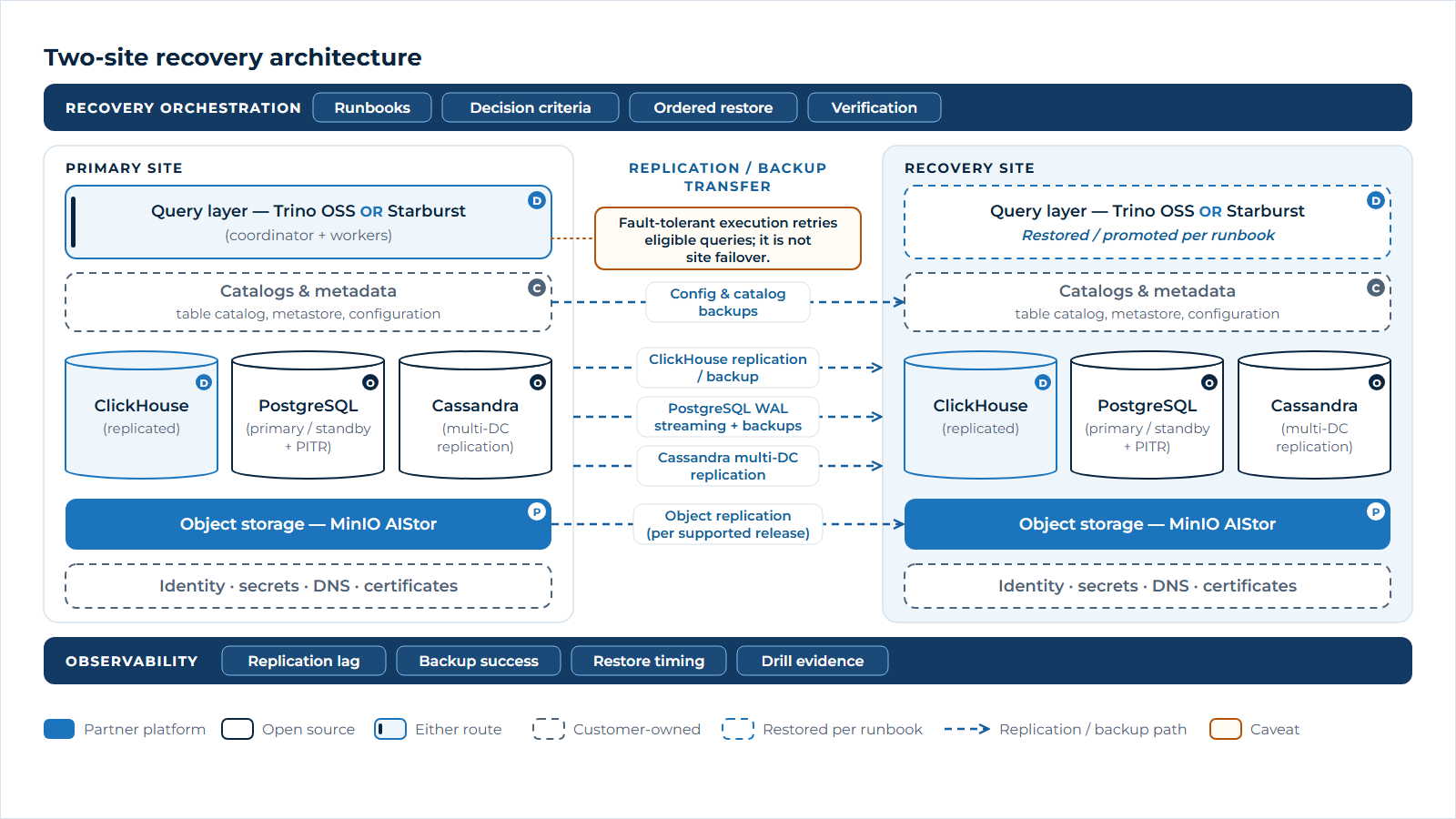
Two-site recovery architecture
USE CASES
Recovery Patterns We Design and Test.
Multi-site Trino recovery
Restore federated SQL access at a second site, covering coordinators, workers, catalogs, secrets and the data sources behind them.
Resilient ClickHouse clusters
Design replicated and sharded ClickHouse with a correctly placed coordination quorum and tested backup and restore.

PostgreSQL point-in-time recovery
Implement continuous archiving and PITR, then prove restore times and data recovery points through timed drills.
Cassandra multi-datacenter
Configure replication, consistency and repair across datacenters, and confirm behavior when a datacenter is lost.
YugabyteDB across zones and regions
Place Raft-replicated data across zones or regions, add xCluster replication or read replicas where the design calls for them, and rehearse node, zone and region failures and restores in drills.
Object storage protection
Protect object data, buckets, policies and table catalogs with the data protection features supported by your AIStor release.
DESIGN & ACCEPTANCE CONTROLS
Resilience You Can Demonstrate.
Reliability work ends with evidence, not diagrams. Objectives and thresholds are agreed with you; we do not publish generic availability percentages or guaranteed recovery times.
| Control area | What we define with you | Acceptance evidence |
|---|---|---|
| Explicit RTO and RPO | Objectives per business service and per component | Signed-off objectives matrix |
| Failure scenarios | Node, zone, site, storage, network, dependency and human-error scenarios | Scenario catalogue with expected behavior and owner |
| Coordinator and stateful-component risks | Single points of failure in control planes, catalogs and metadata stores | Risk register with mitigations; coordinator recovery test |
| Dependency mapping | Identity, secrets, DNS, certificates, network and monitoring dependencies | Dependency map validated at the recovery site |
| Backup and restore | Backup scope, frequency, retention, encryption and restore ownership | Timed restore drills recorded against RPO and RTO |
| Failover playbooks | Decision criteria, ordered steps, verification and failback | Runbooks executed in a rehearsal with recorded timings |
| Observability | Replication lag, backup success, restore duration and alert routing | Dashboards and alerts live; alert test completed |
| Drill cadence | Schedule, participants and reporting format | First drill report and agreed ongoing schedule |
When did you last run a restore drill?
We can plan and run one with your team.
Notice — designed and validated per engagement.
High availability and disaster recovery are engineered within each platform’s technical limits and your agreed requirements. Recovery objectives, coverage hours and service levels are defined in the statement of work and service-level agreement, not implied by this page. For open-source platforms, Bassirah provides independent engineering services; vendor escalation applies only where a separate commercial agreement covers it. Trino fault-tolerant execution retries eligible queries and is not an automatic site failover mechanism.
WHAT BASSIRAH DELIVERS
What Bassirah Delivers
- HA/DR readiness assessment against agreed RTO and RPO.
- Component-by-component resilience design for query engines, databases, caches and object storage.
- Backup, PITR and restore implementation with timed drills.
- Dependency mapping for identity, secrets, networking, certificates and monitoring.
- Failover and failback runbooks with decision criteria and owners.
- Recovery observability: replication lag, backup and restore dashboards and alerts.
- Scheduled DR drills with written reports and remediation backlog.
- Contracted managed operations, including backup and restore testing, where agreed.
Why Bassirah
Bassirah brings discovery, architecture decisions, implementation services, integration validation, knowledge transfer and operational support into one managed engagement. Technology selection follows measurable workload and compliance requirements.
Because we engineer query engines, analytical and operational databases, caches and object storage, we can plan recovery across the whole platform rather than one product at a time, and we are clear about what each technology can and cannot do.
HOW WE ENGAGE
From Objectives to Proven Recovery.
- HA/DR Readiness AssessmentAgree objectives, map components and dependencies, and review current replication, backups and runbooks. Output: gap analysis and risk register. Consulting & Architecture →
- Resilience DesignPer-component HA/DR design, recovery orchestration and observability, captured in architecture decision records. Consulting & Architecture →
- Implement & DrillBuild replication, backups and runbooks, then run the first recovery drill and remediate findings. Implementation & Integration →
- Operate & RehearseKeep recovery capability current through scheduled drills, upgrades and contracted managed operations. Managed Services →
HA/DR & Platform Reliability FAQs
Can Bassirah build high availability and disaster recovery across two sites?
Yes, as an engineering offering subject to each platform’s technical limits and your agreed requirements. Trino query retry, coordinator recovery, stateful services, object storage, networking and dependent catalogs are addressed separately, with customer-approved RTO and RPO and tested procedures.
Does Trino fault-tolerant execution give us site failover?
No. Fault-tolerant execution can retry eligible queries or tasks after certain failures. It does not move a cluster to another site. Site recovery needs coordinator, catalog, secrets and data-source recovery designed and tested separately.
Isn't replication enough?
Replication protects against some failures but copies deletions and corruption too. Each stateful system also needs backups, point-in-time recovery where relevant, and restore tests timed against your objectives.
What RTO and RPO can you guarantee?
We do not publish generic targets. Objectives are agreed per service, designed per component and proven in drills. Any contractual commitment is defined in the statement of work and service-level agreement.
Do you cover partner-led platforms as well as open-source ones?
Yes. We design resilience for partner-led platforms such as Starburst, ClickHouse, Redis and MinIO AIStor and for community platforms such as Trino OSS, PostgreSQL, YugabyteDB, Cassandra and MongoDB Community. Vendor escalation applies only where a commercial agreement covers it.
Related Pages
Know Your Platform Will Recover Before You Need It To.
Share your critical services, platforms and recovery objectives. We will show where the gaps are and how to close them.