
OPERATIONAL DATABASE MODERNIZATION
Reliable Databases for Modern Digital Services.
Design transactional, document and distributed NoSQL systems with the correct consistency, latency and availability model for each use case. Bassirah helps you decide where PostgreSQL, MongoDB Community Server and Apache Cassandra belong, when distributed SQL on YugabyteDB is worth its added complexity, where Redis adds value as a cache, and how operational data reaches analytics without overloading production.
PostgreSQL · YugabyteDB · MongoDB Community · Apache Cassandra · Redis · Trino / Starburst
THE CHALLENGE
Digital Services Outgrow Databases Chosen for Yesterday's Workloads.
Many enterprise applications still run on a single database pattern chosen years ago. As channels, data volumes and availability expectations grow, mismatched engines show up as slow releases, fragile failovers and production databases quietly turned into reporting systems.
One engine for every workload
Transactional records, flexible documents and high-ingest event data have different consistency and scaling needs. Forcing them into one model creates workarounds that are expensive to maintain.
Recovery that has never been tested
Backups exist, but restore times, point-in-time recovery and failover behavior have not been proven against the business’s recovery objectives.
Production databases doing analytics
Reporting and ad-hoc queries compete with customer transactions, so teams add replicas and caches without a clear read-path design.
Licensing and lifecycle uncertainty
Proprietary licence renewals, end-of-life versions and unclear licence terms for community software make modernization decisions harder to justify.
TECHNOLOGY ROLES
Distinct Databases for Distinct Jobs.
We treat each database as a deliberate choice, not a default. The table below shows the role each technology typically plays in a modernized operational estate. Final selection follows your access patterns, consistency requirements and operating model.
| Technology | Typical role | Choose it when | Design cautions |
|---|---|---|---|
| PostgreSQL | Relational system of record for transactional applications and enterprise services | You need strong transactional guarantees, relational integrity, SQL and a broad extension ecosystem | Enterprise reliability depends on replication topology, connection management, vacuum and statistics discipline, and tested backup and point-in-time recovery (PITR) |
| YugabyteDB | Distributed SQL system of record with a PostgreSQL-compatible interface (YSQL), for transactional workloads that must scale out or keep accepting writes across zones or regions | One PostgreSQL primary can no longer serve the write volume or data size, writes must continue through a node or zone failure without a manual failover step, or data must be placed in several regions behind one SQL interface | Not a drop-in replacement: schema keys, query plans, latency between zones and some features and extensions behave differently, so compatibility is tested per workload. Where one PostgreSQL primary with replicas meets the objectives, PostgreSQL is the simpler choice |
| MongoDB Community Server (source-available, SSPL) | Document store for applications with evolving domain models | Data is naturally document-shaped and schema flexibility helps delivery speed | Schema design, indexing, shard-key choice, read and write concern settings and licence review need deliberate decisions |
| Apache Cassandra | Distributed, partition-oriented store for high-ingest and geographically distributed data | Write volume, multi-datacenter distribution and predictable partition-level access matter most | Model queries first; partition keys, consistency levels, repair, compaction and capacity planning determine service behavior |
| Redis | Cache and transient application state in front of durable stores | Measured latency or load on a durable store justifies a cache with clear expiry and invalidation rules | Redis is not a default substitute for a durable relational or document database; persistence, eviction and recovery expectations must be validated |
| Trino OSS or Starburst | Federated, read-only analytical access across operational stores and lakehouse data | Teams need cross-source SQL without copying everything, on verified connectors | Connector behavior is validated per source; heavy analytical load is routed away from latency-sensitive primaries |
Trino OSS and Starburst are alternative routes for federated SQL. We recommend one or the other per decision unless a phased coexistence plan is deliberately required. Trino vs Starburst →
Start with PostgreSQL. We recommend YugabyteDB only when a single PostgreSQL primary, with read replicas, connection pooling and tested failover, cannot meet the scale, availability or data-placement objectives, and after your schema and workload have been tested against YSQL. When distributed SQL earns its complexity →
REFERENCE ARCHITECTURE
A Modern Operational Data Estate, Layer by Layer.
This conceptual pattern separates systems of record, caching and analytical read paths so each component can be sized, secured and recovered on its own terms. Every connector, version and topology is validated in a project-specific design before it is relied upon.
- Applications and servicesCall well-defined data access layers through connection pooling, with timeouts and retry behavior agreed per service.
- PostgreSQLHolds relational records of truth, protected by streaming replication, automated failover tooling chosen per environment, and backup with point-in-time recovery. Where one primary cannot meet scale-out or multi-zone write requirements, YugabyteDB is assessed as a PostgreSQL-compatible distributed alternative after compatibility testing.
- MongoDB Community ServerServes document-oriented domains through replica sets, and sharding where data volume and access patterns justify it.
- Apache CassandraStores high-ingest or geographically distributed data with query-first data models, multi-datacenter replication where needed, and scheduled repair.
- RedisCaches hot reads or transient state with explicit expiry and invalidation. Authoritative data always stays in the durable stores.
- Analytical read pathsUse change data capture, replicas or federated SQL through Trino OSS or Starburst on verified connectors, so reporting does not compete with customer transactions. Identity, secrets, encryption, monitoring and backup controls apply across every layer.
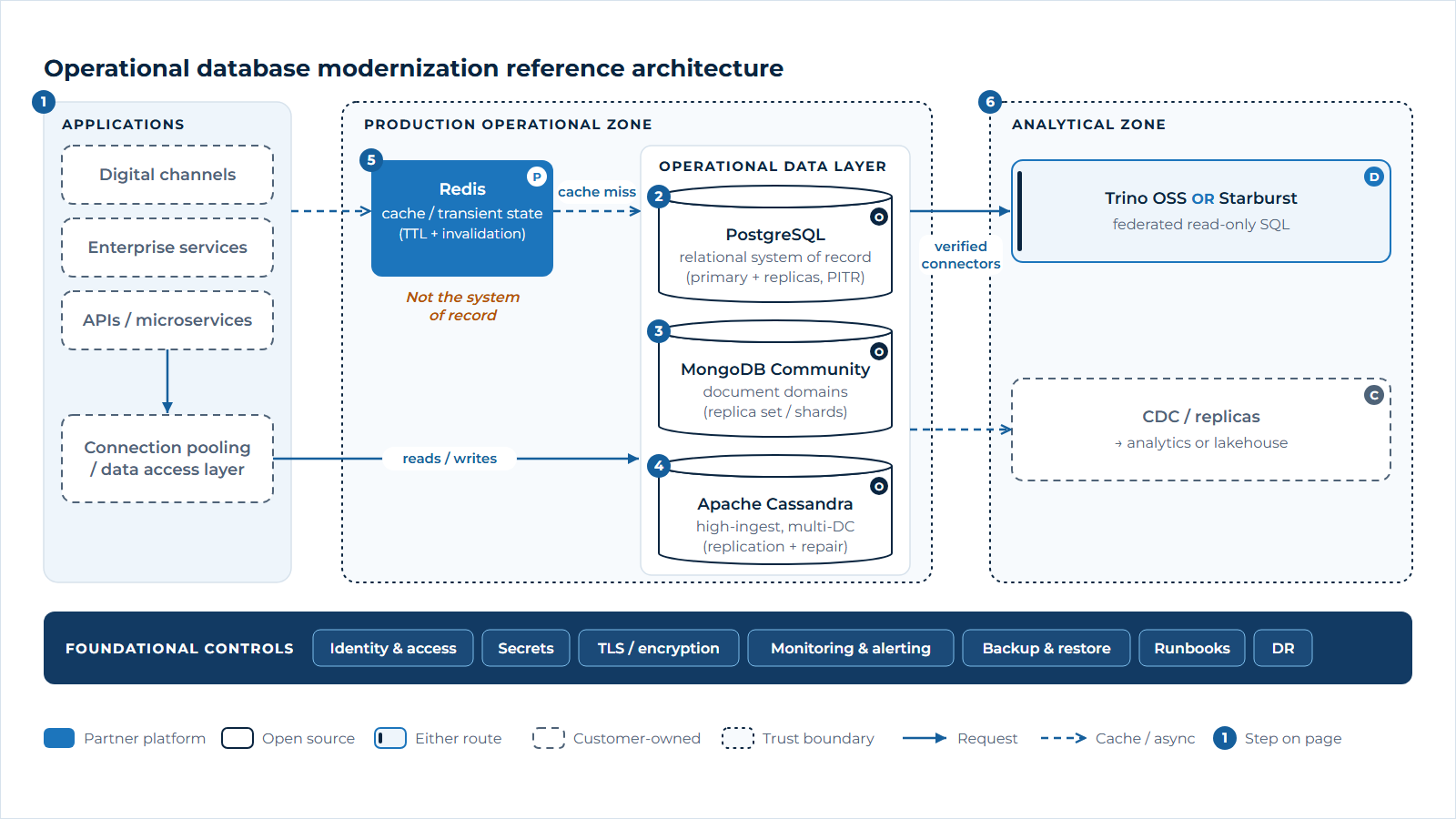
Operational database modernization reference architecture
Unsure which engine fits a workload?
Bring your access patterns and recovery objectives; we will map them to a candidate design.
USE CASES
Where Database Modernization Delivers Value.

Transactional migration
Move relational workloads from proprietary or end-of-life databases to PostgreSQL with schema conversion, data reconciliation, cutover rehearsal and a documented rollback path.
Document services
Build or stabilize document-oriented services on MongoDB Community Server with sound data modeling, indexing, replication and recovery testing.

Distributed high-ingest systems
Design Apache Cassandra clusters for event, telemetry and time-series-like data that must be written continuously and distributed across sites.
Offloading reporting from production
Introduce replicas, change data capture or federated SQL so analytics and reporting stop competing with customer-facing transactions.
DESIGN & ACCEPTANCE CONTROLS
Decisions You Can Test Before Go-Live.
Every engagement converts requirements into explicit design decisions and acceptance evidence. Targets are agreed with your teams; we do not publish generic performance or availability promises.
| Control area | What we define with you | Acceptance evidence |
|---|---|---|
| Schema and access patterns | Data model, query shapes, indexing and partitioning per workload | Reviewed data model; query plans tested against representative data volumes |
| Transactions and consistency | Isolation levels, read and write concerns, Cassandra consistency levels, idempotency rules | Documented consistency matrix per service; failure-mode tests for retries and partial writes |
| Backup and recovery | Backup scope, retention, PITR requirements, restore ownership | Successful timed restore drill against agreed RTO and RPO |
| High availability | Replication topology, failover tooling, quorum and split-brain handling | Planned and unplanned failover tests with recorded results |
| Security | Authentication, roles and least privilege, TLS, encryption options, audit logging, secrets handling | Access review; configuration hardening checklist signed off |
| Connection handling | Pooling, timeouts, retry and back-off policies | Load test showing stable connection behavior at agreed concurrency |
| Service objectives | Latency, availability and throughput SLOs per service | SLO dashboards and alert thresholds live before cutover |
| Migration safety | Migration waves, data reconciliation, cutover and rollback criteria | Reconciliation reports; rehearsed cutover and rollback runbook |
Not sure your backups would restore in time?
Start with a recovery readiness check.
Notice — independent engineering services.
Bassirah provides independent engineering and operational support for PostgreSQL, YugabyteDB, MongoDB Community Server and Apache Cassandra. These services do not imply affiliation with, endorsement by, or escalation rights to the open-source projects or their maintainers. MongoDB Community Server is source-available under the Server Side Public License (SSPL) and is not an OSI-approved open-source licence; review its licence terms for your use case. YugabyteDB is a trademark of YugabyteDB, Inc.; Bassirah is not a partner of YugabyteDB, Inc. and does not resell YugabyteDB Anywhere or YugabyteDB Aeon. Support scope, coverage hours and response commitments are defined in each statement of work.
WHAT BASSIRAH DELIVERS
What Bassirah Delivers
- Database estate assessment: workloads, versions, licences, access patterns and recovery posture.
- Engine selection and architecture decision records for each workload.
- High availability, replication and failover design for PostgreSQL, YugabyteDB, MongoDB Community and Cassandra.
- Backup, PITR, restore drills and disaster recovery design.
- Migration planning, schema conversion, data reconciliation and cutover rehearsal.
- Caching design with Redis where measurements justify it.
- Analytical read paths through CDC, replicas or Trino OSS / Starburst on verified connectors.
- Security hardening, monitoring, runbooks and handover to your DBA and SRE teams, or contracted managed operations.
Why Bassirah
Bassirah brings discovery, architecture decisions, implementation services, integration validation, knowledge transfer and operational support into one managed engagement. Technology selection follows measurable workload and compliance requirements.
Because we work across relational, document, distributed, caching and analytical technologies, we can recommend the combination that fits your services, not the one that fits a single product line.
HOW WE ENGAGE
From Assessment to Operated Platform.
- Database Platform ReviewInventory workloads, versions, licences, recovery posture and pain points. Output: findings, risk register and prioritized recommendations. Consulting & Architecture →
- Target ArchitectureEngine selection, HA/DR design, security model and analytical read-path decisions captured as architecture decision records. Consulting & Architecture →
- Proof & MigrationProve the riskiest assumptions in a focused PoC, then migrate in waves with reconciliation and rehearsed rollback. Migration & Modernization →
- Operate & ImproveHand over runbooks and training, or engage contracted managed operations with scope agreed in the statement of work. Managed Services →
Database Modernization FAQs
How do you decide between PostgreSQL, MongoDB Community and Cassandra?
We start from access patterns, consistency needs, data shape, write volume, geographic distribution and operational skills. PostgreSQL suits relational transactions, MongoDB Community suits document-shaped domains, and Cassandra suits high-ingest, partition-oriented and multi-datacenter workloads. Many estates use more than one, each for a defined job.
When is YugabyteDB a better fit than PostgreSQL?
When one PostgreSQL primary can no longer serve the write volume or data size, when writes must continue through a node or zone failure without a manual failover step, or when data must be placed in several regions behind one SQL interface. If one primary with read replicas and a tested failover meets your objectives, PostgreSQL is simpler to operate and remains our recommendation. YSQL is PostgreSQL-compatible but not identical, so we test your schema and workload first. See YugabyteDB and PostgreSQL.
Is MongoDB Community open source?
MongoDB Community Server is source-available under the Server Side Public License (SSPL) for modern releases. SSPL is not an OSI-approved open-source licence, so we include it in our open-source and community support portfolio with that distinction stated clearly.
Can Redis replace our primary database?
Not by default. Redis is excellent for caching and transient state, but it is not a general substitute for a durable relational or document database. We validate persistence, recovery and consistency expectations before assigning Redis any role beyond caching.
Can we run analytics directly on our operational databases?
Light reporting may be acceptable, but heavy analytics should not compete with customer transactions. We design read paths using replicas, change data capture or federated SQL through Trino OSS or Starburst on verified connectors.
Do you provide vendor support for these databases?
Our services are independent engineering. They do not include upstream project escalation or imply maintainer endorsement. Support scope, coverage and response commitments are defined in each statement of work.
Related Pages
Modernize Your Databases Without Losing Control.
Tell us about your workloads, current databases and recovery objectives. We will propose a pragmatic target architecture and migration route.