- Partners
- Partner PlatformsEight Strategic Technology Partners, delivered with Bassirah architecture, implementation and support.
- ClickHouseReal-time analytical database
- StarburstEnterprise data federation on Trino
- RedisIn-memory data platform and caching
- LangfuseLLM observability and evaluation
- MinIO AIStorObject storage for AI and analytics
- MongoDBMongoDB Atlas and Enterprise Advanced
- PostmanAPI design, testing and governance
- StrategyStrategy Mosaic and Strategy BI
- Open-Source Support
- Solutions
- SolutionsIntegrated solutions built around business outcomes, from lakehouse to AI.
- Enterprise Lakehouse & FederationOpen table formats and federated SQL
- Real-Time AnalyticsAnalytics on streaming and fresh data
- Data Governance & CatalogMetadata, lineage and data quality
- Analytics EngineeringTested, versioned data transformation
- Warehouse ModernizationPlan and run warehouse migrations
- Database ModernizationModernize operational databases
- Enterprise AI & AgentOpsOperate LLM applications and agents
- HA/DR & Platform ReliabilityResilience, failover and recovery
- Fraud & Risk AnalyticsDetection and risk data platforms
- Telecom Network AnalyticsNetwork and subscriber analytics
- Industries
- IndustriesData and AI platforms shaped by the regulation, scale and risk of each sector.
- Banking & Financial ServicesRisk, fraud and regulatory data
- TelecommunicationsNetwork, OSS/BSS and customer data
- Digital Natives & SaaSEmbedded analytics and AI features
- GovernmentSovereign, auditable data platforms
- HealthcareGoverned clinical and operational data
- Services
- ServicesFrom architecture to managed operations, across the platform lifecycle.
- Consulting & ArchitectureAssessments, roadmaps and designs
- Implementation & IntegrationBuild and connect the platform
- Migration & ModernizationPlanned, validated migrations
- Performance & Security OptimizationTuning, hardening and reviews
- Managed ServicesOngoing operations and support
- Training & EnablementHands-on skills for your teams
- Architecture Blueprints
- Architecture BlueprintsReference architectures that show how the technologies fit together.
- Enterprise AI & LLMOps StackModels, retrieval, evaluation, observability
- Telco Core & Distributed AnalyticsEdge-to-core network analytics
- Banking Fraud & Risk Data PlatformStreaming detection on governed data
- SaaS Embedded AnalyticsMulti-tenant analytics in your product
- Open Iceberg LakehouseIceberg tables, Trino and object storage
- Resources
- Company
- Talk to an Expert
DATA WAREHOUSE MODERNIZATION
Move Beyond Monolithic Data Warehouses with Control.
Rationalize workloads by separating retained legacy systems, federated access, open storage and specialized analytics rather than forcing a single migration pattern. Bassirah plans each move from evidence, proves it in reconciled waves and keeps a rollback path at every step.
Trino OSS or Starburst · MinIO AIStor / Iceberg · ClickHouse · dbt
THE CHALLENGE
The Legacy Warehouse Still Matters. It Just Can't Do Everything.
Enterprise data warehouses often hold decades of trusted logic and critical reports. They are also frequently at capacity, expensive to scale, tied to proprietary formats or approaching renewal and end-of-support decisions. A single “lift and shift” to another monolith repeats the same constraints, while a big-bang rewrite puts reporting continuity at risk.
- Capacity is consumed by workloads that do not need premium warehouse resources.
- New use cases such as large-scale history, data science and real-time dashboards do not fit the platform.
- License renewals force decisions before workloads are properly understood.
- SQL dialects, stored procedures and integrations make migration effort hard to estimate.
- Previous migration attempts stalled because outputs could not be reconciled.
Modernization works best as a portfolio of decisions, one workload at a time, based on evidence.
PATTERNS
Choose the Right Move for Each Workload
Most modernization programs use all four patterns. The workload inventory decides which applies where.
Retain
Keep workloads that are stable and well served on the existing warehouse, and stop investing effort where there is no benefit in moving.
Federate
Expose the warehouse alongside other sources through Trino OSS or Starburst, so new consumers can query across systems during and after transition.
Offload
Move selected queries, history or heavy scans to open Iceberg storage on MinIO AIStor or to ClickHouse for analytical serving, relieving warehouse capacity.
Migrate
Rebuild selected logic as tested dbt models on the target platform, then switch consumers once outputs reconcile.
Facing a renewal or end-of-support decision?
Get a workload-level view before you commit.
REFERENCE ARCHITECTURE
Coexistence First, Migration in Controlled Waves
A conceptual pattern. Connectors, SQL compatibility, CDC tooling and licensed capabilities are validated for your legacy platform and target versions.
- Inventory and classifyCatalog workloads, queries, users, schedules, dependencies and costs on the legacy warehouse, and classify each as retain, federate, offload or migrate.
- Federate for continuityRegister the legacy warehouse and other sources in Trino OSS or Starburst, giving consumers one SQL access layer that stays stable while workloads move behind it.
- Extract and replicate selectivelyUse batch extracts or change data capture (CDC) to copy selected tables into MinIO AIStor as Apache Iceberg tables, or into ClickHouse for low-latency analytical workloads. Large batch extracts and backfills can run on Apache Spark, with wave jobs scheduled and monitored through an orchestrator such as Apache Airflow.
- Rebuild logic as codeConvert in-scope transformations and stored procedures into dbt models with tests, documentation and CI/CD, running through verified adapters on the target engine.
- Reconcile and cut overRun legacy and new outputs in parallel, reconcile control totals and key reports, then switch consumers wave by wave with a documented rollback.
- Decommission and optimizeRetire migrated objects on the legacy platform, right-size remaining capacity and govern the new estate with metadata and lineage.
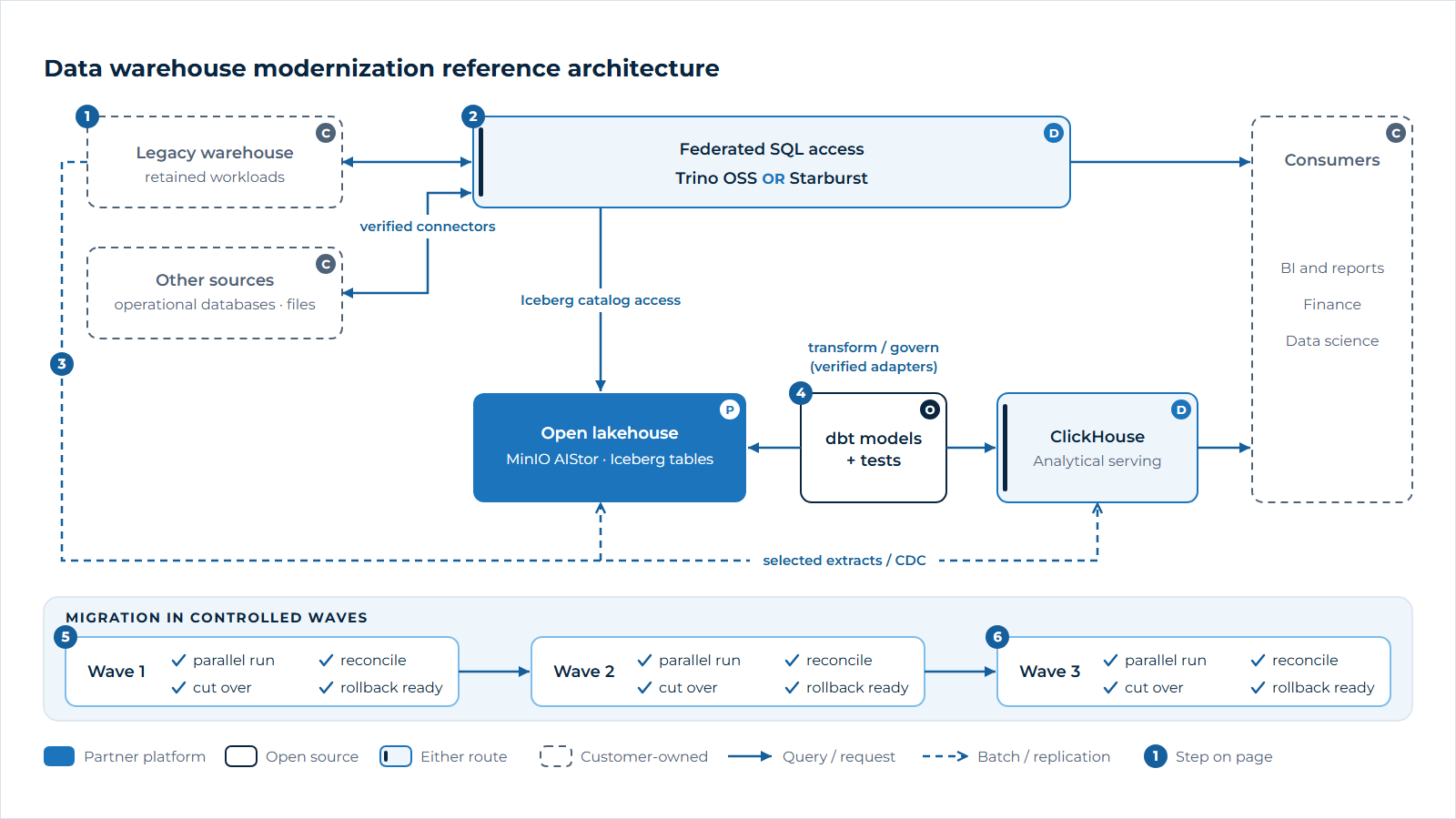
Data warehouse modernization reference architecture
TECHNOLOGY ROLES
Each Component Has One Clear Job
| Component | Role in this solution | Route | Qualification |
|---|---|---|---|
| Legacy warehouse | Continues to serve retained workloads during and after modernization | Customer platform | Source load from federation and extracts measured and limited |
| Trino OSS or Starburst | Federated SQL access across legacy and new platforms; stable layer for consumers | OSS engineering or strategic partner | Alternatives for the same role; connector support for your legacy platform validated |
| MinIO AIStor / Apache Iceberg | Open storage for offloaded history and migrated datasets | Strategic partner (licensed) | Table services and catalog validated for the deployed release and license |
| ClickHouse | Analytical serving for workloads needing low-latency, high-concurrency queries | Strategic partner or OSS engineering | Data model designed for the offloaded query shapes |
| CDC / extract tooling | Moves selected data from legacy to target platforms | Customer-selected or recommended | Consistency, latency and source impact tested |
| dbt Core / dbt OSS | Rebuilt transformation logic with tests and documentation | Independent open-source engineering | Runs through a verified adapter; release named per project |
| DataHub Core (optional) | Metadata and lineage across legacy and new estate | Independent open-source engineering | Catalog only; access enforced in engines and IAM |
See Trino OSS, Starburst, MinIO AIStor, ClickHouse, ClickHouse OSS, dbt, Apache Spark, Apache Airflow and DataHub.
USE CASES
Where Warehouse Modernization Delivers Value

Teradata and legacy modernization assessment
Build a workload-level evidence base, covering usage, cost drivers, SQL complexity and dependencies, to support renewal and roadmap decisions.
Query offloading
Move heavy scans, long history and exploratory workloads to open storage or ClickHouse, releasing legacy capacity for critical reports.
Hybrid coexistence
Run legacy and modern platforms side by side behind one federated access layer while migration proceeds at a safe pace.
DESIGN & ACCEPTANCE CONTROLS
What We Define, and How We Prove It
| Control | What we define | Acceptance evidence |
|---|---|---|
| Workload inventory | Queries, users, schedules, dependencies and cost drivers, classified by pattern | Inventory and classification reviewed with workload owners |
| SQL fidelity | Dialect differences, functions, procedures and semantics that need translation | Translated query set produces matching results on test data |
| Source load | Acceptable load from federation and extracts on the legacy platform | Measured source impact during PoC within agreed limits |
| Migration waves | Scope, sequence, entry and exit criteria for each wave | Wave plan approved; exit criteria met before the next wave starts |
| Rollback | How consumers revert to legacy outputs if a wave fails acceptance | Rollback rehearsed for at least one wave |
| Benchmark | Representative workloads and target performance ranges on the new platform | Benchmark report comparing legacy and target for the agreed query set |
| Reconciliation | Control totals, row counts and key report figures compared between platforms | Reconciliation report within agreed tolerances before cut-over |
Evidence before claims.
Bassirah does not promise percentage cost savings or performance gains in advance. Infrastructure economics are assessed through workload sizing and TCO modeling on your data, and federated access can reduce, but not eliminate, data movement. Trino OSS, dbt, DataHub, Apache Spark and Apache Airflow services are independent Bassirah engineering with no upstream support implied; Starburst and MinIO AIStor capabilities depend on your license and release.
WHY BASSIRAH
Modernization With Traceability and Controlled Risk
Bassirah brings discovery, architecture decisions, implementation services, integration validation, knowledge transfer and operational support into one managed engagement. Technology selection follows measurable workload and compliance requirements.
- Workload-level assessment that supports renewal, roadmap and budget decisions.
- Federation-first coexistence so reporting continuity is protected throughout.
- Multiple target options, including open Iceberg storage, ClickHouse and retained systems, chosen per workload.
- Legacy SQL translation into tested dbt models with reconciliation built in.
- Wave plans with explicit entry, exit and rollback criteria.
- Knowledge transfer and optional managed operations for the new estate.
ENGAGEMENT PATH
How a Warehouse Modernization Engagement Runs
- Modernization assessmentWorkload inventory, classification, cost drivers and target options.
- Target architecture & roadmapRetain, federate, offload and migrate decisions with a wave plan.
- Proof of conceptFederation, offload or migration of a representative workload, benchmarked and reconciled.
- Migration wavesControlled waves with parallel runs, reconciliation, cut-over and rollback readiness.
- Optimize & operateRight-size retained capacity, tune the new estate and run it under contracted managed services if required.
Data Warehouse Modernization FAQ
Do we have to migrate everything off our legacy warehouse?
No. Many organizations retain stable workloads, federate access across old and new platforms, offload heavy or historical queries and migrate only what benefits. The workload inventory drives each decision.
Can you modernize a Teradata environment?
Yes. We assess Teradata and other legacy warehouses at workload level, then plan federation, offloading and migration. Connector support and SQL translation effort are validated for your specific platform and versions.
How do you make sure reports stay correct after migration?
We run legacy and new outputs in parallel and reconcile control totals, row counts and key report figures within agreed tolerances before switching consumers, with a rehearsed rollback for each wave.
How much will modernization save?
It depends on your workloads, licenses, retention and infrastructure. We quantify options through workload sizing and TCO modeling during the assessment rather than quoting generic savings figures.
Will federation slow down our legacy warehouse?
Federated queries do add load to sources. We measure and limit that load during the proof of concept, push down predicates where supported, and land heavier workloads instead of federating them indefinitely. Compare Trino OSS and Starburst →
Related Pages
Modernize Your Warehouse, One Proven Wave at a Time
Tell us about your current warehouse, key workloads and timelines. We will propose an assessment scope and a first wave.