
ANALYTICS ENGINEERING & TRANSFORMATION
Standardize the Way Data Models Are Built and Trusted.
Bring reusable SQL models, documentation, testing and deployment discipline into your enterprise transformation lifecycle. Bassirah designs dbt projects, environments and pipelines around your engines and controls, so every number has a tested, traceable definition.
dbt Core / dbt OSS · ClickHouse · Trino OSS or Starburst · DataHub Core

THE CHALLENGE
Business Logic Hidden in Fragile SQL Is a Business Risk
In many enterprises, the logic behind key figures lives in stored procedures, scheduled scripts and spreadsheet macros written by different teams over many years. Changes are risky, testing is manual, and when two reports disagree it can take days to find out why. As data platforms modernize, that logic has to move too, and it should arrive in a form that can be reviewed, tested and reused.
- The same metric is calculated differently in several reports.
- SQL jobs fail silently or produce wrong results that are found by business users.
- Changes go straight to production without review or automated tests.
- Documentation is missing or out of date, so knowledge depends on a few people.
- Migrating to a new engine means rewriting logic no one fully understands.
Analytics engineering treats transformation code like software: versioned, reviewed, tested and deployed through a pipeline.

OUTCOMES
Models You Can Review, Test and Reuse
Modular, layered models
Source, standardized and business-ready layers with clear dependencies and reusable components.
Automated data tests
Tests for uniqueness, completeness, relationships, accepted values and reconciliation rules run on every change.
CI/CD for data
Version control, peer review and automated promotion across development, test and production environments.
Documentation and lineage
Model documentation and lineage generated from code and published to DataHub for discovery.
REFERENCE ARCHITECTURE
How Transformation Flows From Source to Gold
A conceptual pattern. The dbt distribution, adapter, engine and orchestration tooling are confirmed for each project before any integration is presented as ready.
- Land sources (bronze)Raw data arrives from operational systems, files and streams into the target engine or lakehouse with minimal change, preserving source fidelity for audit and replay.
- Standardize (silver)dbt models clean, type, deduplicate and conform data, with source freshness checks and tests at the boundary.
- Publish business-ready models (gold)Data marts and standardized metrics are built for specific consumers, with owners and documented definitions.
- Run on the right enginedbt Core or dbt OSS executes models through a verified adapter on ClickHouse, Trino or Starburst, according to validated feature support for materializations, incremental strategies and tests.
- Promote through CI/CDPull requests trigger builds and tests in an isolated environment; approved changes are deployed by an orchestrator on a schedule or event trigger.
- Document and tracedbt artifacts are ingested into DataHub Core, linking models to sources, owners, glossary terms and downstream reports.
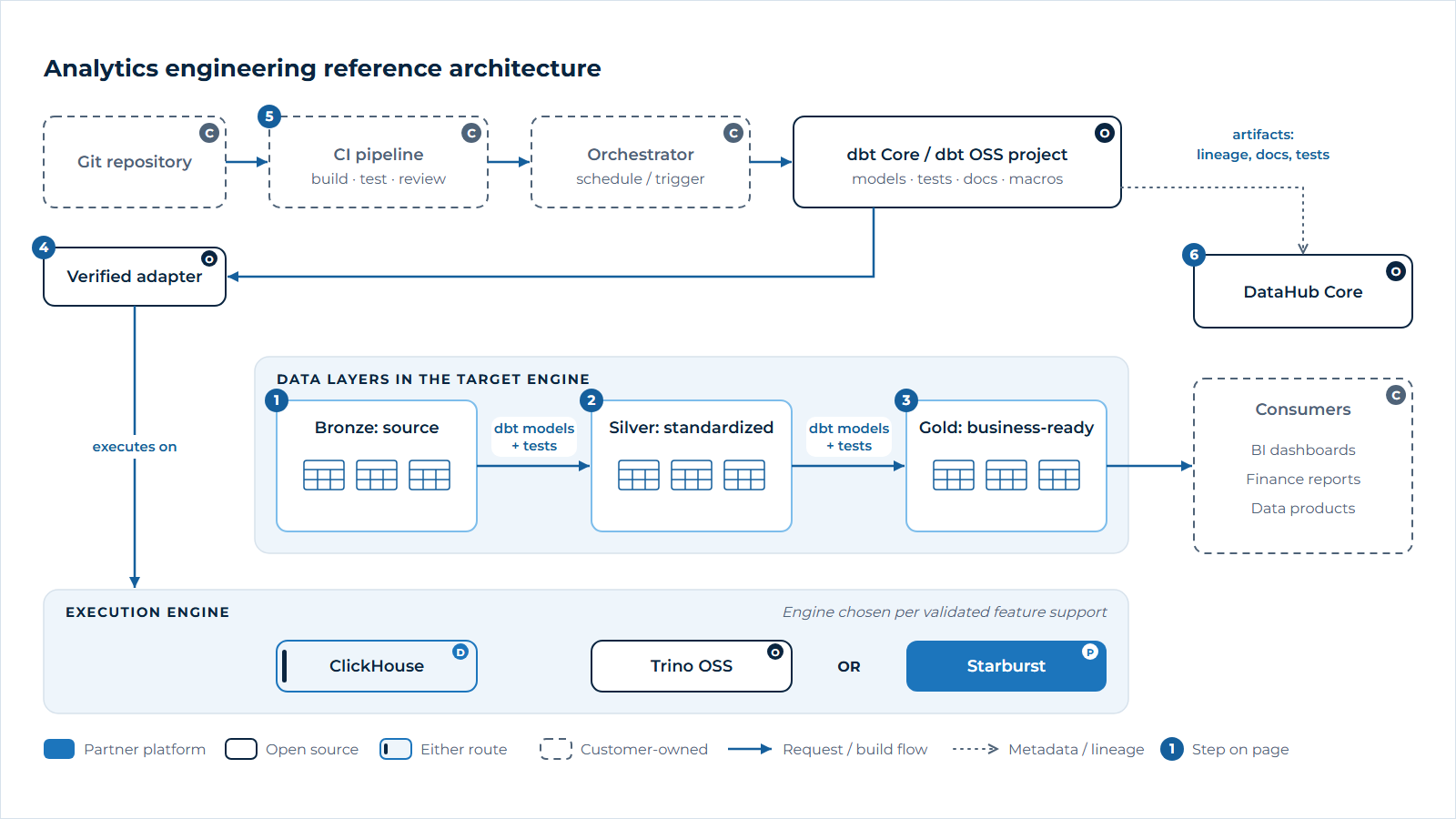
Analytics engineering reference architecture
TECHNOLOGY ROLES
Each Component Has One Clear Job
| Component | Role in this solution | Route | Qualification |
|---|---|---|---|
| dbt Core / dbt OSS | SQL modeling, tests, documentation and deployment discipline | Independent Bassirah open-source engineering | Exact dbt release, distribution and adapter named in every project |
| dbt adapter | Translates dbt operations for the target engine | Community or vendor-maintained, per engine | Compatibility, packaging and runtime requirements confirmed before use |
| ClickHouse | Execution engine for analytical models and fast-serving marts | Strategic partner or OSS engineering | Materialization and incremental strategies validated for the adapter version |
| Trino OSS or Starburst | Execution engine for models over federated sources and Iceberg tables | OSS engineering or strategic partner | Alternatives for the same role; feature support validated per version |
| Orchestrator and CI | Scheduling, dependency triggers, builds and tests on change | Customer-selected or recommended | Integrated with your source control and deployment controls |
| DataHub Core | Model lineage, documentation and ownership in the enterprise catalog | Independent open-source engineering | Catalog only; access enforced in engines and IAM |
See dbt, ClickHouse, ClickHouse OSS, Trino OSS, Starburst and DataHub.
NAMING AND COMPATIBILITY
dbt Core and dbt OSS: We Name What We Support
The open-source dbt ecosystem has evolved. dbt v1 / dbt Core remains widely recognized, while newer dbt v2 product naming uses dbt OSS for the Apache-licensed distribution. In every project, Bassirah states the exact dbt version, distribution and adapter in use, and validates the features your models rely on, such as incremental strategies, materializations and tests, against the target engine.
Independent open-source support.
dbt Core, dbt OSS and DataHub services are independent Bassirah engineering and do not imply affiliation with, endorsement by, or upstream support from dbt Labs, the DataHub project or their maintainers. Adapter availability and feature support vary by engine and version and are confirmed for each project before an integration is described as supported.
Planning a dbt upgrade or a move to dbt OSS?
We will assess versions, adapters and model compatibility.
USE CASES
Where Analytics Engineering Delivers Value

Finance data marts
Build reconciled, auditable marts for management and regulatory reporting, with control totals checked on every run.
Standardized metrics
Define key metrics once in tested models so every dashboard and team uses the same calculation.
Modernization of fragile SQL jobs
Convert stored procedures and scheduled scripts into modular, tested dbt models, often as part of a platform migration.
DESIGN & ACCEPTANCE CONTROLS
What We Define, and How We Prove It
| Control | What we define | Acceptance evidence |
|---|---|---|
| Source-to-target mapping | Field-level mapping and business rules from each source to each gold model | Mapping document reviewed and signed off by data owners |
| Data quality tests | Test suite per layer: keys, nulls, relationships, accepted values, freshness | Test results in CI and production runs, with failure alerting proven |
| CI/CD | Branching, review, build, test and promotion process across environments | Change deployed end to end through the pipeline with an approval record |
| Adapter validation | dbt release, adapter version and engine features required by the models | Compatibility test log for materializations and incremental strategies in use |
| Orchestration validation | Scheduling, dependencies, retries and failure handling | Failure and rerun scenarios exercised in test |
| Reconciling control totals | Row counts and financial totals compared between legacy outputs and new models | Reconciliation report within agreed tolerances for in-scope reports |
| Documentation and lineage | Model descriptions, owners and lineage published to the catalog | Documentation coverage for in-scope models; lineage visible in DataHub |
WHY BASSIRAH
Engineering Discipline for Your Data Models
Bassirah brings discovery, architecture decisions, implementation services, integration validation, knowledge transfer and operational support into one managed engagement. Technology selection follows measurable workload and compliance requirements.
- dbt project architecture, conventions and layering that scale across teams.
- Adapter and engine validation on ClickHouse, Trino OSS or Starburst before commitment.
- Conversion of legacy SQL logic with reconciliation against existing outputs.
- CI/CD, orchestration and test automation integrated with your controls.
- Lineage and documentation published to DataHub Core for enterprise discovery.
- Coaching and training so your analytics engineers own the practice after go-live.
ENGAGEMENT PATH
How an Analytics Engineering Engagement Runs
- Workshop & assessmentCurrent SQL estate, reporting pain points, engines, controls and team skills.
- Project designdbt version and adapter choice, layering, conventions, testing and CI/CD design.
- Pilot domainOne domain, such as a finance mart, built and reconciled end to end.
- Scale & migrateFurther domains and legacy jobs converted in waves.
- Enable & supportTeam training and ongoing support, including contracted managed services if required.
Analytics Engineering & Transformation FAQ
What is analytics engineering?
It is the practice of building data transformations with software-engineering discipline: modular SQL models, version control, peer review, automated tests, documentation and CI/CD. dbt is the most common open-source tool for this practice.
Is dbt Core still the product name?
dbt v1 / dbt Core remains widely recognized, while newer dbt v2 naming uses dbt OSS for the Apache-licensed distribution. We name the exact version, distribution and adapter we support in every project.
Which engines can dbt run on in your solutions?
dbt runs through adapters. In our architectures the common targets are ClickHouse, Trino and Starburst. We confirm current adapter compatibility, packaging and feature support for your versions before relying on them.
Can you migrate our stored procedures to dbt?
Yes. We analyze existing logic, convert it into modular dbt models, add tests and reconcile outputs against the legacy results before switching consumers over.
How does dbt connect to our data catalog?
dbt produces artifacts that describe models, tests and dependencies. DataHub Core can ingest them to show lineage and documentation alongside other metadata. Ingestion is validated for your dbt release. See Data Governance & Catalog →
Related Pages
Build Data Models Your Business Can Trust
Share your current SQL estate, engines and reporting priorities. We will propose a dbt project design and a pilot domain.