

Bassirah Technology

CLICKHOUSE OSS · INDEPENDENT ENGINEERING

Own Your Real-Time Analytics Platform.

Run high-performance analytical workloads on community ClickHouse with independent engineering support from Bassirah, from first cluster sizing to production upgrade discipline.

Considering partner-led ClickHouse? Compare support routes ↓

Independent ClickHouse OSS engineering.

These are independent Bassirah engineering and support offerings. They do not imply upstream vendor or foundation endorsement, official vendor support rights, enterprise feature entitlement or maintenance guarantees. Commercial ClickHouse offerings are separately covered under Strategic Partners.

WHY IT MATTERS

Analytical Speed With Full Control of Topology and Data

ClickHouse OSS provides a powerful analytical engine that can be self-managed where operations teams need control of topology, infrastructure and data.

As a column-oriented database, ClickHouse is designed for high-volume event analysis, aggregations over large tables and analytical APIs. Self-managing it gives you full control over where data lives, how clusters are sized and when upgrades happen. It also means your team owns sharding, replication, coordination, merges, backups and upgrades. Those are the areas where production deployments succeed or struggle, and where Bassirah focuses.

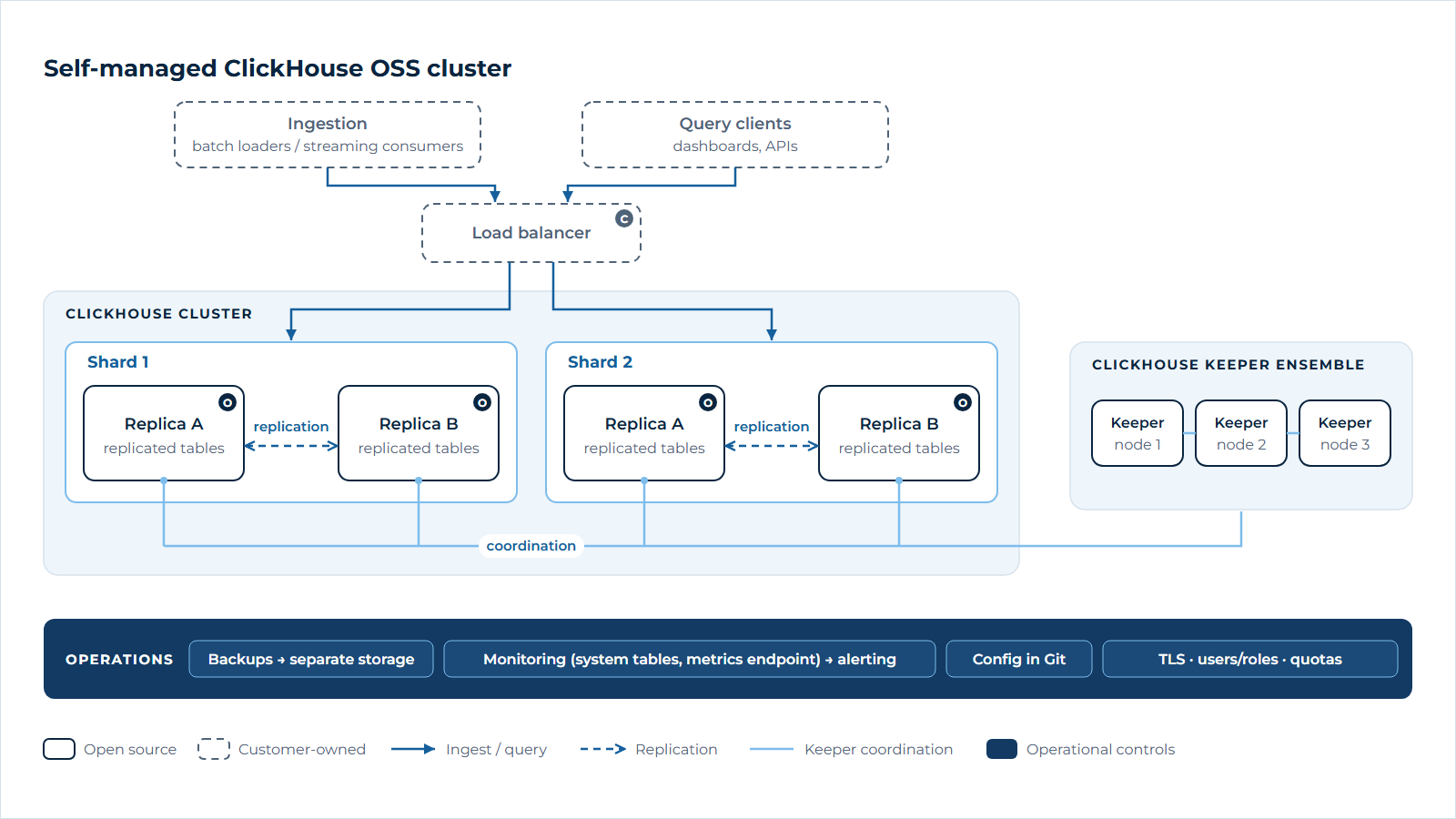
Self-managed ClickHouse OSS cluster with two shards of two replicas each, coordinated by a three-node ClickHouse Keeper ensemble, with backups, monitoring and security controls.

Self-managed ClickHouse OSS cluster

WHAT BASSIRAH DELIVERS

Independent ClickHouse OSS Engineering, From Sizing to Upgrades

  • Topology — Plan shards, replicas, ClickHouse Keeper, ingestion and merge behavior.
  • Data engineering — Engineer data models, materialized views, compression and workload management.
  • Resilience — Implement monitoring, backups, restore tests, availability and DR runbooks.
  • Lifecycle — Prepare production upgrades, compatibility tests and security hardening.
  • Capacity planning — Size CPU, memory, storage and network against measured ingestion rates, retention and query concurrency.
  • Security — TLS, SQL-managed users and roles, row policies, quotas and integration with external authenticators where required.
  • Observability — Dashboards and alerts built on ClickHouse system tables and metrics endpoints, covering replication lag, parts count, merges and query errors.
  • Knowledge transfer — Runbooks and handover sessions for your DBA and SRE teams.

ENGINEERING FOCUS

The Decisions That Shape a Healthy Cluster

Shards and replicas

Choose sharding keys that spread data and queries evenly, and replicate shards with replicated table engines so the loss of one node does not lose data or availability.

ClickHouse Keeper

Run a dedicated Keeper ensemble, typically an odd number of nodes, to coordinate replication and distributed DDL. Keeper health directly affects write availability.

Ingestion and merges

Design batch sizes, asynchronous inserts or streaming ingestion so the engine creates manageable data parts and background merges keep up.

Data modeling

Select primary keys, ordering, partitioning, codecs, TTL rules and materialized views around your query patterns and retention policy.

USE CASES

Where Self-Managed ClickHouse Fits

Real-time product and operational analytics

Dashboards and investigations over fresh event data, served at workload-appropriate latency.

Abstract illustration of high-volume event data being organized for analysis

Logs, events and telemetry analytics

High-volume observability and telemetry data with retention tiers and compression designed for cost control.

Analytics APIs and warehouse acceleration

Low-latency analytics APIs and warehouse acceleration, offloading heavy analytical queries from transactional or legacy systems.

Is your cluster struggling with merges, parts or slow queries?

We will profile it and prioritize fixes.

RESILIENCE

Engineered for Recovery and Safe Upgrades

We design availability per failure domain and prove recovery with restore tests, against RTO and RPO you approve.

Engineered for Recovery and Safe Upgrades
Failure domainDesign patternHow we validate
Single replica nodeReplicated tables with at least two replicas per shard; load balancing across replicasNode loss under load; replication catch-up monitoring
Keeper ensembleOdd-numbered Keeper ensemble on separate failure domains, with its own monitoringKeeper node loss test; quorum loss runbook
Data corruption or human errorScheduled backups to separate storage, plus documented restore and partition-level recoveryRestore drill into an isolated environment
Site or regionReplicas or backups in a second site, with DNS or application-level switchoverDocumented failover and failback drill

Upgrade discipline

  • Choose and document which upstream release line you standardize on, and when you move.
  • Review backward-incompatible changes and settings changes before each upgrade.
  • Test upgrades on a staging cluster with representative data and query suites.
  • Roll out replica by replica with health checks and a rollback decision point.

Bassirah does not produce official ClickHouse releases or security fixes. We assess, test and roll out upstream releases on your behalf. Related: HA/DR & Platform Reliability.

TWO ROUTES, ONE TECHNOLOGY

ClickHouse OSS or Partner-Led ClickHouse?

ClickHouse appears in both Bassirah portfolios because there are two different procurement and support routes into related technology: independent engineering services for the open-source edition, and partner-led ClickHouse solutions. Architecture and available features depend on the selected deployment and entitlement. We help you choose based on control, capability and support requirements.

ClickHouse OSS or Partner-Led ClickHouse?
Decision factorClickHouse OSS (independent support)Partner-led ClickHouse (Strategic Partner)
SoftwareCommunity edition under an open-source licenseCommercial ClickHouse offerings, subject to contract
Deployment and controlSelf-managed on infrastructure you choose; you control topology, data location and upgrade timingDeployment options as offered under the commercial program, which may include vendor-managed services
Feature availabilityCommunity-edition features of the release you runFeatures depend on the selected offering and entitlement; some capabilities may differ from the community edition
Upstream supportCommunity channels; Bassirah contractual engineering supportVendor-backed support per contract, plus Bassirah services
OperationsYour team and/or Bassirah operate the cluster, per agreed support scopeOperational responsibilities shared with the vendor per the selected offering
Upgrade managementCustomer/Bassirah validation of release choice and compatibilityVendor release and support lifecycle according to contract
Cost profileNo license fee; budget for infrastructure, engineering and operationsSubscription or consumption fees plus implementation services
Selection ruleChoose when self-management meets your control, security and operating objectivesChoose when commercial assurances, managed operations or licensed capabilities justify it

No feature promises across routes.

We do not assume that a capability available in a commercial ClickHouse offering is available in the community edition, or the reverse. We confirm features, versions and support entitlements for the exact deployment you choose.

Self-manage ClickHouse OSS

You want full control of infrastructure and data, your workloads fit community-edition capabilities, and you are ready to own operations with Bassirah’s support.

Explore partner-led ClickHouse

You want vendor-backed support, commercial capabilities or vendor-managed operations, with Bassirah handling architecture, integration and data modeling.

WORKS WITH

ClickHouse OSS in the Wider Portfolio

Integrate dbt, DataHub and Redis based on workload and compatibility.

Redis

Low-latency serving, caching and application state alongside ClickHouse analytical history, where measurements justify it.

Strategic Partner

dbt Core & dbt OSS

SQL transformations on ClickHouse where the current adapter supports your required features.

OSS

DataHub Core

Metadata, ownership and lineage for ClickHouse databases and tables.

OSS

Real-Time Analytics

The end-to-end solution pattern from event ingestion to analytical serving.

Solution

ClickHouse OSS: Frequently Asked Questions

They represent two procurement and support routes into related technology: partner-led ClickHouse solutions and independent engineering services for the OSS edition. Architecture and available features depend on the selected deployment and entitlement.

No. Our ClickHouse OSS services are independent engineering and support. Vendor-backed support applies only where separately covered by a commercial agreement, which we can discuss through our partner-led route.

Replicated ClickHouse deployments need a coordination service. ClickHouse Keeper is the project’s own coordination service and is the usual choice for new deployments. We plan the Keeper ensemble, or a migration from an existing ZooKeeper setup, as part of the cluster design.

We design backups to separate storage using the backup mechanisms available in your release, define retention, and run restore drills into an isolated environment. Replication protects availability. It does not replace backups, because errors and deletions replicate too.

Yes. We assess feature, version and data compatibility, plan the migration path and validate the result. The right route depends on your control, capability and support requirements.

Run ClickHouse on Your Terms.

Tell us about your data volumes, query patterns and operating model. We will scope a readiness assessment and a practical next step.

Telco Distributed Analytics

Banking Fraud & Risk

SaaS Embedded Analytics

Telecom Network Analytics

Related Insights