







Bassirah Technology

APACHE AIRFLOW · INDEPENDENT ENGINEERING

Orchestration Engineered for the Day Something Fails.

Design, upgrade and operate self-managed Apache Airflow, from executors and Dag standards to the move from Airflow 2 to Airflow 3, tested against your own pipelines.

Independent Apache Airflow engineering.

These are independent Bassirah engineering and support offerings. They do not imply upstream vendor or foundation endorsement, official vendor support rights, enterprise feature entitlement or maintenance guarantees.

Apache Airflow, Airflow and Apache are either registered trademarks or trademarks of The Apache Software Foundation. Bassirah is not a partner of Astronomer, Amazon Web Services or Google Cloud.

Supported releases.

Apache Airflow is a project of The Apache Software Foundation, developed by its community and released under the Apache License 2.0. Bassirah provides independent engineering for the Airflow 3 release line, with 3.3 as the default target, and plans upgrades for deployments still on Airflow 2. The exact versions in scope are named in each statement of work. Last reviewed: 26 October 2026.

Release information from the Apache Airflow "Supported Versions" page and the apache-airflow release history on PyPI, accessed 26 October 2026. The project lists Airflow 3 in maintenance, with limited-maintenance and end-of-life dates still to be decided. Versions in limited maintenance receive security and critical bug fixes only; end-of-life versions receive none. The community decides these dates.
Release lineStatus on 26 October 2026How Bassirah treats it
Airflow 3.3Current feature release: 3.3.0 on 6 July 2026; latest patch 3.3.2, 17 September 2026. Airflow 3 is in maintenance; end-of-life date not yet set by the projectDefault target for new deployments and upgrades
Airflow 3.4Pre-release only: 3.4.0 beta 2, 20 October 2026Tested in non-production; not a production target until a final release
Airflow 3.0 to 3.2Earlier feature releases of Airflow 3; the last patches were 3.0.6, 3.1.8 and 3.2.2Upgrade to the latest 3.3 patch release
Airflow 2 (last release 2.11.2)End of life since 22 April 2026, after limited maintenance from 22 October 2025Upgrade assessment and planned move to Airflow 3

WHY IT MATTERS

Pipelines as Code. Shared Infrastructure. Real Operational Risk.

Apache Airflow is a community platform for authoring, scheduling and monitoring workflows in Python. Teams define pipelines as Dags, and Airflow runs each task in order, on schedule or when upstream data changes.

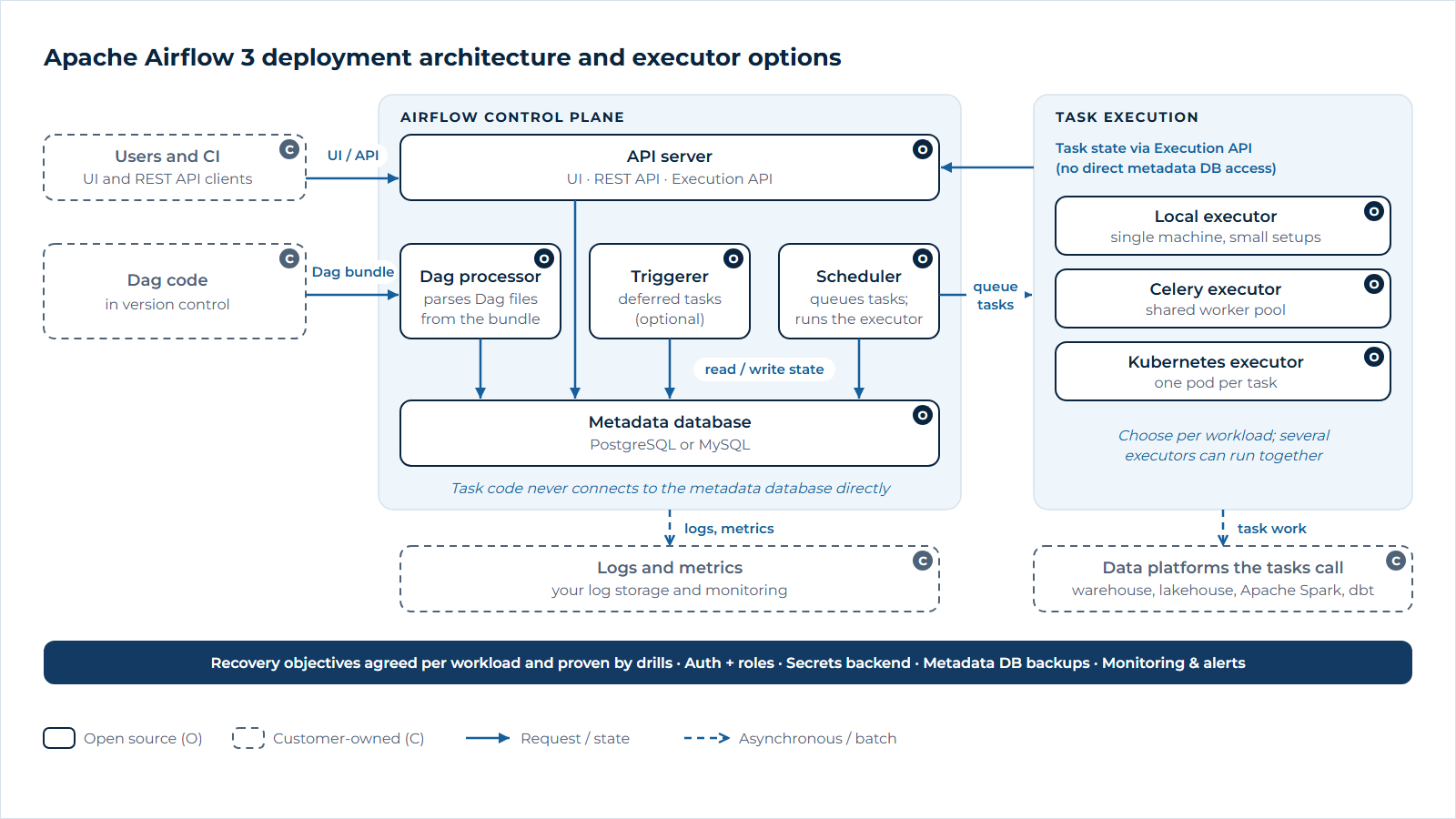
Airflow 3 changed the architecture. Tasks now report state through the API server instead of writing to the metadata database, a separate Dag processor parses pipeline code, and Dag versioning, assets and event-driven scheduling are built in. Many teams still carry Airflow 2 Dags, plugins and operators that depend on removed features. Airflow also runs the code your Dag authors write, so executor choice and isolation are security decisions as well as capacity decisions. Bassirah tests these changes against your own Dags and engineers the deployment so it holds up in production.

Abstract illustration of a workflow running across connected systems

WHAT BASSIRAH DELIVERS

Independent Apache Airflow Engineering and Operations

  • Architecture and executors — Design the scheduler, Dag processor, API server, triggerer, workers and metadata database, and choose executors per workload.
  • Deployment — Deploy self-managed Airflow on Kubernetes with the project’s Helm chart, or on virtual machines, with configuration under version control.
  • Airflow 3 upgrades — Move Airflow 2 deployments to Airflow 3 with upgrade checks, Dag and plugin refactoring, rehearsal on a copy of production and a planned cutover.
  • Dag standards and testing — Coding standards, reviews, automated Dag tests and a promotion path from development to production.
  • Security — Authentication, role design with least privilege, secrets backends and task isolation matched to the project’s security model.
  • Upgrades and providers — Planned feature and patch upgrades for Airflow core and provider packages, which the project releases separately.
  • Observability — Metrics, logs, task and scheduler health, metadata database health and alerts tied to the pipelines that matter.
  • Troubleshooting and managed support — Incident troubleshooting, health reviews of existing deployments and, where you want it, contracted operations under an agreed scope.

FIT FIRST

When Self-Managed Airflow Earns Its Complexity

Airflow adds services to run, secure and upgrade. We recommend running it yourself when the workloads need what it provides, and we say so when a simpler scheduler or a managed service is enough.

When Self-Managed Airflow Earns Its Complexity
RequirementSelf-managed Airflow is worth evaluating when…Something simpler is often enough when…
DependenciesPipelines span many systems, with dependencies, retries and backfills that need one place to define and observe themA few independent jobs run on fixed schedules, and cron or the tool's own scheduler covers them
Code and reviewTeams want pipelines in Python, under version control, with reviews and automated testsPipelines are built in a low-code tool that already schedules them
ControlYou need to choose the executor, network placement, isolation and upgrade timing yourselfA managed Airflow service from your cloud provider meets your network, security and version needs
Scale of useSeveral teams share the platform and need standards, access control and capacity planningOne team runs a small number of pipelines
OperationsYour team, or a contracted provider, will run and upgrade the scheduler, workers and metadata databaseYou want the smallest possible operational footprint

Already using dbt? See how we orchestrate model runs on our dbt engineering page. Moving between self-managed Airflow and a managed service is itself an upgrade project: we never assume Dags will run unchanged.

ARCHITECTURE AND EXECUTORS

Components and Executors, Chosen Deliberately

An Airflow 3 deployment has a scheduler, a Dag processor that parses pipeline code from a Dag bundle, an API server for the UI and REST API, and a metadata database. Workers and a triggerer are added as needed. Each executor and placement choice trades isolation, cost and operating effort differently. We choose them per workload, then prove recovery from a lost scheduler, worker or database in tested recovery exercises against objectives you approve.

Components and Executors, Chosen Deliberately
DecisionTypical approachTrade-off we make explicit
ExecutorLocalExecutor for small single-machine setups; CeleryExecutor or KubernetesExecutor for distributed work; several executors configured together where workloads differSimplicity and start-up speed vs. isolation and independent scaling
Task isolationOne pod per task with the KubernetesExecutor, or separate worker pools, for teams or code with different trust levelsStronger isolation vs. more infrastructure to run
Dag deliveryDag bundles from version control, with the Dag processor running as its own serviceControlled, versioned releases vs. a slower path for quick fixes
Metadata databasePostgreSQL or MySQL, sized, backed up and cleaned on a scheduleDatabase effort vs. scheduler health and upgrade time
Deferred workA triggerer for deferrable operators that wait on external systemsOne more service vs. worker slots freed while tasks wait
Apache Airflow 3 architecture: Dag code from version control is parsed by the Dag processor, the scheduler queues tasks to a Local, Celery or Kubernetes executor, workers report task state through the API server's Execution API instead of the metadata database, and the scheduler, Dag processor, triggerer and API server keep state in a PostgreSQL or MySQL metadata database.

Apache Airflow 3 deployment architecture and executor options

OPERATIONS

Evidence-Led Operations for a Shared Platform

Abstract illustration of pipeline code passing checks before release

Dag standards and testing

Coding standards, import-time checks and automated tests run before Dags reach production, so one broken file does not stall the platform.

Abstract illustration of a staged path from one release to the next

Upgrades

Feature and patch upgrades for core and providers, with upgrade checks, a database backup, staging rehearsal and a rollback decision point.

Abstract illustration of tasks distributed across worker pools

Executors and capacity

Pools, queues and executor settings tuned from measured task load, so critical pipelines get capacity when they need it.

Abstract illustration of monitoring panels for a workflow platform

Monitoring and recovery

Scheduler, worker and metadata database health with actionable alerts, plus database backups, cleanup and restore drills.

UPGRADE

Move to Airflow 3 With Traceability and Controlled Risk

Delivered through our migration and modernization practice, from Airflow 2 or from other schedulers.

  1. InventoryCatalog Dags, custom operators, plugins, providers, connections, executors and the version you run today.
  2. Run upgrade checksBring Airflow 2 to a supported starting version, then run the project’s Ruff upgrade rules and configuration checks to list what must change.
  3. Refactor and testReplace removed features such as SubDAGs, SLAs, old context variables and direct database access from tasks, then test Dags in staging.
  4. Rehearse the migrationBack up and clean the metadata database, rehearse the migration on a copy of production and compare pipeline results.
  5. Cut overExecute a rehearsed cutover with explicit rollback decision points, then stabilize and hand over.

Still running Airflow 2?

Airflow 2 reached end of life on 22 April 2026. Start with an upgrade check on your own Dags.

USE CASES

Where Apache Airflow Fits

Data platform pipelines

Ingestion, transformation and table maintenance across warehouses and lakehouses, including scheduled dbt runs.

Machine learning and AI workflows

Feature preparation, training, evaluation and batch inference steps, with each run tracked and repeatable.

Asset- and event-driven workflows

Pipelines that start when upstream data or an external event arrives, rather than only on a clock.

SUPPORT ROUTES

Community, Independent Support or a Managed Service

Apache Airflow is open source. Several companies also offer commercial routes: Astronomer offers commercial Airflow products, including its Astro platform; Amazon Web Services offers Amazon Managed Workflows for Apache Airflow (Amazon MWAA); and Google offers Cloud Composer, which it is renaming Managed Service for Apache Airflow. Bassirah is not a partner of Astronomer, Amazon Web Services or Google Cloud. We support self-managed Airflow independently and are clear about where our commitments end.

Community, Independent Support or a Managed Service
Decision factorCommunity onlyBassirah independent supportManaged service or vendor contract
Who operates AirflowYour teamYour team with Bassirah engineering, or Bassirah under a managed scopeThe provider runs the platform; your team owns the Dags, under the provider's terms
Help with incidentsPublic community channels, no response commitmentResponse targets per your agreementProvider support under its own terms
Code defectsReported by you to the projectReproduced, worked around and reported upstream by BassirahHandled by the provider under its terms
Upstream fixes and releasesOn the project's timelineOn the project's timeline; we track them, test them and apply them through change controlVersions and upgrade timing set by the provider
Commercial productsNot includedNot included: Bassirah does not resell Astronomer, Amazon MWAA or Cloud ComposerContracted directly with the provider

If you need a managed Airflow service or vendor support, that is contracted with the provider you choose. How cases, severities and response targets work for our independent support is set out in our open-source support model. For fully contracted operations, see Managed Services.

WORKS WITH

Apache Airflow in the Wider Portfolio

Airflow coordinates work that other platforms perform. We connect it to transformation, processing, metadata and storage where each fits, and test every integration first.

dbt

Transformation models and tests whose scheduled runs and dependencies Airflow can orchestrate.

OSS

Apache Spark

Batch and large-scale processing jobs that Airflow submits, tracks and retries.

OSS

DataHub

Metadata and lineage for the pipelines Airflow runs, where the integration is configured and tested.

OSS

MinIO AIStor

S3-compatible object storage for the data, files and lakehouse tables that pipelines read and write.

Strategic Partner

Apache Airflow: Frequently Asked Questions

Yes. Apache Airflow is a project of The Apache Software Foundation, released under the Apache License 2.0. Astronomer, Amazon MWAA and Google Cloud Composer are commercial routes from other companies. Bassirah supports self-managed Airflow and is not endorsed by The Apache Software Foundation or by those companies.

Not by the project. Airflow 2 entered limited maintenance on 22 October 2025 and reached end of life on 22 April 2026; its last release is 2.11.2. The project issues security advisories only for release lines that still receive releases, so Airflow 2 deployments should plan the move to Airflow 3.

Often not. Airflow 3 removes SubDAGs, SLAs, several context variables such as execution_date, and direct metadata database access from task code, and it changes some defaults. The project’s Ruff upgrade rules find many issues, and we test every Dag in staging before cutover.

We work on the Airflow 3 release line, with 3.3 as the default target, and we plan upgrades for deployments on earlier Airflow 3 releases and on Airflow 2. Pre-release versions, such as the 3.4 betas, are for testing only. The versions in scope are confirmed in each statement of work.

No. Bassirah is not a partner of Astronomer, Amazon Web Services or Google Cloud, and does not provide vendor support, vendor security fixes or vendor escalation. Our services are independent engineering and support, with scope and response targets defined in your agreement. Code fixes and releases follow the project’s timeline. See our support model.

A managed service suits teams that accept the provider’s versions, networking and upgrade timing. Self-managed Airflow suits teams that need control over executors, isolation and upgrade timing. We compare both against your requirements before you commit.

Make Orchestration Predictable.

Tell us about your Dags, executors and upgrade plans. We will scope an assessment and a practical next step.

Analytics Engineering & Transformation

Enterprise Lakehouse & Federation

Migration & Modernization

Open-Source Support Model

Related Insights