





Bassirah Technology

APACHE KAFKA · INDEPENDENT ENGINEERING

Event Streaming, Engineered for Production.

Design, migrate and operate self-managed Apache Kafka, from KRaft clusters and partition design to upgrades and cross-cluster recovery, tested against your own workloads.

Independent Apache Kafka engineering.

These are independent Bassirah engineering and support offerings. They do not imply upstream vendor or foundation endorsement, official vendor support rights, enterprise feature entitlement or maintenance guarantees.

Apache Kafka, Kafka and the Kafka logo are trademarks of The Apache Software Foundation. Bassirah is not affiliated with or endorsed by The Apache Software Foundation, and is not a partner of Confluent, Amazon Web Services or Aiven.

Supported releases.

Apache Kafka is a project of The Apache Software Foundation, released under the Apache License 2.0. Bassirah provides independent engineering for the 4.4, 4.3 and 4.2 release lines, which the project lists as supported releases, and plans upgrades and ZooKeeper-to-KRaft migrations for clusters on earlier lines. The exact versions in scope are named in each statement of work. Last reviewed: 26 October 2026.

Release information from the Apache Kafka downloads page and the Apache Kafka 4.4 upgrade notes, accessed 26 October 2026. The project aims for three releases a year and makes bugfix releases as needed for supported releases only. It does not publish end-of-life dates.
Release lineStatus on 26 October 2026How Bassirah treats it
4.4Listed as supported; 4.4.0 released 22 October 2026Target for new deployments once clients, connectors and tooling are validated against it
4.3Listed as supported; latest release 4.3.2, 23 October 2026Production target for upgrades where validation is complete
4.2Listed as supported; latest release 4.2.2, 29 September 2026Supported; plan the next upgrade, since bugfix releases are made for supported releases only
4.1 and 4.0Archived; latest releases 4.1.2 (17 March 2026) and 4.0.2 (16 March 2026)Upgrade planning to a supported 4.x line
3.9 and earlierArchived; 3.9 is the last line with ZooKeeper mode, latest release 3.9.2 (21 February 2026)ZooKeeper-to-KRaft migration on 3.9, then a planned upgrade to 4.x

WHY IT MATTERS

A Durable Event Log. Not Just a Message Queue.

Apache Kafka is an open-source distributed event streaming platform. Producers write events to topics, and consumers read them independently, so systems can share data without calling each other directly.

Topics are split into partitions spread across brokers, and each partition is replicated. Events are kept for a configured retention period rather than deleted after they are read. Since Apache Kafka 4.0, clusters run only in KRaft mode: ZooKeeper mode has been removed, and its metadata role is handled by Kafka’s own controllers. Partition keys, replication settings, retention and client configuration decide how a cluster behaves when load grows or a broker fails. Bassirah designs those choices for your workloads, tests them before production and keeps the cluster on a supported release line.

Abstract illustration of event streams fanning out to independent consumers

WHAT BASSIRAH DELIVERS

Independent Apache Kafka Engineering and Operations

  • Fit and architecture — Assess whether an event log fits the workload, then design clusters, topics, partitions, replication and retention.
  • Deployment — Deploy self-managed Apache Kafka in KRaft mode on Kubernetes, virtual machines or bare metal, with configuration under version control.
  • KRaft migration — Move ZooKeeper-based clusters to KRaft on the 3.9 line, with rehearsed phases and a clear point of no return.
  • Upgrades — Rolling upgrades to supported 4.x lines, with checks for Java versions, client compatibility, removed features and metadata version changes.
  • Security — Encryption in transit, client and broker authentication with SSL or SASL, and authorization designed with least privilege.
  • Integration — Kafka Connect source and sink connectors, and Kafka Streams applications, tested against your systems.
  • Observability — Broker and controller health, consumer lag, under-replicated partitions and disk use, with actionable alerts.
  • Troubleshooting and managed support — Incident troubleshooting, health reviews of existing clusters and, where you want it, contracted operations under an agreed scope.

FIT FIRST

When an Event Log Earns Its Complexity

Apache Kafka adds a distributed system to operate. We recommend it when the workload needs a durable, replayable event log, and we say so when a simpler option is enough.

When an Event Log Earns Its Complexity
RequirementApache Kafka is worth evaluating when…A simpler option is often enough when…
ConsumersSeveral independent systems need to read the same events, at their own paceOne consumer processes each message once and then it can be discarded
ReplayTeams need to reprocess past events, for example to rebuild a view or recover from a bugMessages have no value after they are processed
Volume and growthEvent volume is growing and must be spread across partitions and brokersA single queue or database table handles the volume with headroom
IntegrationMany sources and sinks need connecting through a common event backboneTwo systems exchange data on a schedule, and a batch job or API call is enough
OperationsYour team, or a contracted provider, will operate a distributed system, or you accept a managed serviceYou want the smallest possible operational footprint and no event platform to run

Kafka is often paired with a stream processor. See our Apache Flink engineering page for stateful stream processing, and our real-time analytics solution for end-to-end designs. We never assume a workload needs Kafka until its consumers, replay needs and volumes are clear.

TOPOLOGY AND RESILIENCE

Replication and Recovery, Chosen Deliberately

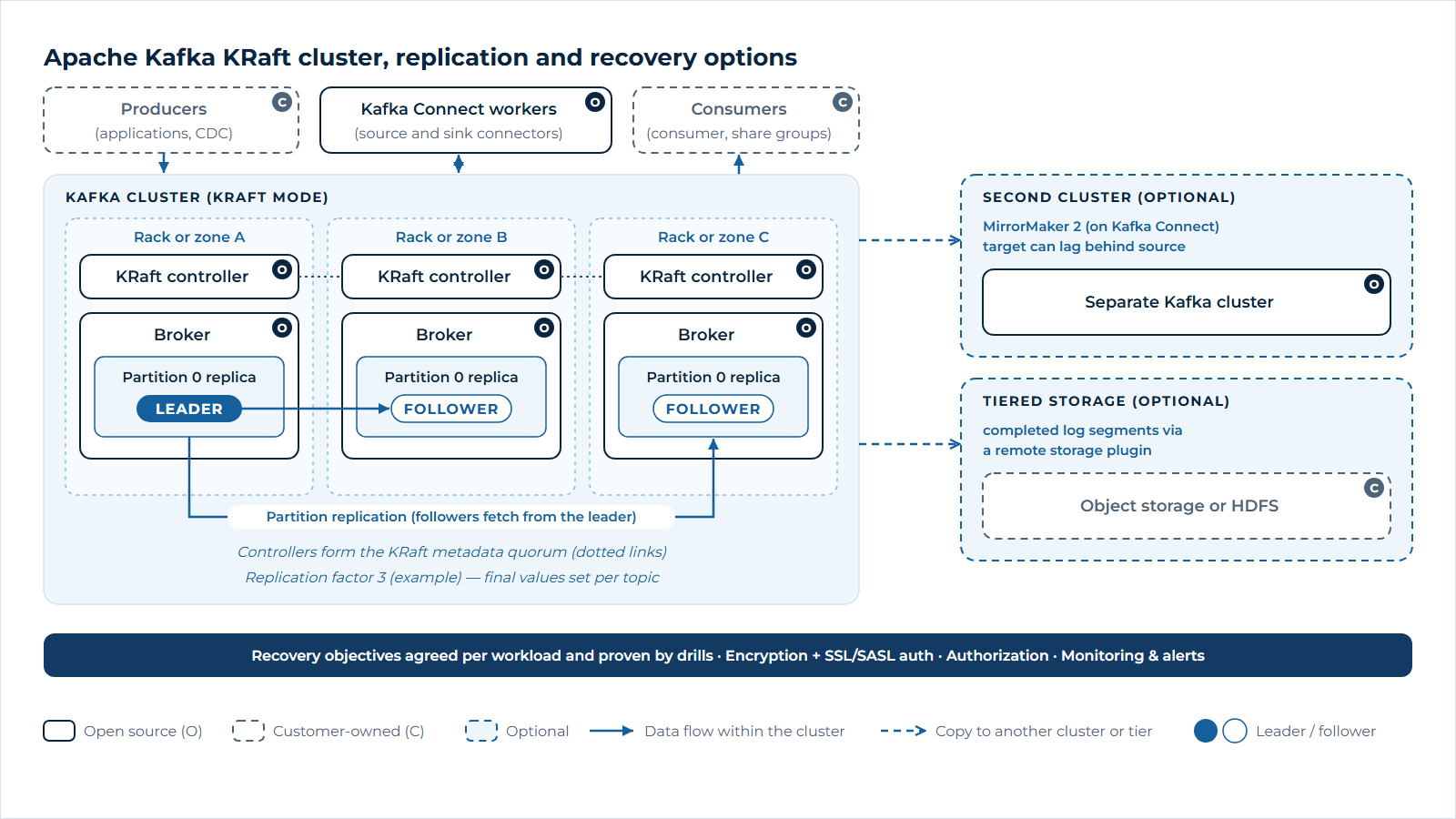
Apache Kafka replicates each partition across brokers inside a cluster, keeps cluster metadata in a KRaft controller quorum, can mirror topics to a second cluster with MirrorMaker 2, and can move older log segments to remote storage with Tiered Storage. Each option trades cost, complexity and data loss exposure differently. We choose them per workload, then prove the effect of a broker, zone or cluster failure in tested recovery exercises against objectives you approve.

Replication and Recovery, Chosen Deliberately
DecisionTypical approachTrade-off we make explicit
Replication within a clusterPartition replicas spread across brokers in different racks or zones, with the replication factor set per topicStorage and network cost vs. tolerance of broker or zone loss
Producer durabilityProducer acknowledgment and minimum in-sync replica settings chosen per topicWrite latency vs. the risk of losing acknowledged writes
Metadata quorumKRaft controllers on separate nodes or zones, sized and placed by designNumber of controllers to operate vs. tolerance of controller loss
Replication between clustersMirrorMaker 2, built on Kafka Connect, for active/passive or active/active designsAn independent recovery cluster vs. a target that can lag behind the source, and offset handling at failover
Long retentionTiered Storage with a remote storage plugin for object storage or HDFSLower broker disk use vs. a plugin to supply and operate, and no support for compacted topics
Apache Kafka topology: producers, consumers and Kafka Connect workers use a KRaft-mode cluster spread across three racks or zones, where each partition has a leader and followers on different brokers and a KRaft controller quorum holds the metadata, with optional MirrorMaker 2 replication to a second cluster and optional Tiered Storage to object storage or HDFS.

Apache Kafka KRaft cluster, replication and recovery options

OPERATIONS

Evidence-Led Operations for an Event Platform

Abstract illustration of a topic split into ordered partitions

Topic and partition design

Choose partition keys, partition counts and retention so load spreads evenly and the ordering your consumers need is kept.

Abstract illustration of producers writing and consumers reading at their own pace

Producers and consumers

Review producer acknowledgments, batching and consumer group settings, and trace consumer lag back to its cause before changing configuration.

Abstract illustration of a staged path from one release to the next

Upgrades

Rolling upgrades with checks for Java versions, client compatibility and removed features, rehearsed in staging with a decision point before metadata is finalized.

Abstract illustration of monitoring panels for an event streaming cluster

Monitoring and capacity

Broker and controller health, consumer lag, under-replicated partitions and disk growth with actionable alerts and capacity reviews.

KRAFT AND 4.X

Move From ZooKeeper to KRaft and Kafka 4.x With Controlled Risk

Apache Kafka 4.0 removed ZooKeeper mode, so ZooKeeper-based clusters must be migrated to KRaft before they can be upgraded to 4.x. Delivered through our migration and modernization practice.

  1. InventoryCatalog brokers, versions, ZooKeeper dependencies, clients, connectors, Kafka Streams applications and tooling.
  2. Reach the bridge releaseBring ZooKeeper-based clusters to the 3.9 line with the settings the migration requires, and confirm clients and Java versions for 4.x.
  3. Migrate to KRaftProvision KRaft controllers, run the migration in phases and rehearse each step. Rollback is possible only until the migration is finalized.
  4. Upgrade to 4.xRoll brokers to a supported 4.x line one at a time, validate behavior, then finalize the metadata version.
  5. Stabilize and hand overConfirm monitoring, alerts and runbooks for the KRaft cluster, then retire ZooKeeper.

Still running ZooKeeper?

Start with a migration assessment of your clusters, clients and tooling.

USE CASES

Where Apache Kafka Fits

Event-driven applications

Services that publish and react to business events, without calling each other directly.

Change data capture and integration

Database changes and system events streamed to analytics, search and other systems through Kafka Connect.

Real-time analytics pipelines

Event streams feeding stream processors and analytical databases, where results are needed soon after events occur.

SUPPORT ROUTES

Community, Independent Support or a Commercial Service

Apache Kafka is open source under the Apache License 2.0. Several vendors offer their own Kafka-based products and services, for example Confluent Platform and Confluent Cloud from Confluent, Amazon Managed Streaming for Apache Kafka (Amazon MSK) from Amazon Web Services, and Aiven for Apache Kafka. Bassirah supports the open-source Apache Kafka independently and is not a partner of these vendors.

Community, Independent Support or a Commercial Service
Decision factorCommunity onlyBassirah independent supportCommercial vendor or managed service
Who operates Apache KafkaYour teamYour team with Bassirah engineering, or Bassirah under a managed scopeYour team with the vendor's self-managed product, or the vendor for a managed service, under the vendor's terms
Help with incidentsPublic community channels, no response commitmentResponse targets per your agreementVendor support under the vendor's own terms
Code defectsReported by you to the projectReproduced, worked around and reported upstream by BassirahHandled by the vendor under its terms
Upstream fixes and releasesOn the project's timelineOn the project's timeline; we track them, test them and apply them through change controlUnder the vendor's terms
Commercial productsNot includedNot included: Bassirah does not resell or license vendor Kafka products or servicesContracted directly with the vendor

If you need a vendor’s product, managed service or vendor-backed support, that is contracted with the vendor. How cases, severities and response targets work for our independent support is set out in our open-source support model. For fully contracted operations, see Managed Services.

WORKS WITH

Apache Kafka in the Wider Portfolio

Apache Kafka is one part of our streaming and real-time data practice. We place it alongside stream processing, analytical databases and object storage where each fits, and test every integration first.

Apache Flink

Stateful stream processing over Kafka topics, when transformations, joins or windows need more than consumer code.

OSS

ClickHouse

Real-time analytical queries over event data loaded from Kafka, with the ingestion path tested first.

Strategic Partner

MinIO AIStor

S3-compatible object storage for data landed from Kafka, where your connectors and plugins are validated against it.

Strategic Partner

Managed Services

Contracted operations, monitoring and incident handling for Kafka estates.

Apache Kafka: Frequently Asked Questions

Yes. Apache Kafka is a project of The Apache Software Foundation, released under the Apache License 2.0. Vendors such as Confluent, Amazon Web Services and Aiven offer their own Kafka-based products and services under their own terms. Bassirah supports the open-source project and is not endorsed by the ASF or by these vendors.

Yes. Apache Kafka 4.0 removed ZooKeeper mode, and ZooKeeper-based clusters must be migrated to KRaft before they can be upgraded to 4.x. The migration runs on the 3.9 line. After it is finalized, you cannot return to ZooKeeper mode, so we rehearse each phase first.

When one consumer processes each message once, when past messages have no value, or when a scheduled batch job connects the systems well enough. A simpler queue or integration is easier to operate. We say so in the fit assessment.

We work on the 4.4, 4.3 and 4.2 lines, which the project lists as supported releases, and we plan upgrades for clusters on earlier lines, including ZooKeeper-to-KRaft migrations on 3.9. The versions in scope are confirmed in each statement of work.

No. There is no official vendor support for the Apache project itself, and Bassirah is not a partner of Confluent, Amazon Web Services or Aiven. Our services are independent engineering and support, with scope and response targets defined in your agreement. Code fixes and releases follow the project’s timeline. See our support model.

Yes. Partitions are replicated across brokers within a cluster, which can be spread across racks or zones, and MirrorMaker 2 can replicate topics to a second cluster for disaster recovery or active/active designs. The target cluster can lag behind the source, so we design failover and consumer offsets for your objectives and test them.

Make Event Streaming Predictable.

Tell us about your clusters, workloads and recovery objectives. We will scope an assessment and a practical next step.

Real-Time Analytics

HA/DR & Platform Reliability

Migration & Modernization

Open-Source Support Model

Related Insights