




Bassirah Technology

STRATEGIC TECHNOLOGY PARTNER · STARBURST

Enterprise SQL Access Across Distributed Data.

Simplify access to data lakes, warehouses and operational systems with Starburst’s Trino-based enterprise data platform, supported by Bassirah architecture and integration services.

Evaluating community Trino? Compare Trino OSS and Starburst →

Starburst is one of Bassirah’s Strategic Technology Partners. Our relationship is subject to the applicable Starburst program and agreement. Implementation scope, resell rights and support entitlements are confirmed in each customer engagement.

WHY STARBURST

Query Data Where It Lives, With Enterprise Controls

Enable cross-source analytics and open lakehouse adoption while applying governance and workload-specific controls.

Enterprise data rarely sits in one place. Customer records live in operational databases, history sits in data lakes, and curated models live in warehouses. Starburst is a commercial data platform built on the Trino distributed SQL engine. It lets analysts and applications query across these sources with standard SQL, and it adds enterprise capabilities and vendor support options beyond the community engine, depending on the edition purchased.

Bassirah designs the platform around your sources, security model and workloads: which catalogs to expose, how access is controlled, where federation helps and where curated data or a dedicated analytical store is the better answer.

  • Federated SQL access can reduce data duplication for selected queries.
  • Open lakehouse adoption on Apache Iceberg and S3-compatible storage, where supported.
  • Governance and workload controls applied consistently across domains.
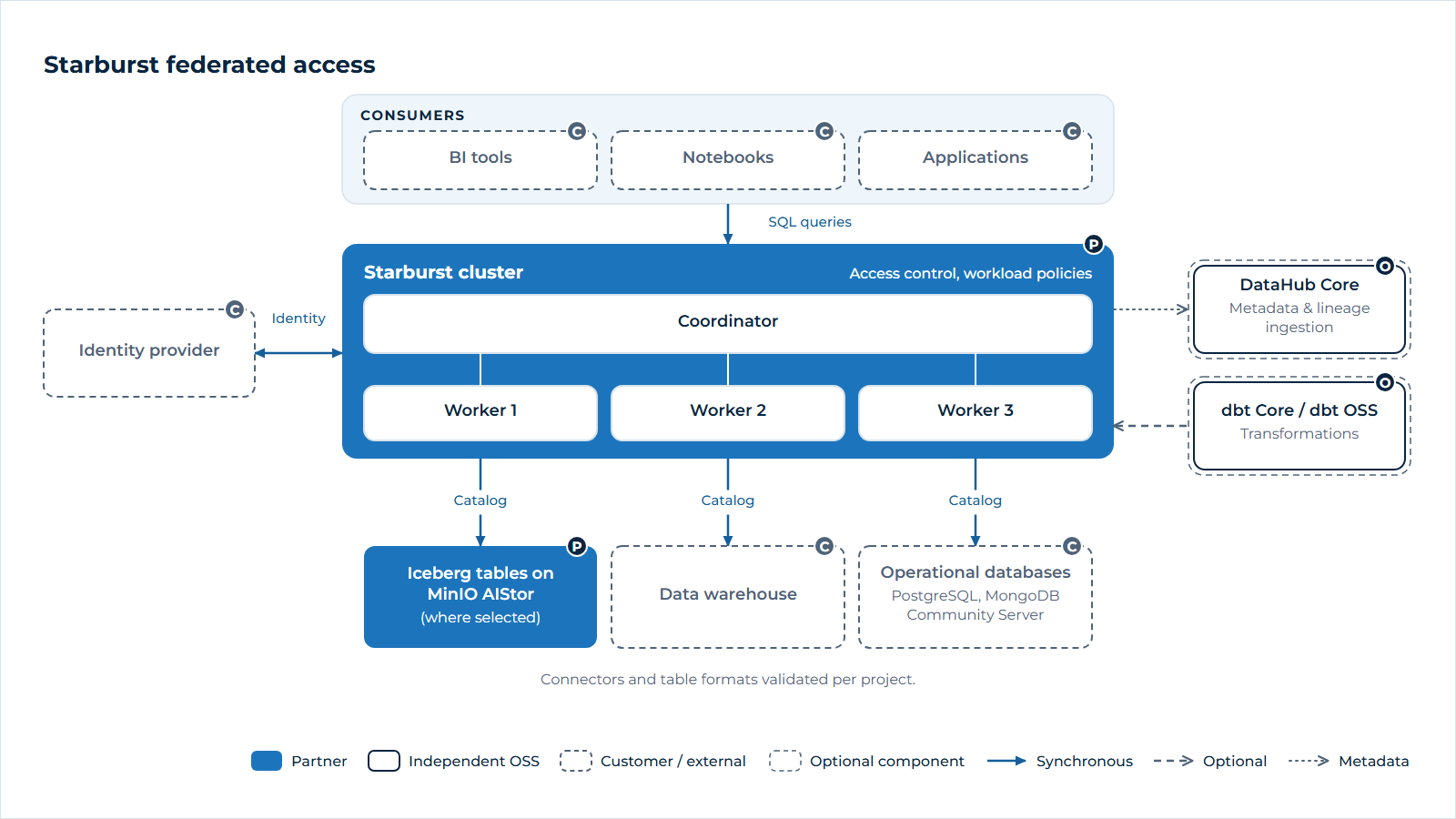
BI tools and applications send SQL to a Starburst cluster of coordinator and workers, which queries Iceberg tables on MinIO AIStor (where selected), a data warehouse and operational databases through catalogs, with identity integration and optional DataHub Core and dbt Core.

Starburst federated access

WHAT BASSIRAH DELIVERS

From Federation Assessment to Governed Production

Our Starburst engagements combine architecture, integration and operational discipline.

  • Assess enterprise federation, connector coverage, security and performance requirements.
  • Implement Starburst infrastructure, catalogs, workload policies and integrations.
  • Design query performance, caching/acceleration patterns and observability.
  • Plan coexistence and migration from Trino OSS when commercial enterprise requirements justify it.
  • Integrate enterprise identity, TLS, authentication and authorization with your security standards.
  • Configure resource management and workload isolation for BI, ad hoc and scheduled workloads.
  • Connect lakehouse catalogs and object storage, including Apache Iceberg tables where supported.
  • Deliver runbooks, upgrade procedures and knowledge transfer, or continue with contracted managed support.

USE CASES

Where Starburst Delivers Value

Solution concepts. Each design is validated against your sources and workloads.

Federated SQL across distributed sources

Query distributed databases and data lakes from one SQL interface, without first moving every dataset into a single repository.

Open lakehouse SQL access and modernization

Provide SQL access to open table formats on object storage as part of a phased lakehouse or warehouse modernization program.

Curved building wings wrapping around a central courtyard garden at dusk

Governed multi-domain analytics

Give enterprise users access to data across business domains with consistent, auditable access controls.

TRANSPARENT DECISION GUIDE

Trino OSS or Starburst: Which Route Fits?

Trino is the open-source distributed SQL engine. Starburst Enterprise is a commercial, self-hosted distribution based on Trino. Bassirah supports both, through separate offerings: partner-led Starburst solutions on this page, and independent Trino OSS engineering on our open-source practice. Use this guide to frame the decision.

Trino OSS or Starburst: Which Route Fits?
Decision factorTrino OSS (independent support)Starburst (partner-led)
Core positioningCommunity distributed SQL engineCommercial, self-hosted Trino distribution with additional capabilities
Software subscriptionCommunity licensing; infrastructure/engineering costs remainCommercial entitlements where applicable, subject to contract
ConnectorsTrino community connectors; testing neededAdditional supported integrations/connectors per purchased edition
Security and governanceBuilt-in capabilities, plugins and integrator implementationAdditional enterprise controls and support options per commercial package
Upstream supportCommunity channel; Bassirah contractual engineering supportVendor-backed support per contract, plus Bassirah services
Upgrade managementCustomer/Bassirah validation of release cadence and compatibilityVendor release/support lifecycle according to contract
Selection ruleChoose when OSS capabilities meet security, support and operating objectivesChoose when commercial controls, tested releases or vendor assurances justify it

Neither route is always faster or safer. We evaluate your actual versions, connectors, workloads, support needs and licensing before recommending one. Within a given federated-query decision, Trino OSS and Starburst Enterprise are alternatives, unless a phased coexistence strategy is deliberately planned.

DESIGN PRINCIPLES

Federated Access, Designed Responsibly

Federation is powerful, but it does not remove the need for data modeling, metadata or governance. We design Starburst platforms around four principles.

Federate where it adds value

Federated SQL can reduce data duplication for selected queries. Latency-critical or very high-concurrency workloads may still need curated datasets or a dedicated analytical store such as partner-led ClickHouse or ClickHouse OSS.

Respect source systems

Protect operational databases with workload policies, pushdown review and query limits, so analytical demand does not degrade transactional services.

Govern at the enforcement point

Define where access policies are decided and enforced, in Starburst, in the source systems or both, and document it. Catalogs such as DataHub add visibility but do not enforce access on their own.

Plan resilience per component

Treat coordinators, workers, catalogs and metastores, object storage, identity and networking as separate resilience concerns, each with tested recovery procedures.

Already running Trino OSS?

We can plan coexistence or migration when commercial requirements justify it.

WORKS WELL WITH

Starburst in an Integrated Platform

Trino OSS

A separate, independent OSS support offering for teams choosing the community engine.

MinIO AIStor

S3-compatible storage and an Iceberg-based data foundation for lakehouse tables.

DataHub Core

Catalogs assets, ownership and lineage across Starburst catalogs and sources.

dbt Core / dbt OSS

SQL transformations and tests, where the current adapter supports your Starburst version.

SEE IT IN CONTEXT

Where Starburst Fits in Real Architectures

Open Iceberg Lakehouse

Starburst or Trino OSS for SQL access over Iceberg tables on MinIO AIStor, with dbt Core and DataHub Core.

Enterprise Lakehouse & Federation

Governed federation across lakes, warehouses and operational systems.

Data Warehouse Modernization

Phase workloads away from legacy warehouses with federated access during transition.

HOW WE ENGAGE

A Clear Path From Discovery to Production

  1. Discovery workshopMap sources, users, query patterns, security model and current Trino or warehouse estate. Example deliverables: Requirements and non-functional requirements summary.
  2. Route and edition decisionCompare Trino OSS and Starburst options against your requirements; confirm edition and entitlement scope. Example deliverables: Architecture decision record, licensing assumptions.
  3. DesignDefine catalogs, access control, workload policies, topology and resilience. Example deliverables: Reference design, sizing assumptions, phased roadmap.
  4. Build and validateDeploy and integrate, then test representative queries and security controls. Example deliverables: Working deployment, test results, runbooks.
  5. Operate and optimizeHand over or continue with contracted managed support and periodic optimization. Example deliverables: Operational handover, knowledge transfer, optimization backlog.

Starburst: Frequently Asked Questions

Trino is the open-source distributed SQL engine. Starburst Enterprise is a commercial distribution based on Trino, with additional product capabilities and vendor support options. Bassirah can help evaluate either route based on your security, connector, operations and commercial requirements.

Yes, when commercial requirements justify it. Because Starburst is based on Trino, much of the SQL and catalog configuration carries over, but connector behavior, security configuration and release versions must be tested. We plan coexistence, cutover and rollback steps explicitly.

No. Federated SQL can reduce data duplication for selected queries, but most enterprises still need data modeling, transformations, metadata and governance. Some workloads perform better on curated datasets or a dedicated analytical store.

Starburst supports Iceberg tables on S3-compatible object storage. The exact AIStor configuration, catalog type, network setup and connector compatibility must be validated in the target architecture.

Vendor-backed support applies according to your Starburst agreement. Bassirah provides architecture, implementation, integration and contracted managed support. The division of responsibilities is documented in each engagement.

No. Starburst federates SQL across many sources. ClickHouse, partner-led or OSS, is a column-oriented database designed for low-latency serving of data stored in it. They solve different problems and are often used together.

Continue Exploring

Trino OSS Support

Independent engineering for community Trino.

Open Iceberg Lakehouse

Starburst or Trino OSS over Iceberg tables on MinIO AIStor.

MinIO AIStor

The object and table foundation for lakehouse access.

Data Governance & Catalog

DataHub metadata, lineage and ownership.

Related Insights

Unify Access to Your Distributed Data.

Tell us about your sources, users and governance requirements. We will help you design and operate the right federated SQL platform.