

Bassirah Technology

STRATEGIC TECHNOLOGY PARTNER · CLICKHOUSE

Real-Time Analytics at Enterprise Scale.

Design high-performance analytical applications with ClickHouse. Bassirah helps customers match deployment architecture, data modeling and operational design to real workload requirements.

Running self-managed ClickHouse OSS? See independent OSS support →

ClickHouse is one of Bassirah’s Strategic Technology Partners. Our relationship is subject to the applicable ClickHouse program and agreement. Implementation scope, resell rights and support entitlements are confirmed in each customer engagement.

WHY CLICKHOUSE

Analytics That Keep Pace With Your Events

Use column-oriented analytics for high-volume event analysis, operational intelligence, observability and customer-facing analytical experiences.

ClickHouse is a column-oriented database designed for real-time analytics. It stores data by column, compresses it efficiently and processes queries in parallel, which makes it well suited to aggregations over very large event, log and time-series datasets. The result depends on design: table engines, sort keys, ingestion patterns and cluster topology determine whether a workload performs as intended.

That is where Bassirah focuses. We start from your queries, data volumes, concurrency and freshness requirements, then design the data model, deployment and operating procedures to meet them, and validate the outcome against agreed acceptance criteria.

  • Fast aggregation over large analytical datasets, designed and validated for your workload.
  • Analytical offload that protects transactional systems from reporting load.
  • Deployment architecture matched to your operating model and the ClickHouse offering you select.
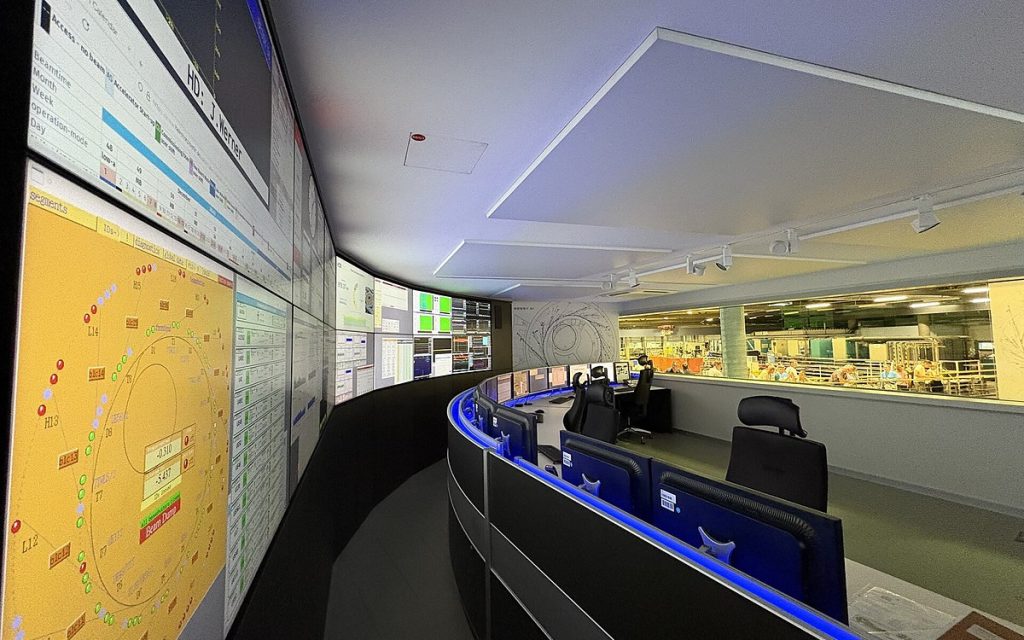
Control room with a long curved wall of displays and a curved operator desk

WHAT BASSIRAH DELIVERS

From Workload Sizing to Production Operations

Our ClickHouse engagements cover the full lifecycle, from architecture decisions to hardened production operations.

  • Evaluate analytics workloads and size clusters against concurrency, latency and ingestion requirements.
  • Design schemas, partitioning, materialized views, ingest patterns and backup/restore plans.
  • Implement secure production deployment, observability, resilience and performance tuning.
  • Compare partner-led ClickHouse and ClickHouse OSS consumption models, without unverified feature promises.
  • Define sort keys, data types, compression and retention (TTL) rules aligned to query patterns and storage cost.
  • Design replication, sharding and coordination (ClickHouse Keeper) for the availability objectives you approve.
  • Integrate identity, network controls, encryption and role-based access with your enterprise security standards.
  • Hand over runbooks, upgrade procedures and knowledge transfer, or continue with contracted managed support.

USE CASES

Where ClickHouse Delivers Value

Solution concepts. Each design is validated against your workload.

Isolated dashboard tiles served by a shared analytics core

Operational dashboards and customer-facing analytics

Serve interactive dashboards and in-product analytics to many concurrent users, with tenant-aware data models and secure query access.

Telemetry, event analytics and observability

Ingest and analyze logs, metrics, traces and business events for operations, security and product teams.

Analytical offloading

Move heavy analytical queries away from transactional databases or legacy data warehouses, reducing contention and supporting modernization.

ARCHITECTURE DISCIPLINE

The Decisions That Determine ClickHouse Performance

Most ClickHouse performance and reliability outcomes are decided early. We make these decisions explicit, document them and test them.

Latency and throughput targets are defined with you and validated in a proof of concept. We do not publish generic performance figures.
Design areaWhat we decideHow we validate
Data modelTable engines, sort and primary keys, data types, denormalization and projectionsRepresentative query set and data volumes
IngestionBatch sizes, insert frequency, streaming or CDC sources, deduplication approachSustained ingest test with merge behavior monitored
Pre-aggregationMaterialized views and rollup tables for frequent query shapesQuery latency and storage comparison before and after
TopologyShards, replicas, ClickHouse Keeper placement and failure domainsNode and replica failure tests
Retention and storageTTL rules, tiering to object storage where supported, partition strategy for data managementStorage growth and cost model at target retention
OperationsBackup and restore, monitoring, upgrade path, access controlRestore drill and upgrade rehearsal
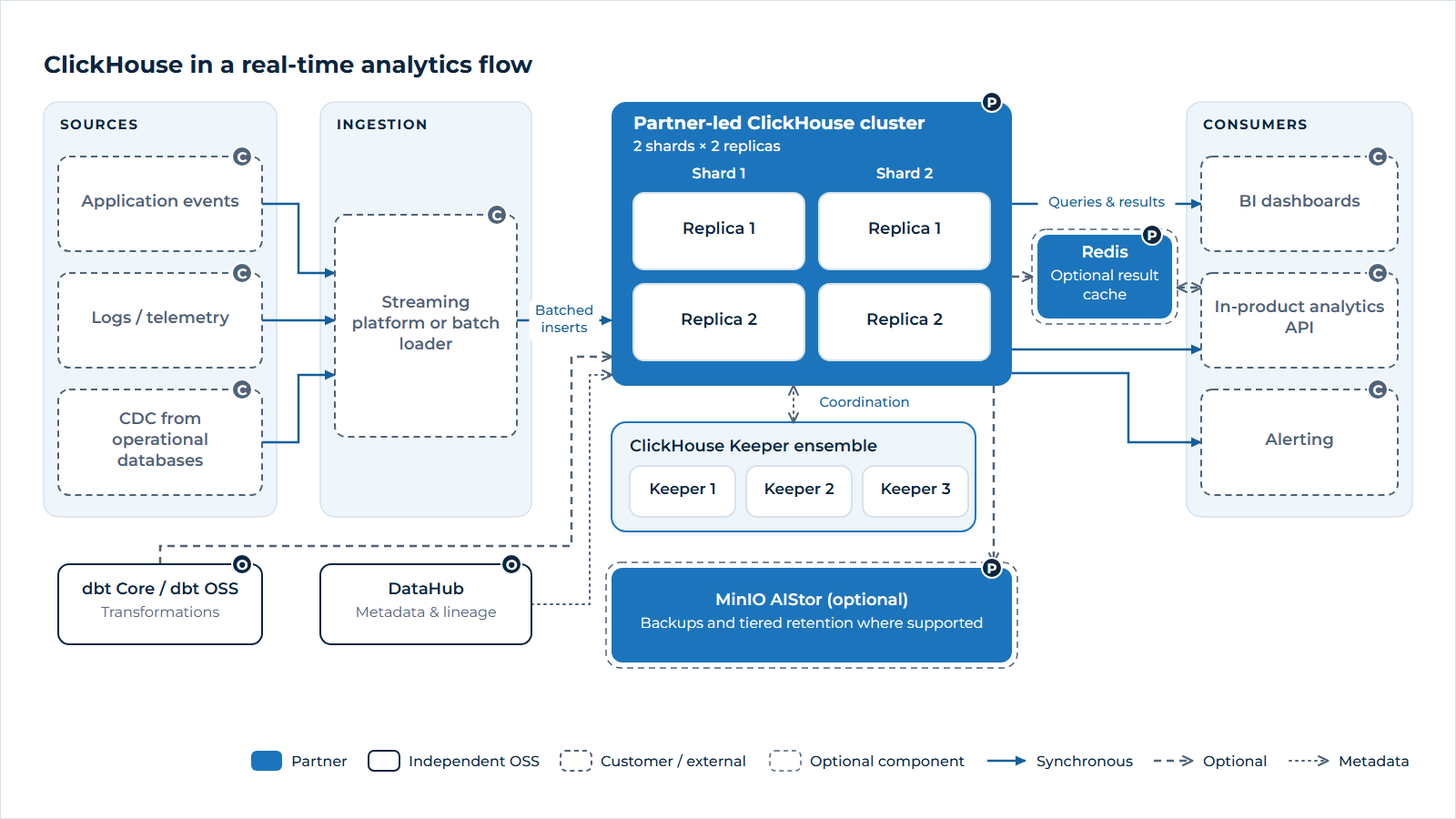
Data flows from application events, logs and database change streams through batched ingestion into a replicated partner-led ClickHouse cluster coordinated by ClickHouse Keeper, then to dashboards and analytics APIs, with optional Redis caching and optional MinIO AIStor backups.

ClickHouse in a real-time analytics flow

Have a workload in mind?

Bring your queries and data volumes. We will design a PoC with measurable success criteria.

CHOOSE YOUR SUPPORT ROUTE

Partner-Led ClickHouse or Independent ClickHouse OSS Support?

ClickHouse appears in both of Bassirah’s portfolios. They are two procurement and support routes into related technology, with different commercial terms and responsibilities. Choose the one that fits your operating model, or ask us to compare them for your workload.

Partner-Led ClickHouse or Independent ClickHouse OSS Support?
Decision factorPartner-led ClickHouse (this page)ClickHouse OSS, independent support
SoftwareClickHouse commercial offerings, per the customer's agreementSelf-managed community ClickHouse
Licensing and costCommercial subscription or consumption terms, subject to contractCommunity license; infrastructure and engineering costs remain
Vendor supportVendor-backed support where included in the customer's agreementNo vendor support, escalation or upstream SLA implied
Operations ownershipShared between the provider's offering, the customer and Bassirah, as contractedCustomer, with Bassirah engineering and optional contracted managed support
Best fitWorkloads that need commercial assurances, managed options or licensed capabilitiesTeams that want full control of topology, infrastructure and data
Bassirah's roleArchitecture, integration, deployment, optimization and operations alongside the providerCluster design, tuning, upgrades, backups, DR runbooks and contracted operational support

Available features depend on the selected deployment and entitlement. Bassirah does not make feature promises until the edition and contract are confirmed.

WORKS WELL WITH

ClickHouse in an Integrated Platform

ClickHouse fits best as a dedicated analytical serving layer. We connect it with complementary platforms where the workload justifies it.

Redis

Application acceleration and bounded result caching in front of analytical queries.

dbt Core & dbt OSS

SQL transformations and tests, where the current adapter supports your ClickHouse version.

DataHub Core

Metadata, ownership and lineage across ClickHouse tables and upstream sources.

MinIO AIStor

Object-storage patterns for backups and lower-cost retention, where supported.

Langfuse

ClickHouse stores Langfuse trace analytics in supported self-hosted architectures.

SEE IT IN CONTEXT

Where ClickHouse Fits in Real Architectures

Real-Time Analytics

From streaming data to decisions, with ClickHouse as the analytical serving layer.

Modern Telco Core & Distributed Analytics

ClickHouse holds normalized CDR and network facts for investigative and dashboard queries.

Banking Fraud & Risk Data Platform

ClickHouse supports fraud investigation, monitoring and trend analysis outside the synchronous decision path.

Embedded Analytics for SaaS

ClickHouse serves tenant-aware product and customer analytics with mandatory tenant keys and query security.

HOW WE ENGAGE

A Clear Path From Workshop to Production

  1. Architecture workshopReview workloads, query patterns, data sources, volumes and operating constraints. Example deliverables: Requirements and non-functional requirements summary.
  2. DesignSelect the ClickHouse offering and topology; design data models and ingestion. Example deliverables: Architecture decision record, reference design, sizing assumptions.
  3. Proof of conceptTest representative queries and ingest against agreed success criteria. Example deliverables: PoC report with measured results and recommendations.
  4. ImplementationDeploy, secure and integrate the production platform. Example deliverables: Working deployment, test results, runbooks.
  5. Operate and optimizeHand over or continue with contracted managed support and periodic health checks. Example deliverables: Operational handover, knowledge transfer, optimization backlog.

ClickHouse: Frequently Asked Questions

They are two procurement and support routes into related technology. Partner-led ClickHouse is built on ClickHouse commercial offerings, where vendor-backed support may apply under your agreement. ClickHouse OSS support is independent Bassirah engineering for self-managed community ClickHouse, with no vendor support or escalation implied. Available features depend on the selected deployment and entitlement.

ClickHouse is a column-oriented database designed for fast serving of data stored in it. Trino and Starburst query data where it already lives across many sources. Many architectures use both: federation for broad access, and ClickHouse for low-latency, high-concurrency analytics on curated datasets.

No. ClickHouse is designed for analytical workloads, not high-frequency row-level updates and transactions. We typically keep transactional systems such as PostgreSQL as the source of truth and offload analytical queries to ClickHouse.

We size against measured inputs: data volume and growth, retention, ingestion rate, query shapes, concurrency and latency targets. Sizing assumptions are documented and validated in a proof of concept before production commitments.

We design replication and coordination with ClickHouse Keeper across failure domains, define backup and restore procedures, and test them with restore drills. Recovery objectives are agreed with you and validated per deployment.

Yes, where current adapters and ingestion connectors support your ClickHouse version and deployment. We verify compatibility in the project architecture before relying on an integration.

Continue Exploring

ClickHouse OSS Support

Independent engineering for self-managed ClickHouse.

Real-Time Analytics

The solution ClickHouse most often anchors.

Embedded Analytics for SaaS

Tenant-aware analytical serving blueprint.

All Strategic Partners

Explore the full partner portfolio.

Related Insights

Build Analytics That Scale With Your Business.

Tell us about your analytical workloads, users and constraints. We will help you design, prove and operate the right ClickHouse architecture.