

APACHE SUPERSET · INDEPENDENT ENGINEERING
Self-Managed BI You Can Run With Confidence.
Design, secure and operate Apache Superset for governed dashboards, SQL exploration and embedded analytics, on infrastructure you control.
Independent Apache Superset engineering.
These are independent Bassirah engineering and support offerings. They do not imply upstream vendor or foundation endorsement, official vendor support rights, enterprise feature entitlement or maintenance guarantees.
Apache Superset, Superset and Apache are trademarks of the Apache Software Foundation.
Supported releases.
Apache Superset is a project of the Apache Software Foundation, released under the Apache License 2.0. Bassirah provides independent engineering for the 6.1 release line and for existing 6.0 deployments. We test the 7.0 release line in staging while it is at release-candidate stage and move production estates once you approve. The exact versions in scope are named in each statement of work. Last reviewed: 20 October 2026.
| Release line | Status on 20 October 2026 | How Bassirah treats it |
|---|---|---|
| 7.0 | Release candidates published (7.0.0rc1 on 13 October 2026, 7.0.0rc2 on 16 October 2026); no final 7.0.0 release yet | Upgrade testing in staging only, until a final release is published |
| 6.1 | Current release line: 6.1.0, released 13 May 2026 | Default target for new deployments and upgrades |
| 6.0 | 6.0.0, released 18 December 2025 | Supported for existing deployments, with an upgrade plan to 6.1 |
| 5.0 and earlier | Older release lines (for example 5.0.0, June 2025, and 4.1.4, August 2025) | Upgrade assessment and migration planning |
WHY IT MATTERS
Open BI Is Easy to Start. Production BI Has to Be Engineered.
Apache Superset gives teams a no-code chart builder, a SQL IDE, interactive dashboards and a semantic layer of datasets and metrics, connected to the databases they already run.
A working demo is not a production platform. Superset depends on a metadata database, a cache, Celery workers and a scheduler, and a headless browser for reports. Who can see which rows is decided by roles and row level security that someone has to design. Dashboard speed depends as much on the database underneath and on caching as on Superset itself. Bassirah engineers those parts so that dashboards stay fast, access stays correct and upgrades stay predictable.
WHAT BASSIRAH DELIVERS
Independent Superset Engineering, From Architecture to Operations
- Architecture and deployment — Design and deploy Superset on Kubernetes or containers, with a production metadata database, cache, Celery workers and scheduler.
- Data connections — Connect Trino, ClickHouse, PostgreSQL and other databases through tested drivers, with least-privilege service accounts.
- Security and access — Single sign-on through OAuth or LDAP, role design, row level security and secrets management.
- Performance and operations — Caching, asynchronous queries, monitoring, backups and upgrade planning.
- Datasets and semantic layer — Curated datasets and shared metric definitions, so dashboards use one version of each number.
- Alerts and reports — Scheduled reports and data-driven alerts by email, Slack or webhook, with the worker and browser setup they need.
- Embedded analytics — Dashboards embedded in your own application with the Embedded SDK and guest tokens, reviewed for security.
- Upgrades and runbooks — Tested upgrade paths, metadata backups, rollback plans and runbooks handed over to your team.
ARCHITECTURE
Every Component Sized, Secured and Backed Up
Superset is a Flask and React application with supporting services. The project’s documentation recommends Kubernetes for production. For new Kubernetes deployments it points to the Apache Superset Kubernetes Operator and marks the in-repository Helm chart as deprecated. Docker Compose suits evaluation and development. We design each component for your environment and document how it is operated.
| Component | What it does | What we design and verify |
|---|---|---|
| Superset web application | Serves the user interface and REST API | Gunicorn workers behind a load balancer, health checks on the /health endpoint, proxy and TLS settings |
| Metadata database | Stores charts, dashboards, users, permissions and logs | PostgreSQL or MySQL (the documented metadata engines, not SQLite), backups before every upgrade, restore tests |
| Cache | Stores chart data, dashboard filter state and chart-builder state | Redis (the documented recommendation) or another supported backend, timeouts per chart, dataset or database |
| Celery workers and scheduler | Run long SQL Lab queries, alerts and reports, thumbnails and cache warm-up | Message broker (Redis or RabbitMQ), a single scheduler instance, worker sizing and queue monitoring |
| Headless browser | Renders dashboard and chart screenshots for reports and thumbnails | Playwright with Chromium on the worker image, which the 7.0 release line requires |
| Container image | Packages Superset with your database drivers and configuration | Pinned versions, drivers for your databases, configuration and secrets kept outside the image |
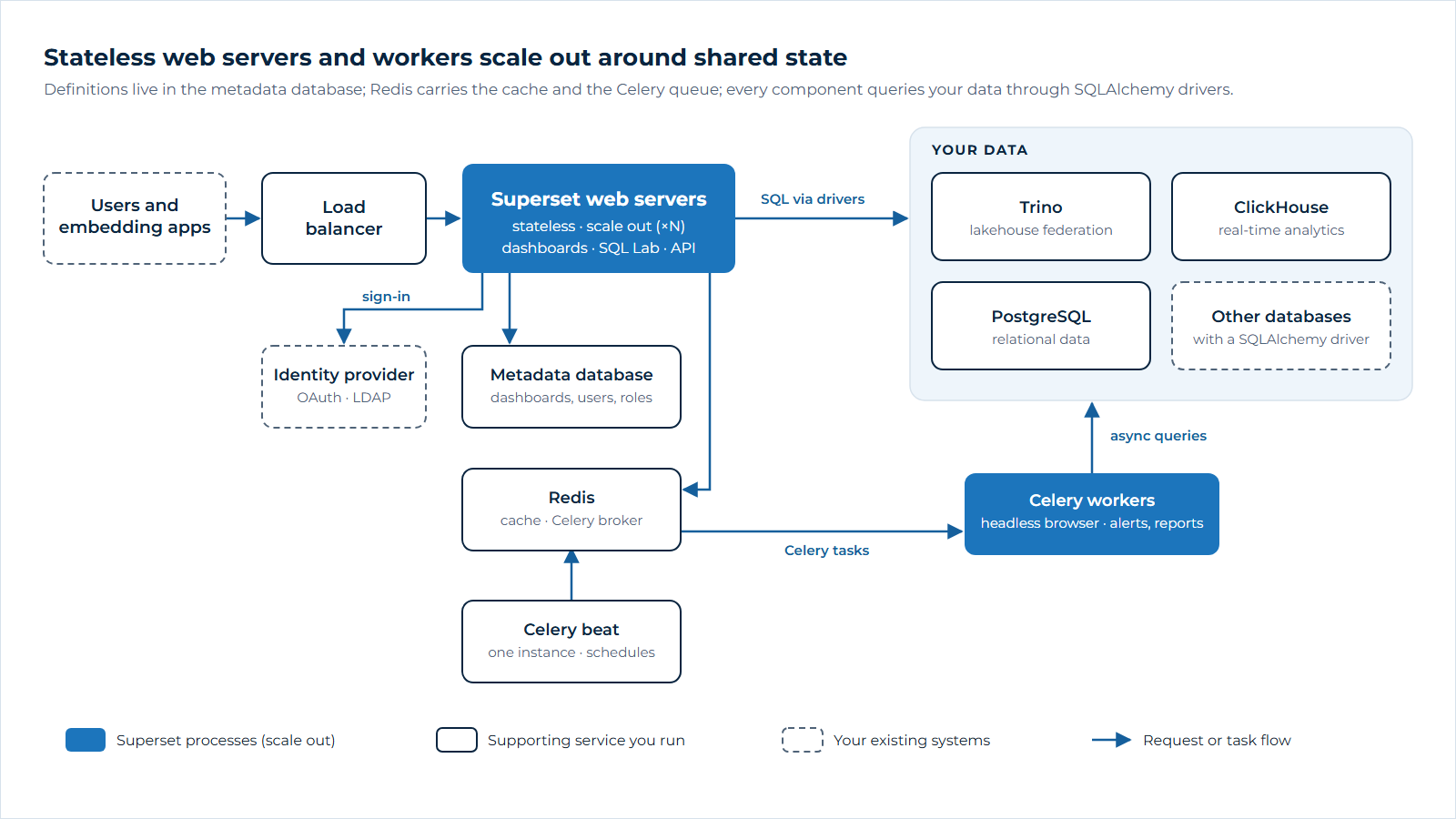
Apache Superset production architecture
Deployment discipline
- Choose the deployment method deliberately: Kubernetes for production, Docker Compose only for evaluation or development.
- Keep a strong, rotated secret key and every other secret out of source control.
- Run one scheduler instance only, so reports are not delivered twice.
- Back up the metadata database and test the restore before going live.
DATA SOURCES
Superset Visualizes. Your Database Does the Heavy Lifting.
Superset connects to each database through a Python DB-API driver and a SQLAlchemy dialect. We build those drivers into your image, test them against your versions, and connect with service accounts that can read only what Superset needs.
Trino
One SQL connection across lakehouse tables and operational sources, with resource controls on the Trino side.
ClickHouse
Fast aggregation over large event and time-series tables for interactive dashboards.
PostgreSQL
Operational and reporting data, queried from replicas or reporting schemas to protect the primary.
Other databases
The documentation lists drivers for many other SQL engines. We confirm driver maturity and features for each one before it reaches production.
SECURITY
The Right People See the Right Rows
Superset uses Flask AppBuilder for authentication and permissions. We design identity, roles and data access together, following the project’s guidance for securing production installations.
Single sign-on
OAuth providers or LDAP through Flask AppBuilder, with identity-provider groups mapped to Superset roles.
Roles and permissions
Custom roles built alongside the built-in Admin, Alpha, Gamma, sql_lab and Public roles, rather than changing the built-in ones.
Row level security
Row level security filters per dataset and role, so each team or tenant sees only its own rows. Tested before go-live.
Secrets and hardening
Strong, rotated secret keys, content security policy, limited-privilege database accounts and a regular review of security advisories.
CAPABILITIES
From Governed Datasets to Dashboards in Your Product
Datasets and metrics
Physical and virtual datasets with shared metric definitions, so dashboards reuse one definition of each measure.
Dashboards and SQL Lab
Interactive dashboards with filters, cross-filtering, drill to detail and drill by, plus SQL Lab for analysts who work in SQL.
Alerts and reports
Scheduled reports and SQL-condition alerts by email, Slack or webhook, as PNG or PDF, and CSV or Excel for charts.
Embedded analytics
Dashboards embedded in your application through the Embedded SDK, with guest tokens issued by your own back end.
PERFORMANCE AND LIFECYCLE
Fast Dashboards, Predictable Upgrades
Evidence-led tuning
Push work to the engine
Design datasets and aggregates so the database, not Superset, does the heavy computation.
Cache deliberately
Set cache timeouts per chart, dataset or database, and warm caches for the dashboards people open first.
Run long queries asynchronously
Use Celery workers for long SQL Lab and chart queries, so web workers stay responsive.
Upgrade path
- Read the release notesReview the project’s upgrade notes and breaking changes for every version you will pass through.
- Back up metadataBack up the metadata database and confirm the restore works.
- Rehearse in stagingUpgrade a staging copy, run the database migration, and test dashboards, reports, embedding and access rules.
- Upgrade productionUpgrade during an agreed window with a rollback decision point, then monitor.
Slow dashboards, failing reports or an overdue upgrade?
We will review your Superset deployment and prioritize fixes.
SUPPORT ROUTES
Community, Independent Support or a Managed Platform
Apache Superset is a community project of the Apache Software Foundation. Teams rely on the community, an independent provider such as Bassirah, or a combination of both. We are clear about where our commitments end.
| Decision factor | Community only | Bassirah independent support | Bassirah managed platform |
|---|---|---|---|
| Who operates Superset | Your team | Your team, with Bassirah engineering support | Bassirah, within the agreed scope |
| Help with incidents | Public community channels, no response commitment | Response targets per your agreement | Response targets per your agreement, plus monitoring and runbook execution |
| Code defects | Reported by you to the project | Reproduced, worked around and reported upstream by Bassirah | Reproduced, worked around and reported upstream by Bassirah |
| Upstream fixes and releases | On the community's timeline | On the community's timeline; we track them and apply them | On the community's timeline; we apply them through change control |
| Upgrades | Your team | Planned and tested with you | Planned, tested and carried out by Bassirah |
How cases, severities and response targets work is set out in our open-source support model. For fully contracted operations, see Managed Services.
WORKS WITH
Superset in the Wider Portfolio
Superset is the presentation layer. Query engines, caching and conversational analytics around it decide how far it scales.
Trino OSS
Federated SQL across lakehouse and operational sources, behind one Superset connection.
OSS
ClickHouse OSS
Analytical storage for high-volume event data behind interactive dashboards.
OSS
GenBI
Conversational analytics that can hand charts and boards off to Apache Superset.
Bassirah product
Redis
Cache and Celery message broker for Superset, where your design calls for it.
Strategic Partner
Apache Superset: Frequently Asked Questions
Is Apache Superset open source?
Yes. Apache Superset is a project of the Apache Software Foundation, released under the Apache License 2.0. Bassirah is an independent provider. Our services are not endorsed by the Apache Software Foundation or the Superset project.
Which Superset versions do you support?
We work on the 6.1 release line and existing 6.0 deployments, and we test the 7.0 release line in staging while it is at release-candidate stage. The versions in scope are confirmed in each statement of work.
Do you provide official Apache Superset support?
Apache Superset is a community project of the Apache Software Foundation. Our services are independent engineering and support, with scope and response targets defined in your agreement. Code fixes and releases come from the Superset community on its own timeline. See our support model.
Can Superset connect to Trino, ClickHouse and PostgreSQL?
Yes. Superset connects to each database through a Python DB-API driver and a SQLAlchemy dialect. We build the drivers into your image, test them against your database versions and use limited-privilege service accounts.
Can we sign in with our corporate identity provider?
Yes. Superset uses Flask AppBuilder, which supports OAuth providers and LDAP. We connect your identity provider, map its groups to Superset roles and design row level security for your data.
Can you embed Superset dashboards in our application?
Yes. Superset’s Embedded SDK places a dashboard in your application, and your back end issues guest tokens for each viewer. We design the token flow, the roles behind it and the secrets that protect it, and test access before launch.
Make Self-Managed BI Dependable.
Tell us about your Superset version, databases, users and embedding plans. We will scope a platform assessment and a practical next step.